Transformer Procurement for Mining Projects in Zambia: Weak Grids, Voltage Fluctuation, and Expansion Loads
Transformer selection for a mining project in Zambia should never begin with a catalogue capacity. A mine may operate crushers, ball mills, hoists, dewatering pumps, ventilation systems, workshops, and accommodation loads on the same network. Some loads are continuous. Others start with a high current and create a sharp voltage dip. At Zisheng Electric, we normally ask for the grid connection data, motor list, production schedule, and expansion plan before recommending a unit. For a Zambia mining transformer, the weak-grid condition, voltage fluctuation, outage cost, and spare-parts strategy often matter more than the nameplate MVA alone.
Why Mining Loads in Zambia Need a Project-Specific Transformer
Mining and industrial demand is a material part of Zambia’s power system. Public information released by ZESCO in 2025 noted that mining activity in areas including Mkushi, Mpongwe, and Kabwe had increased power demand, and that a 250 MVA transformer was procured for Kabwe to improve capacity and redundancy. ZESCO tender notices in 2026 also included a 66/33 kV, 10 MVA transformer and associated grid works. These references show why reinforcement and redundancy are practical concerns, but they do not replace the connection data for an individual mine.
A mining load normally creates three engineering pressures. Large motors can impose significant starting current. A continuous process makes even a short outage expensive. Expansion can arrive earlier than the financial model originally assumed. Selecting a transformer from the present average kW may push it into sustained high-temperature operation. Adding every possible future load from day one can create years of low loading, unnecessary capital cost, and avoidable no-load losses.
| Project Input | Data Required | Influence on Transformer Selection |
|---|---|---|
| Grid condition | Maximum and minimum voltage, fault level, outage history | Tap range, impedance, insulation level, and protection |
| Mining load | Demand profile, motor list, starting method, duty cycle | Capacity, temperature rise, and transient voltage dip |
| Site environment | Altitude, ambient temperature, dust, rainfall, corrosion | Cooling, enclosure, coating, and insulation correction |
| Expansion plan | New production lines, commissioning dates, standby philosophy | Number of units, parallel operation, and spare bays |
| Maintenance resources | Lifting access, local skills, spare inventory, response time | Accessory standardisation and maintainability |
Capacity Assessment: Use the Load Timeline, Not Only the Load List
Separate Continuous, Intermittent, and Standby Loads
Installed kW should not be added directly. Crushing and grinding equipment may run together, while dewatering pumps cycle according to water level. Ventilation and auxiliary systems create a stable base load. Each group needs a demand factor, coincidence factor, power factor, and operating duration. The engineering team should then verify the resulting peak against the production shift schedule.
Large motor starting requires a separate calculation. A transformer can have adequate thermal capacity and still allow an unacceptable voltage dip at the motor terminals. The study should use the motor rating, locked-rotor current, starting method, upstream fault level, feeder impedance, and the voltage sensitivity of other running equipment.
Consider a preliminary study that indicates 6.5 MVA today and a further 2.5 MVA after a new process line is commissioned. One option is a single 10 MVA transformer with provisions for a future parallel unit. Another is two smaller transformers installed in stages. The first arrangement is simple, but planned maintenance may interrupt the whole plant. The second can improve redundancy, although protection, parallel operation, and no-load losses become more complex. The correct choice depends on the cost of lost production and the certainty of expansion.
Motor Starting on a Weak Grid
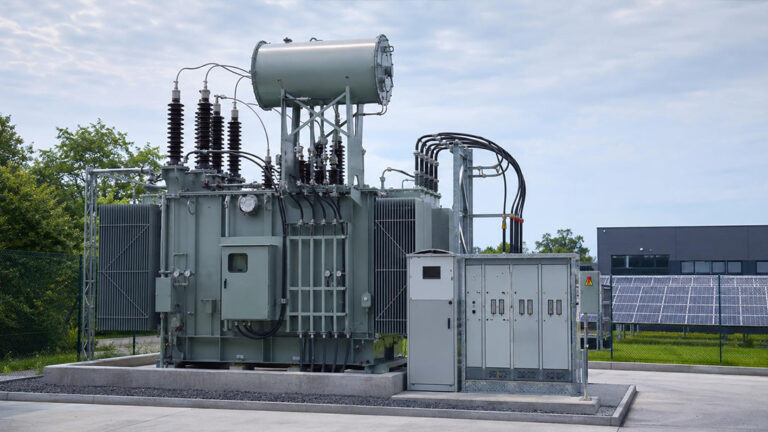
A long incoming line or a low system short-circuit level will amplify the voltage dip during motor starting. The specification should state the maximum and minimum fault levels at the point of connection, the permitted steady-state voltage range, and the allowable transient dip. It should also identify whether each large motor uses direct-on-line starting, a soft starter, or a variable-frequency drive.
Transformer impedance creates a real trade-off. A higher impedance limits fault current but increases voltage drop during a large load step. A lower impedance improves voltage regulation but may push switchgear and busbar fault duties beyond their ratings. The transformer, switchgear, cable, and protection studies must therefore use the same impedance basis.
Where primary voltage varies over a wide range, the project may consider an off-circuit tap range or an on-load tap changer. OLTC should not be specified simply because the grid is described as unstable. Voltage records should show the magnitude and duration of the variation. The project should then define the regulation target, expected operations per day, control philosophy, and bypass arrangement.
Environmental and Installation Conditions
Zambia is not one uniform design environment. Altitude, maximum ambient temperature, access road, dust level, and rainfall must come from the actual site survey. High temperature reduces thermal margin. Altitude affects external insulation and cooling. Conductive dust can contaminate bushings and switchgear. Seasonal road conditions may restrict the delivery window for a heavy transformer.

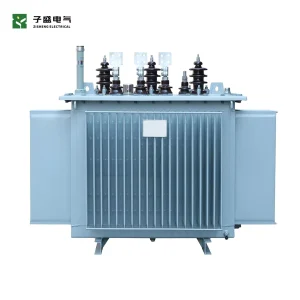
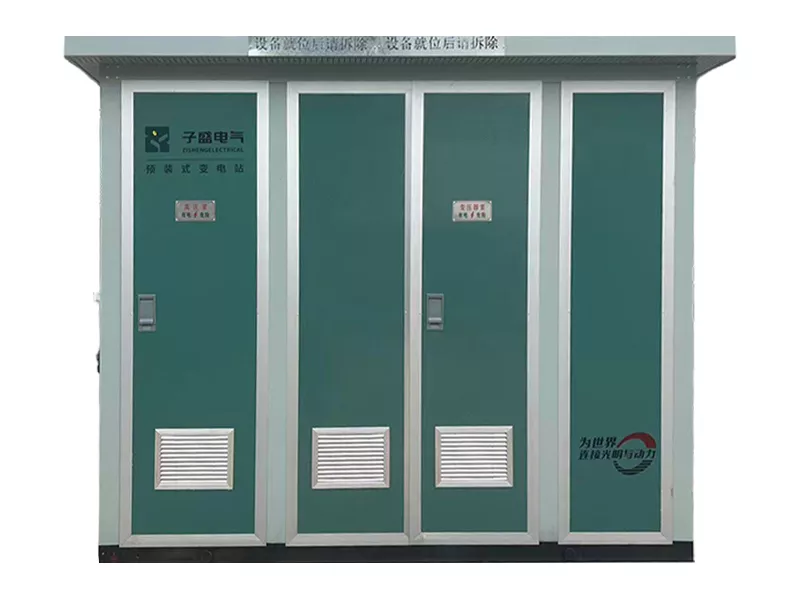
For an outdoor oil-immersed unit, review radiator access, conservator arrangement, breather maintenance, tank coating, terminal-box sealing, and clearance for bushing inspection. Equipment near a crushing area needs a realistic cleaning plan. When a prefabricated substation is proposed, the enclosure ventilation, internal temperature rise, maintenance aisle, fire separation, and transport dimensions need to be checked as one package.
For dispersed mining loads, a substation transformer solution may be coordinated with the RMU, medium-voltage switchgear, low-voltage board, and protection system. This reduces interface ambiguity, but the EPC contractor should still define the exact electrical and mechanical limits of supply.
Parameters That Must Be Clear in the Purchase Specification
| Parameter | Recommended Definition | Risk if Left Unclear |
|---|---|---|
| Rating and loading | Rated MVA, ambient correction, emergency loading cycle | Nameplate capacity does not reflect the continuous duty |
| Voltage and tapping | Nominal and highest system voltage, range, step, operating condition | The delivered unit cannot maintain the site bus voltage |
| Short-circuit impedance | Guaranteed value, tolerance, tap position, parallel requirement | Switchgear duty or motor-start voltage becomes unacceptable |
| Losses | No-load and load-loss guarantees with an evaluation method | Purchase price is compared without lifetime energy cost |
| Accessories | Temperature, oil level, pressure, gas relay, marshalling interfaces | Protection and SCADA circuits require late redesign |
| Standards and tests | Applicable IEC editions, routine, type, and special tests | FAT scope and commercial responsibility remain disputed |
Loss evaluation deserves a separate commercial calculation. A mine that operates around the clock can accumulate substantial energy cost from a small efficiency difference. Procurement teams can use the method described in our article on the annual cost of a one-percent transformer efficiency reduction, but the calculation must use the project’s own tariff, load curve, and discount rate.

FAT, Transport, and Spares
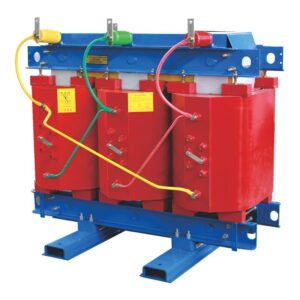
The FAT schedule should cover ratio, vector group, winding resistance, insulation tests, no-load loss, load loss, impedance, and accessory functions. When the owner or EPC contractor will witness the tests, the notification period, calibrated instruments, report format, and non-conformance process should be agreed before testing. For a severe cyclic load, the design review may also require thermal calculations and a review of winding mechanical strength.
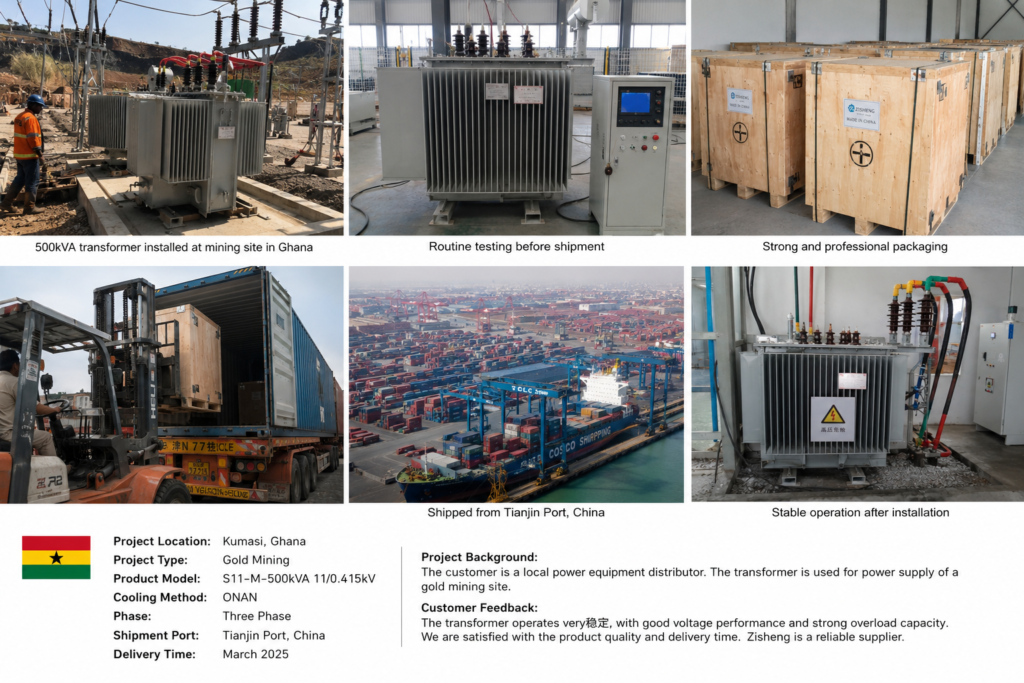
The transport plan must use a route survey rather than a general distance estimate. Bridge capacity, turning radius, gradients, unloading crane capacity, and rainy-season access can control the feasible shipping configuration. The project should define whether the transformer travels filled with oil or under dry gas, which accessories are removed, how radiators are packed, and which insulation and oil tests are repeated after arrival.
Our 500 kVA transformer delivery for a Ghana gold-mining project provides a useful example of delivery planning, but its rating and site assumptions should never be copied into a Zambia project without a fresh engineering review.
Information to Send with the RFQ
A technically comparable quotation needs the single-line diagram, load list, connection-point data, environmental conditions, expansion schedule, installation arrangement, and FAT requirements. If some information is not yet available, mark it as TBC and assign a closure date. This is much safer than allowing each bidder to use a different assumption and then comparing prices that do not represent the same scope.
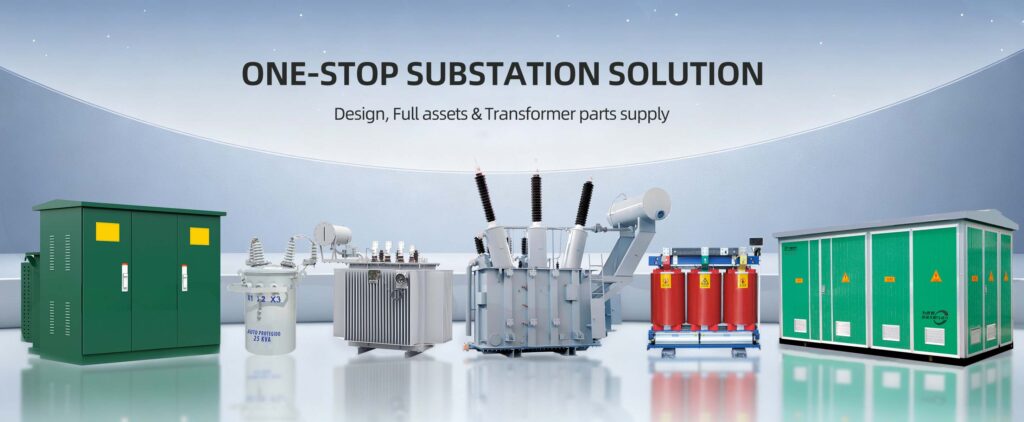
Zisheng Electric suppliesOil-Immersed Transformers, Compact Substation, Pad Mounted Transformers, Pole Mounted Transformers and Dry Type Transformers. We can provide technical matching based on project capacity, voltage level, environmental conditions, and technical specifications, with an initial response to inquiries within 24 hours. For a Zambia mining project, the load schedule and grid data allow us to review capacity staging, impedance, tap range, FAT, and delivery boundaries at the quotation stage.
About ZISHENG ELECTRICAL
Zisheng are a professional 19+ years manufacturer in producing Oil-Immersed Transformers, Compact Substation, Pad Mounted Transformers, Pole Mounted Transformers and Dry Type Transformers. We own the certificates of ISO/CE/IEC 60076 and TUV Rheinland.
Transformers undergo rigorous FAT and type testing, support voltage/capacity customization. Welcome to consult for Catalog and Product. you can contact us at email [email protected].