Kenya Transformer Loss Evaluation: Comparing Bids Beyond Purchase Price
A transformer quotation can look attractive until the operating assumptions are placed beside it. From Zisheng Electric’s engineering perspective, the useful question is not simply which offer has the lowest loss figure. It is which technically suitable design will waste less energy under the load the project will actually carry. That is the starting point for Kenya transformer loss evaluation.
An industrial buyer, a distribution contractor and a mini-grid developer may require similar-looking equipment but use it differently. One transformer may remain energized through long periods of light demand. Another may carry a steady process load. A third may serve generation that varies during the day. Their purchasing decisions should not be driven by the same efficiency percentage without checking how it was calculated.
This guide focuses on bid comparison. It does not prescribe a national loss limit, a current electricity tariff or a universal transformer rating for Kenya.
Define the Electrical Duty Before Comparing Losses
Write down the energy path: source, feeder, transformer, switchgear and load. Identify which equipment remains energized when production stops and where energy is metered. A transformer on the generation side of a mini-grid is not automatically interchangeable with a customer step-down transformer, even when the voltage numbers appear similar.
There is a concrete Kenyan example. REREC’s published Liboi solar mini-grid upgrade tender specifies a 0.415/11 kV step-up transformer for a 50 Hz AC system. Those values describe that tender’s generation interface; they are not a specification for every Kenyan installation. For procurement, the lesson is to obtain the actual project datasheet before applying a catalogue loss figure. REREC project tender
For a customer connection, confirm the utility-approved supply arrangement and ownership boundary. The buyer should know whether the transformer is customer-owned, part of a utility delivery package or inside an isolated project network. That determines which specification and acceptance documents must govern the purchase.
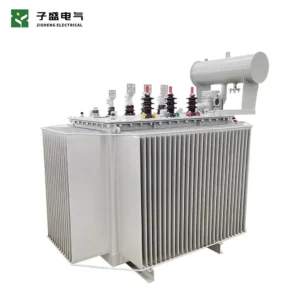
Our 200 kVA, 11 kV/0.415 kV distribution transformer is a product reference for medium-voltage-to-low-voltage distribution. Its catalogue voltage pair does not establish suitability for an individual Kenyan connection. Capacity, connection arrangement, losses and project approval still need confirmation.
Separate No-Load Loss from Load Loss
No-load loss, usually written as P0, is the power absorbed while an energized transformer supplies no external load under the stated measurement conditions. It is associated mainly with the magnetic core. A low-load installation can therefore accumulate substantial loss energy even when very little useful power is being delivered.
Load loss, written here as Pk, is the loss associated with carrying rated current at a specified reference temperature and frequency. At approximately constant voltage and comparable temperature, the load-dependent component can be estimated using the square of the load-current fraction. Half current does not mean half load loss; the simple estimate is one-quarter. American Public Power Association engineering discussion
The approximation has limits. Temperature, phase imbalance and harmonic currents can change the result. Request an appropriate engineering assessment where non-linear loads are material; a basic spreadsheet is not a substitute for that assessment. Manufacturer explanation of loss mechanisms
An efficiency percentage alone hides these distinctions. Ask for the load point, power factor and measurement basis behind it. Two quotations can display the same percentage while offering different P0 and Pk values, producing different annual energy losses on the same site.

Build a Comparable Kenya Transformer Loss Evaluation Sheet
Before scoring prices, give every bidder the same technical schedule. A blank cell should remain an open clarification, not be treated as zero loss or assumed compliance.
| Input | Main risk if omitted | Procurement check |
|---|---|---|
| Rated capacity and operating duty | Comparing equipment that cannot serve the same load | Match continuous duty, peak demand and documented expansion stages |
| Rated voltages, frequency and tap basis | Treating incompatible designs as equivalent | Use the approved connection data and the same comparison tap |
| Guaranteed no-load loss | Confusing a typical catalogue figure with a commitment | Obtain the guaranteed value, units and measurement conditions |
| Guaranteed load loss | Ranking values measured on different bases | Align reference temperature, rated current and winding combination |
| Impedance and protection interface | Improving one figure while creating an unacceptable system interface | Confirm that the offered design remains compatible with project studies |
| Energized hours and demand profile | Overstating or understating annual energy losses | Separate standby, production, seasonal operation and de-energized periods |
| Cooling and auxiliary demand | Excluding energy consumed by associated equipment | Identify fans, controls and other applicable auxiliaries separately |
| Acceptance basis and deviations | Discovering commercial disagreement during inspection | Close guaranteed-value wording, tolerances and deviation handling before order |
Keep technical compliance separate from the economic ranking. A lower calculated operating cost does not make a non-compliant voltage arrangement acceptable. It also does not compensate for missing accessories, an unsuitable enclosure or an unapproved terminal layout.
Ask bidders to return a signed deviation schedule alongside the completed datasheet. A short, explicit qualification is easier to review than an assumption hidden in a drawing note or a general sales document.
Use the Load Curve, Not Just the Average Demand
For an initial comparison, use:
Estimated loss energy = P0 × energized hours + Pk × sum of (load fraction² × interval hours).
Use kilowatts for P0 and Pk to obtain kilowatt-hours. The load fraction should represent current relative to rated current; using kVA divided by rated kVA is a practical approximation when voltage is close to the rating. Keep auxiliary energy outside this simplified expression unless it has been explicitly included.
The square matters. A facility alternating between light and heavy demand does not have the same load loss as a facility operating continuously at its average demand. Squaring the average load generally understates the average of the squared loads when loading varies.
A Worked Bid-Comparison Example
The following calculation uses invented arithmetic inputs solely to demonstrate the method. They are not Zisheng Electric specifications, supplier quotations, measured test results or typical Kenyan operating data.
| Illustrative operating period | Hours per day | Load fraction | Load fraction² × hours |
|---|---|---|---|
| Light demand | 12 | 0.20 | 0.48 |
| Normal production | 8 | 0.60 | 2.88 |
| Heavy demand | 4 | 0.90 | 3.24 |
| Total | 24 | Variable | 6.60 |
Assume both designs have already passed the same technical compliance review. Design X has P0 = 0.60 kW and Pk = 4.80 kW. Design Y has P0 = 0.40 kW and Pk = 5.40 kW. Assume 365 identical days, continuous energization, comparable reference conditions and no auxiliary demand.
The squared-load total is 6.60 × 365 = 2,409 equivalent full-current-loss hours. Estimated annual losses are 16,819.2 kWh for X and 16,512.6 kWh for Y. Y uses 306.6 kWh less loss energy under this profile despite its higher rated load loss.
Check Whether the Ranking Survives a Different Duty
Change the assumption to continuous 60% loading and the ranking reverses. X produces an estimated 20,393.28 kWh of annual loss energy; Y produces 20,533.44 kWh. Neither design is universally better. The preferred offer depends on the duty and the premium charged for it.
Connect the Calculation to the Kenyan Project
Use the project’s own operating evidence. For an existing factory, request interval demand records covering representative production, shutdown and seasonal periods. For a new installation, document how the forecast was built from equipment demand and operating hours. Do not present a forecast as measured history.
A water project may have very different duty between operating seasons. A mini-grid transformer may remain energized when generation is low, depending on the actual switching arrangement. A factory with staged expansion may spend its first years at a much lower loading than the final design case. Treat these as project questions, not assumptions about all sites in Kenya.
For pump systems, review the separate Kenya irrigation transformer guide when considering starting demand and long feeders. The annual loss comparison addresses a different issue: how much energy the selected design consumes across its operating schedule. Both reviews are needed, but one should not replace the other.
Confirm the metering location before translating loss energy into an owner’s cost. Physical losses exist regardless of who pays for them. Whether a specific loss appears directly in a customer’s bill depends on the contractual and metering arrangement. Obtain the relevant connection and billing information instead of assuming that every purchaser bears the same loss cost.
Compare the Price Premium Against a Transparent Scenario
Use the project’s approved electricity cost assumptions, not an unverified national average. Record the currency, date, applicable charges and whether taxes or demand-related charges have been included. A simple energy-only comparison should be labelled as such.
Calculate a low, central and high operating case. Change demand growth and energized hours where those inputs are uncertain. If the offers exchange places after a small change in assumptions, report that sensitivity to the procurement team. A precise-looking result is not a strong decision when its inputs are weak.
Keep installation and maintenance scope visible beside the energy calculation. Delivery terms, transport dimensions, accessories and required inspection documents can alter the practical value of a quotation. Avoid hiding these differences inside a single adjustment that nobody can audit.
If a tender already defines an evaluation formula, use that formula for the tender assessment. A buyer’s internal operating-cost comparison can be useful alongside it, but should not silently replace the specified scoring method. Document which calculation supports which decision.
Make the Guarantee Traceable to Acceptance
From a design-review perspective, a guaranteed loss figure is most useful when it remains attached to the exact offered configuration. A later change to voltage, winding arrangement, cooling duty or another material design condition should trigger confirmation of the performance schedule. Do not assume the original figures remain valid after a redesign.
What the Acceptance Report Must Identify
Agree what the acceptance report must identify: transformer serial number, drawing revision, rated data, tap position, test conditions, reported losses and the basis for any corrections. The contract should distinguish guaranteed values from typical values and define how deviations will be handled. This is a commercial and engineering clarification to close before testing, not during shipment release.
The transformer factory testing overview provides related background on inspection stages. For the actual purchase, use the agreed inspection plan and applicable project requirements. Do not infer that a general website article establishes the acceptance limits for a particular order.
Procurement should retain the approved datasheet and final test report together. That gives the operating team a clear record of what was purchased and what was verified, rather than a collection of disconnected sales documents.
Choose a Design for Its Duty, Not Its Series Name
An efficiency-oriented range such as the S22 series low-loss transformer can be considered during supplier discussions. The series name is not a substitute for guaranteed P0 and Pk values for the requested rating, nor does it establish Kenyan utility approval.
Ask for the comparison in one page: compliant configuration, guaranteed losses, operating assumptions, estimated annual energy loss, purchase premium and unresolved deviations. Keep the calculations reproducible. A reviewer should be able to change the load profile and understand why the ranking changed without asking the original author to rebuild the analysis.
Send the Inputs Needed for a Technical Comparison
For Kenya transformer loss evaluation, send the single-line diagram, transformer datasheet, applicable utility or project specification, load schedule, available interval demand records and site conditions. Include the intended energized hours and any confirmed expansion stages. Those inputs make a discussion about loss performance specific enough to support procurement.
Zisheng Electric supplies oil-immersed transformers and related distribution equipment. Technical matching can be based on project capacity, voltage, environmental conditions and the agreed technical specification; final suitability and guaranteed performance require confirmation for the selected design.
Our engineering team will review the requirements and respond to project inquiries within 24 hours.
About ZISHENG ELECTRICAL
Zisheng are a professional 19+ years manufacturer in producing Oil-Immersed Transformers, Compact Substation, Pad Mounted Transformers, Pole Mounted Transformers and Dry Type Transformers. We own the certificates of ISO/CE/IEC 60076 and TUV Rheinland.
Transformers undergo rigorous FAT and type testing, support voltage/capacity customization. Welcome to consult for Catalog and Product. you can contact us at email [email protected].