Transformer Transport Shock Recorder Review for Inland African Projects: Event Context and Release
Zisheng Electric often receives a practical question from EPC buyers before an inland delivery: what should an impact recorder prove, and who decides what happens when it records an event? A transformer transport shock recorder review is useful only when the logger, route record, receiving inspection and engineering disposition describe the same shipment. A peak value on a screen cannot, by itself, establish that a transformer is damaged or fit for energization.
For a long route from port to mine, utility substation or industrial plant, the delivery chain may involve a vessel, terminal, customs yard, road carrier and site crane. The handover point can be ambiguous. A procurement specification should therefore describe the evidence to collect before dispatch and the decision to make after receipt. This guide concentrates on that evidence, rather than on whether the unit should travel assembled or split; the latter choice is covered in our inland African transformer shipping configuration guide.
What a transformer transport shock recorder review can answer
A recorder can establish that an acceleration event was logged at a particular time and, if configured appropriately, show its magnitude, duration and direction. It does not identify a broken winding support, a displaced accessory or a compromised seal. Those are engineering questions requiring inspection, comparison with factory evidence and, where justified, testing. The event trace is a prompt for a controlled review, not a verdict.
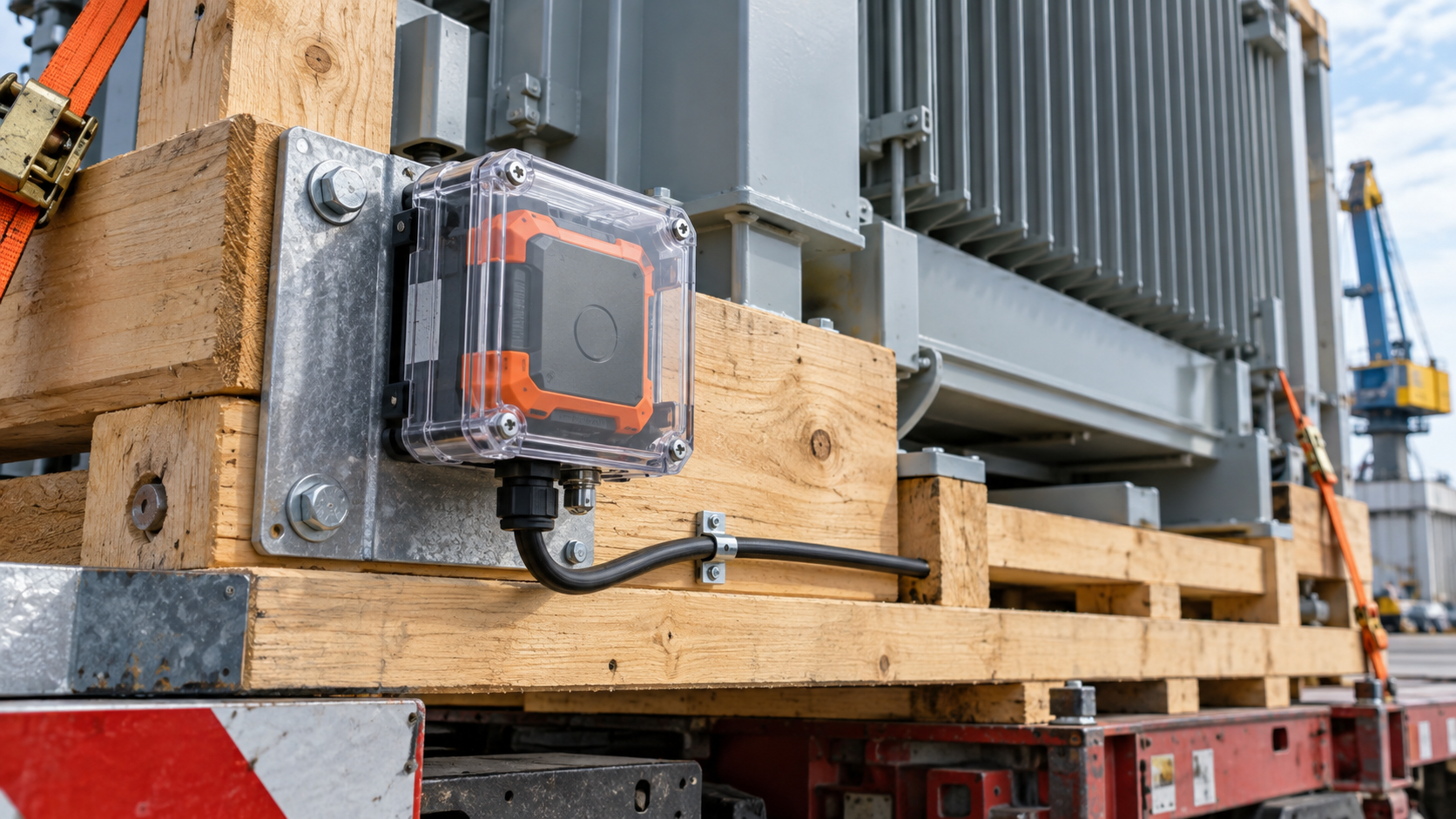
Before placing the order, the buyer should identify the shipped object. A main tank with radiators removed has a different restraint system from a fully assembled distribution transformer. Packing cases for bushings, cooler banks and control cabinets may need separate monitoring or at least a separate condition record. Ask the manufacturer and carrier to mark the recorder position and its mounting method on the shipping drawing. A device loosely attached to a pallet can measure the pallet’s local motion rather than the tank’s response.
Define the measurement before defining a limit
The specification should state the axes, recording interval or event capture method, clock setting, power supply, memory capacity and access to the raw trace. It should also state whether the device is a continuous logger, a threshold-triggered event recorder or a simple mechanical indicator. These devices answer different questions. A threshold indicator that has tripped cannot reconstruct the route or show the duration of the event.
There is no responsible universal shock limit for every transformer and every shipping configuration. The acceptable trigger and any hold point must be agreed for the actual unit, transport supports, mounting point and project specification. The factory may have a transport analysis or handling instructions that support a project-specific criterion. If those documents are not available, write a conservative escalation rule and require engineering disposition; do not invent a number in the purchase order.
Put transport evidence into the procurement package
The purchase order should assign ownership for providing the recorder, fitting it, setting its clock, activating it, downloading the data and retaining the original file. A commercial line saying “shock recorder included” leaves all of those tasks open. The carrier should know whether the logger may be reset at a transshipment point and who records the seal or serial number at each custody transfer.
The route survey should cover the equipment envelope, mass, centre of gravity, axle load, bridge and overhead restrictions, turning space, gradients, road condition, lifting points and final off-loading plan. It is possible to meet the permit requirements and still subject the load to hard handling. The road method statement should indicate where low-speed manoeuvres, temporary ramps or crane transfers require special care. The route record then gives context to the trace rather than serving as a substitute for it.
For remote projects, confirm how the data will be retrieved if the recorder is damaged or its battery is exhausted. A named person should be able to download and preserve the raw file on arrival. Photographs of the screen alone may omit axis, duration, time-zone and device settings. Keep the device serial number and configuration with the trace.
| Decision point | Evidence to request | Why it changes the release decision |
|---|---|---|
| Before dispatch | Approved shipping drawing, restraint plan, logger model and mounting photo, clock and trigger settings, baseline condition photos | Defines what was measured and what condition is being compared |
| Custody transfers | Dated seal, handling and route records; photographs after lifting or repacking | Places a recorded event within a specific operation and responsible handover |
| On arrival | Original trace, serial number, battery status, exterior and accessory inspection, preservation readings | Distinguishes a clean delivery from a trace or condition needing investigation |
| After a flagged event | Manufacturer’s engineering review, targeted inspection and tests, written disposition | Prevents a logger alarm or a visual check alone from becoming an acceptance decision |
Build a route and custody timeline
At dispatch, record the time reference, seal number, vehicle, transporter, loading location and photographs of the restrained unit. For a shipment crossing borders or changing carrier, require a handover entry for each lift or storage period. Note if a logger was removed for customs inspection or if its mounting was altered. Without that entry, a later acceleration peak may be impossible to associate with a specific handling event.
Time zones matter on routes with port documents, trucking logs and site diaries prepared by different teams. Convert all records to one stated reference time before judging a correlation. A sharp peak during a known crane set-down has a different investigation path from an unexplained event on a road section, but neither can be dismissed automatically. Ask whether the event direction aligns with the restraint plan, whether it is a single impulse or repeated vibration, and whether the recorder captured pre- and post-event context.

Do not confuse sensor orientation with the transformer’s longitudinal, transverse and vertical axes. The installation photograph and device orientation record should allow the analyst to transform the trace into the shipping drawing’s directions. If orientation is uncertain, say so in the review and avoid a confident claim about which restraint or internal component was loaded.
Receiving inspection before any release
The receiving team should photograph the truck and tie-down arrangement before the load is disturbed. Check for shifted restraints, damaged frames, broken seals, oil leakage, dented tank walls, distorted lifting points and damaged accessory cases. Record ambient and storage conditions if the transformer will wait at site. Inspect the logger’s physical condition and download the original trace before it is reset or returned to the carrier.
For an oil-immersed power transformer, compare the delivered configuration with the shipping drawing: detached radiators and bushings, blanked openings, positive-pressure or preservation arrangements, transported oil quantity and separately packed control equipment. An intact outer crate does not establish the condition of parts inside it. Conversely, a cosmetic scuff on packing does not automatically require invasive transformer testing. The inspection report should separate packaging damage, equipment damage and missing evidence.
Receiving inspection also has a commercial purpose. It fixes the condition at the transfer of custody and helps the EPC contractor preserve recourse while the carrier, manufacturer and site team are still available. The West Africa mining transformer project guide discusses the wider logistics and staged-load context for remote sites. A mine’s commissioning schedule can make a late decision on transport damage more costly than the immediate repair itself.

Preservation is part of the condition record
If the transformer travels without some accessories or is stored before assembly, preserve the manufacturer’s instructions for temporary closures, moisture control, pressure checks and storage interval. A shock trace cannot detect gradual moisture ingress, a missing blanking plate or a mishandled accessory case. Record the arrival condition immediately, then maintain a separate preservation log until installation. The receiving checklist should make clear when responsibility transfers from transport contractor to site storage team.
How to review a flagged event
First protect the evidence. Keep the raw data, device settings, original file name and download date. Collect the route log, driver report, lifting records, photographs, restraint inspection and any witness note. Do not overwrite the trace with a cropped screenshot. Confirm that the event is real rather than a logger handling artefact, loose mounting or clock mismatch; record the reasoning either way.
Next ask the transformer manufacturer to review the event against the approved shipping configuration. A written response should state the relevant assumptions, the parts potentially affected and the proposed scope of inspection or testing. Depending on the event and the unit, this may include external examination, restraint and support checks, pressure or oil condition checks, insulation and winding measurements, or a comparison with factory test baselines. The scope is an engineering decision, not a fixed package that every project must buy.
A hold should be explicit: identify which operations are paused, who can authorize release and what evidence closes the hold. An alarm may justify preventing unloading by an unsafe method, opening a packing case, assembly, oil filling or energization at different stages. “Do not energize” is not enough if the immediate risk is a displaced load during off-loading. The site safety plan still governs handling.
Separate logistics acceptance from electrical acceptance
The carrier’s proof of delivery, the EPC receiving report and the manufacturer’s technical release serve different purposes. A signed delivery note may establish that a shipment reached site; it does not replace a condition inspection. An engineering release after a flagged event may permit assembly, but energization still depends on the project’s installation, test and utility interface requirements. These gates should appear separately in the handover matrix.
Write the decision trail in language a later commissioning engineer can follow: event observed, evidence checked, likely mechanism, inspection or test performed, findings, open limitations and authorized next step. If the data are incomplete, state the uncertainty and the compensating work. Avoid a bare “acceptable” stamp without a scope or signatory. The same discipline helps a distributor who will store and re-dispatch a unit; see our transformer warehouse storage guide for the subsequent custody period.
Specify the right contract interfaces
The manufacturer should define lifting points, shipping supports, permitted disassembly, preservation requirements and the engineering contact for events. The transport contractor should define route, vehicle, restraint inspections, transfer points and event notification. The EPC contractor should define site access, off-loading, receiving witness and the hold-point authority. A distributor may be the contractual buyer while the EPC team performs receipt; both parties need the same data package.
The bid comparison should price the recorder, installation, data retrieval, witnessing, spare battery or device arrangements and an event review service if required. Ask bidders to state exclusions. Some proposals include a logger but leave the customer to interpret data; others assume the carrier retains the device. Neither arrangement is necessarily wrong if the contract makes the deliverables and access rights clear.
For 132 kV and 138 kV power transformer projects, the transport envelope and accessory split may require a more formal interface schedule. The same evidence logic also applies to a 110 kV or 115 kV power transformer when the unit is transferred between port, inland carrier and installation contractor. The voltage label does not define a shock limit; the actual design and shipment do.
Close the transformer transport shock recorder review
A useful closeout packet contains the approved shipping arrangement, logger serial number and settings, installation photo, route and custody timeline, raw data, arrival inspection, event review if any, test evidence and written release. It should identify unresolved limitations. That packet gives the project owner a defensible reason to proceed and gives the commissioning team a clear boundary between transport condition and electrical acceptance.
Send Zisheng Electric the transformer drawings, data sheets, load list, technical specification, single-line diagram, grid parameters, environmental conditions, route and installation-site constraints, plus the proposed recorder and transport method. We can align the monitoring and hold points with the selected power transformer and the project’s receiving plan. Our engineering team will review the requirements and respond to project inquiries within 24 hours.
About ZISHENG ELECTRICAL
Zisheng are a professional 19+ years manufacturer in producing Oil-Immersed Transformers, Compact Substation, Pad Mounted Transformers, Pole Mounted Transformers and Dry Type Transformers. We own the certificates of ISO/CE/IEC 60076 and TUV Rheinland.
Transformers undergo rigorous FAT and type testing, support voltage/capacity customization. Welcome to consult for Catalog and Product. you can contact us at email [email protected].