Transformer Selection Guide for Industrial Projects in the Middle East: Practical Experience in High-Temperature, Salt-Mist, and Dusty Environments
If you are responsible for an EPC project in the Middle East, or handling equipment procurement for petrochemical and energy projects in the region, transformer selection has probably caused you some headaches.

The problem is not that the standards are insufficient — it is that the conditions assumed by the standards often do not match actual site conditions.
In the Jubail coastal industrial area of eastern Saudi Arabia, outdoor temperatures can easily exceed 45°C in summer, while surface temperatures can rise above 60°C. IEC 60076 defines temperature rise limits based on a maximum ambient temperature of 40°C. Applying this standard directly without adjustment will eventually lead to excessive winding temperature rise.
At coastal sites in the UAE, the salt content in the air is extremely high. Standard galvanized steel enclosures may begin showing corrosion spots within two or three years, and radiators may develop perforation within five years. This is not speculation — these are issues Zisheng Electric has personally observed during after-sales inspections of Middle East projects.
Oil fields in southern Iraq present even greater challenges. Grid voltage fluctuations can sometimes reach ±10% or higher. If the tap range is insufficient, the equipment may struggle to maintain stable power supply after commissioning.
Below, we will break down the experience we have accumulated from years of transformer projects in the Middle East. If you are currently preparing a technical solution for a specific project, you can also skip directly to the end and contact us — send us your parameters, and we will provide a technical solution and quotation.
I. High Temperature Conditions: Do Not Increase Capacity First — Verify Temperature Rise First
How should high temperatures be handled? A common approach among many design institutes is simply increasing the transformer capacity by one level — for example, selecting a 2500kVA transformer when the calculated requirement is 2000kVA.
This approach is not necessarily wrong and can cover most situations, but it is neither economical nor precise.
For Saudi Aramco projects, Zisheng Electric’s approach is to recalculate temperature rise limits based on actual project ambient conditions and then determine the required capacity. This ensures compliance with technical requirements while avoiding unnecessary oversizing and keeping project costs under control.
IEC 60076-2 clearly specifies that transformer temperature rise limits are based on a 40°C ambient temperature.
For every 1°C increase in ambient temperature, the allowable temperature rise limit decreases by 1°C.
The key point is this: a 50°C ambient temperature cannot simply be treated as “designing for 50°C.” The portion exceeding the standard condition must be deducted from the available temperature rise margin.
How Is It Calculated?
Take a Saudi petrochemical project we completed as an example.
Design ambient temperature: 50°C.
The standard winding average temperature rise limit is 65K (resistance method). Under a 50°C ambient condition, the actual available temperature rise margin becomes:
65 – (50 – 40) = 55K
A standard-designed 2000kVA transformer will have reduced actual load capability under these conditions.
Based on engineering experience, to meet a 2000kVA load requirement, the selected capacity should be:
2000 / 0.85 ≈ 2350kVA
Therefore, selecting a 2500kVA transformer directly in the actual project is a reasonable solution.
If the project requires a 55°C design ambient temperature, the temperature rise margin is further reduced:
65 – (55 – 40) = 50K
The capacity increase factor may need to start from 25%-30%.
Commonly Overlooked Factors
Some major oil companies specify in their technical requirements that temperature rise must not exceed 55K. This adds another limitation on top of the high ambient temperature conditions.
We have encountered projects where standard solutions failed technical approval. The solution was to optimize the cooling structure — increasing radiator surface area and oil volume to reduce temperature rise to within specification limits.
For such projects, the transformer capacity may need to be increased by more than 40% compared with the calculated load requirement.
What Zisheng Electric can provide:
Our engineering team can prepare detailed temperature rise verification calculations and capacity correction solutions based on actual ambient temperature, load profile, and cooling method.
Technical bid documents can include:
- Derating calculation logic;
- Temperature correction curves;
- Temperature rise calculation sheets.
These are also the documents that Middle East consultants closely review during technical evaluation.
II. Salt Spray Corrosion: C5-M Protection Is Not Simply About Applying Two More Layers of Paint
The main industrial zones in the Middle East — Jubail and Yanbu in Saudi Arabia, Abu Dhabi and Dubai in the UAE, Shuaiba in Kuwait, Mesaieed in Qatar, and Khor Al-Zubair in Iraq — are almost all located along the coastline. High salt concentration in the air creates continuous corrosion risks for transformer enclosures, radiators, terminals, and fasteners.
How Should the Corrosion Protection Level Be Determined?
ISO 12944-2 classifies atmospheric corrosion environments from C1 to CX. C5-M is specifically designed for severe marine environments with high salt spray exposure.
For our coastal project in Khor Al-Zubair, Iraq, the owner directly required C5-M corrosion protection. Kuwait MEW specifications also clearly define coastal projects as requiring designs suitable for high salt spray environments.
Based on Zisheng Electric’s experience delivering projects in the Middle East, C5-M corrosion protection requires much stricter process control than many people expect.
Selecting the correct coating system is only the first step. If surface preparation and application control are not properly managed, the expected service life will still be significantly reduced.
Our Corrosion Protection Process
Step 1: Hot-Dip Galvanizing as the Base Protection Layer
The zinc coating thickness is not less than 85μm, according to ISO 1461 standards.
The corrosion protection performance and service life of hot-dip galvanizing and electro-galvanizing are not comparable — this has been verified through our experience in coastal projects.
Step 2: Three-Layer Coating System
- Zinc-rich epoxy primer, dry film thickness not less than 80μm
- Epoxy micaceous iron oxide intermediate coating, dry film thickness not less than 80μm
- Polyurethane topcoat, dry film thickness not less than 80μm
The total dry film thickness of the three layers is not less than 240μm.
Areas prone to coating weakness, such as edges, weld seams, and bolt holes, receive additional reinforcement.
Step 3: Process Control
The same coating materials can have completely different service lives depending on surface preparation and application quality.
Our factory maintains strict process standards for:
- Abrasive blasting grade;
- Coating interval control;
- Curing conditions.
Do Not Ignore Accessories and Sealing Components
Radiators:
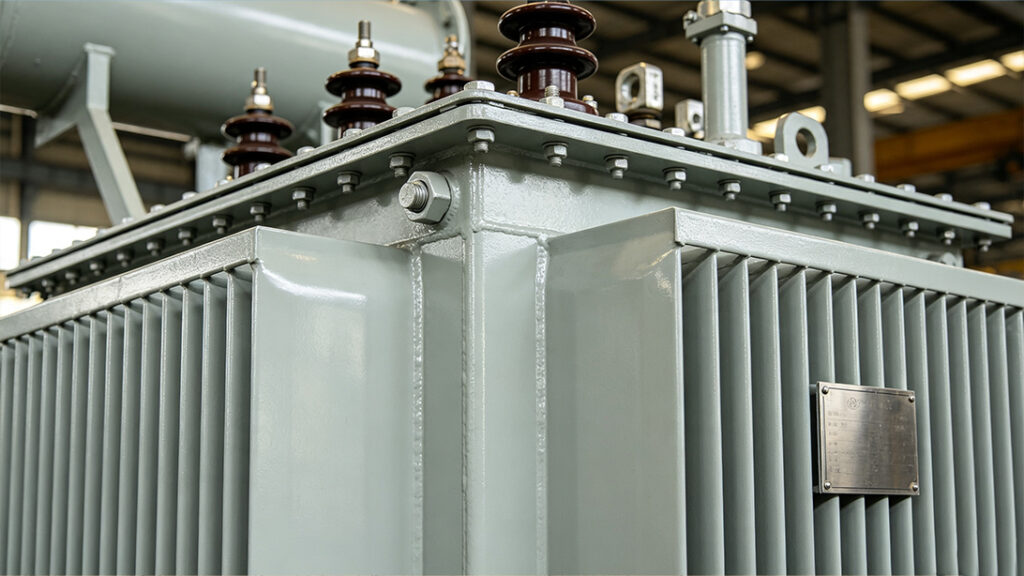
We use corrosion-resistant steel materials and chamfer cutting edges to prevent coating cracking at sharp edges.
Terminals:
Copper terminals are silver-plated or tin-plated, with fasteners using A4-80 grade stainless steel.
Nameplates:
Stainless steel laser-engraved nameplates are used. Standard aluminum nameplates may become unreadable after only a few years in such environments.
Sealing Components:
Standard equipment uses fluororubber (FKM) or EPDM rubber. Ordinary nitrile rubber ages much faster under high-temperature salt spray conditions.
What We Can Provide:
Before shipment, each project can be provided with:
- Coating adhesion test reports
- Salt spray test reports
The testing duration is not less than 720 hours according to ISO 9227 standards, with reports issued by third-party laboratories.
These documents are frequently required during project handover and acceptance for Middle East projects.
III. Dust and Sand Environments: More Damaging Than Many People Expect
People who have never experienced sandstorms in the Middle East often underestimate the destructive impact of fine sand on electrical equipment.
Strong winds carry fine sand particles into radiator gaps, blocking heat dissipation channels;
Abrasive particles damage the external insulation surfaces of bushings, gradually reducing the effectiveness of creepage distance;
Sealing components experience accelerated wear.
These types of damage are not always immediately visible to the naked eye.
How Should the Protection Level Be Selected?
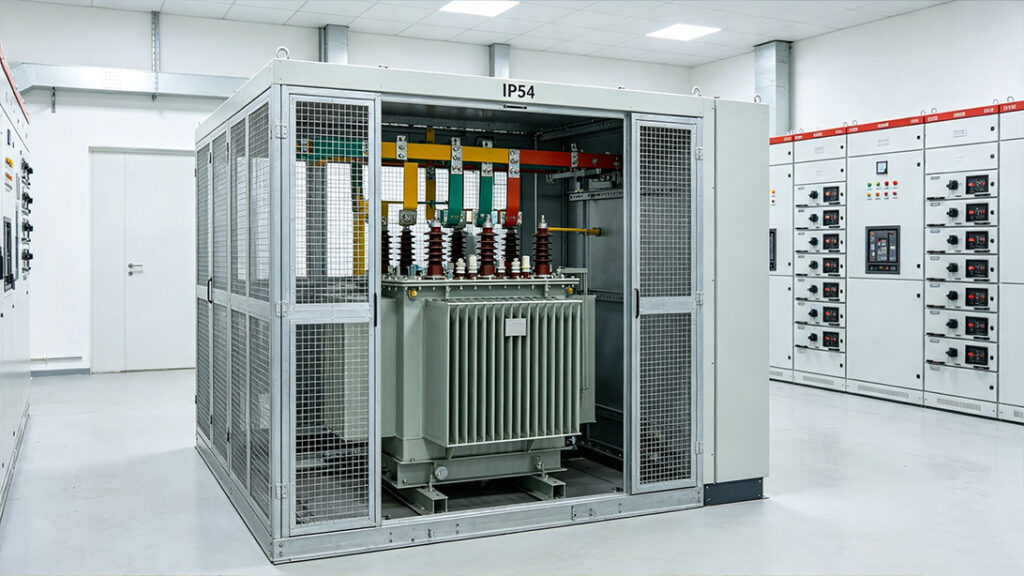
For outdoor-installed transformers, the protection level should be at least IP54, and for severe dust environments we recommend IP55 or higher.
IP54 provides protection against dust and water splashing.
However, during actual selection, the IP rating alone should not be considered. The following factors must also be evaluated:
- Local dust concentration;
- Maintenance frequency;
- Equipment cooling requirements.
An excessively high protection level can affect heat dissipation, which must be balanced during the design stage.
We normally recommend the most suitable balance based on the frequency and severity of sand and dust exposure at the project location.
Oil-Immersed Transformer Solution
Fully sealed corrugated tank designs are widely used in our Middle East desert projects.
They have no conservator tank and no breather, preventing external air and dust from entering through the breathing system and contaminating the insulating oil.
The corrugated tank walls also serve as additional cooling surfaces, reducing maintenance requirements.
The limitation is that oil level cannot be directly observed through a conservator oil level indicator. Instead, operating conditions must be evaluated through devices such as pressure relief valves and oil temperature indicators.
During commissioning training, we specifically explain this change to site operation and maintenance personnel.

Dry-Type Transformer Solution
For outdoor installation, the enclosure protection level should be at least IP54.
Removable dust filters must be installed at air intake openings, and a regular cleaning schedule must be established — installation alone is not sufficient.
We specify filter cleaning intervals in the operation and maintenance manual and repeatedly emphasize this requirement during commissioning training.
IV. Grid Voltage Fluctuation: Ensure Sufficient Tap Range Before Commissioning
Power grid conditions in some industrial areas of Iraq are relatively complex.
Voltage deviations can sometimes reach ±10% or even wider, and frequency fluctuations are also common.
Under these conditions, if the tap changer adjustment range is selected too small, the transformer may not be able to regulate voltage properly after commissioning, creating serious operational problems.
How Should a De-Energized Tap Changer (DETC) Be Selected?
The standard configuration is:
±2 × 2.5%, 4 positions, with a total adjustment range of ±5%.
This configuration is sufficient for regions with relatively stable power grids in the Middle East, such as most areas of Saudi Arabia and the UAE.
For Iraqi projects, Zisheng Electric’s standard recommendation is at least ±4 × 2.5%, 8 positions, with a total adjustment range of ±10%.
Our project at the Rumaila oil field adopted this configuration, and voltage fluctuation issues were largely resolved after commissioning.
If the owner or utility company can provide power quality monitoring data from the connection point, we can accurately match the tap range according to actual operating conditions.
When Is an On-Load Tap Changer (OLTC) Required?
OLTC should be considered when:
- The plant contains precision control equipment with strict voltage stability requirements;
- Grid fluctuations are too large for DETC adjustment capability.
OLTC allows voltage regulation under load, with adjustment ranges that can reach ±4 × 2.5% or wider.
The trade-offs are:
- Higher equipment cost;
- More complex maintenance requirements;
- Higher sealing requirements for the tap changer compartment in dusty Middle East environments.
We evaluate each project individually with customers — if OLTC is required, we recommend it; if it is unnecessary, we do not force the solution. The cost difference can be significant.
During technical discussions, we confirm:
- Connection point voltage level;
- Grid short-circuit capacity;
- Historical voltage fluctuation data.
These three parameters directly influence tap changer selection and current ratings. The earlier these details are available, the better.
V. Different Countries Have Different Requirements — We Match Solutions to Each Market
Middle Eastern countries generally use IEC 60076 as the technical foundation.
However, each country has additional requirements. Zisheng Electric has accumulated experience developing corresponding solutions for different markets.
Saudi Arabia
SEC specifications must comply with SEC DS-02-012, covering requirements such as efficiency, noise level, and temperature rise.
SASO mandatory certification is also required. Current efficiency requirements are at least IE2, while an increasing number of new projects require IE3.
Transformers exported by Zisheng Electric to Saudi Arabia have been delivered in multiple batches according to IE3 efficiency standards.
Saudi Aramco projects must additionally comply with SAES-P-100 and SAES-P-114, which are more detailed and stricter than SEC requirements.
Aramco also requires:
- IKTVA localization documents;
- Aramco-format nameplate data.
We prepare these documents during the bidding stage rather than waiting until contract award and then completing them under time pressure.
United Arab Emirates
DEWA and ADWEC each maintain approved supplier lists.
If a supplier is not yet listed, we can assist with the qualification process, but the approval cycle is relatively long and requires advance planning.
Kuwait
MEW has dedicated technical requirements for coastal salt spray environments.
Our C5-M corrosion protection solution can meet these requirements item by item.
Qatar
Kahramaa requires 50°C tropicalized design.
Our high-temperature derating solutions have been successfully delivered for Qatar projects.
Iraq
Technical standards follow IEC 60076.
Procurement requires approval through the Iraqi General Tendering Committee, and suppliers need a registered local agent.
We have local cooperation channels and can support the bidding process.
Due to large grid voltage fluctuations, we recommend using the widest practical tap range configuration to provide sufficient operational flexibility.
| Market | Applicable Standards | Key Certification Requirements | Zisheng Support |
|---|---|---|---|
| Saudi Arabia (Aramco) | IEC 60076 + SAES-P | SAES requirements + IKTVA + Aramco nameplate | Technical solution + document preparation |
| Saudi Arabia (Non-Aramco) | IEC 60076 + SEC DS-02-012 | SASO certification + SEC approval | IE2/IE3 efficiency options |
| UAE | IEC 60076 + DEWA/ADWEC | Supplier approval + efficiency requirements | Qualification support |
| Qatar | IEC 60076 + Kahramaa | Kahramaa approval + 50°C design | Proven high-temperature solutions |
| Kuwait | IEC 60076 + MEW | MEW specifications + coastal salt spray design | C5-M corrosion protection solutions |
| Iraq | IEC 60076 | Local agent + tender committee approval | Local channel support + wide tap range solutions |
Before starting transformer selection, we recommend providing us with the project country and owner information. We can then match the applicable standards and certification requirements and prepare a complete technical compliance checklist.
This service is provided free of charge. The goal is to help customers avoid technical issues during the bidding stage.
VI. Oil-Immersed or Dry-Type? The Choice Depends on Installation and Application
There is no standard answer to this question. The right choice depends on the installation location, capacity requirements, and owner preferences.
We manufacture both oil-immersed and dry-type transformers, and we can objectively evaluate which solution is more suitable for your project.
Oil-Immersed Transformers
Oil-immersed transformers remain the primary choice for Middle East industrial projects, especially outdoor power distribution systems.
They offer:
- Large capacity capability;
- Excellent heat dissipation performance;
- Strong overload capability;
- Competitive overall cost.
They are widely used in:
- Oil fields;
- Gas plants;
- Large industrial parks;
- Regional substations.
Our fully sealed corrugated tank transformer series has been widely delivered in Middle East desert regions.
It eliminates the need for conservator tanks and breathers, providing better moisture and dust protection while reducing operation and maintenance requirements.
Dry-Type Transformers
Dry-type transformers are suitable for indoor substations and areas with strict fire safety requirements.
Without insulating oil, they eliminate risks associated with oil leakage and fire. They also require less maintenance.
If the transformer room has air conditioning or sufficient ventilation, the impact of high ambient temperatures can be significantly reduced.
We recommend Class H insulation (180°C) because it provides better thermal resistance compared with Class F insulation (155°C).
An enclosure protection level of IP54 or above can effectively handle general dust environments.
Capacity Selection Reference
For applications below 2000kVA, both dry-type and oil-immersed transformers can be suitable. The final choice depends on installation conditions and owner preferences.
For large industrial power distribution systems, oil-immersed transformers generally have advantages in cooling performance and economic efficiency.
If you are uncertain which option to select, provide the installation conditions and load information, and we can prepare a comparative solution.
VII. Several Projects We Have Completed
Case 1: Coastal Petrochemical Plant Power Distribution Project in Saudi Arabia
The owner was Saudi Aramco, and the plant was located in a coastal industrial area.
The requirements included:
- 50°C design ambient temperature
- C5-M salt spray corrosion environment
- 24-hour continuous operation
- Extremely high power supply reliability requirements
Main Transformer Configuration (Supplied by Zisheng Electric):
33kV/13.8kV, 5000kVA, oil-immersed transformer
ONAN/ONAF dual cooling mode
(Natural cooling during normal operation, automatic transition to forced air cooling under high temperature conditions)
De-energized tap changer: ±2 × 2.5%
Hot-dip galvanized enclosure with epoxy-polyurethane heavy-duty corrosion protection
Total dry film thickness: ≥280μm
Temperature rise designed at 55K
(10K lower than IEC standard limits)
Capacity increased by approximately 28% compared with calculated load requirements
Auxiliary Transformer:
11kV/0.415kV, 2000kVA, dry-type transformer
Class H insulation, IP54 enclosure
Installed inside the electrical room.
Aramco SAES specifications include dedicated requirements for temperature rise margin, corrosion protection level, and nameplate format.
We confirmed these requirements repeatedly with the owner’s electrical team during the design stage before finalizing the solution.
For projects with similar Aramco-level requirements, we recommend starting technical coordination at least two months before bidding.
Case 2: Rumaila Oil Field Project in Southern Iraq
The site was approximately 80 km from Basra.
The project faced:
- Large grid voltage fluctuations
- Limited maintenance conditions
- Frequent sand and dust exposure
Selected Solution (Supplied by Zisheng Electric):
33kV/11kV, 2500kVA, oil-immersed transformer
Fully sealed corrugated tank design
De-energized tap changer: ±4 × 2.5%
Total adjustment range: ±10%
IP55 protection level
C4 corrosion protection coating
(The site was some distance from the coastline, so C5-M was not mandatory, but the owner required enhanced coating thickness.)
Equipped with a grounding transformer, with neutral point grounded through a low resistance grounding system.
The expanded tap range, twice that of conventional configurations, effectively solved voltage fluctuation issues after commissioning.
The fully sealed tank operated for three years, and oil quality tests showed no problems.
This tap configuration later became our standard recommendation for similar Iraqi projects.
Case 3: Large Infrastructure Project Near the Red Sea Coast in Saudi Arabia
The project was located close to the sea with a salt spray environment.
However, because it was located in an urban area, strict requirements were imposed on noise levels and appearance.
Configuration by Application Area (Supplied by Zisheng Electric):
Regional substation:
132kV/33kV, oil-immersed transformer, shielded design
Park distribution system:
33kV/13.8kV, dry-type transformer, indoor installation
Terminal distribution:
13.8kV/0.415kV, dry-type transformer, Class H insulation
Urban areas have strict noise control requirements, and dry-type transformers provide better noise performance.
The owner also had clear efficiency requirements.
All transformers adopted IE3 efficiency levels, with no-load loss and load loss reduced by 10%-15% compared with conventional products.

VIII. Standards and Certifications: Clarify Requirements Before Bidding
Certification requirements vary between Middle Eastern countries, but one thing is common:
IEC 60076 type test reports are a basic requirement.
Short-circuit withstand capability testing (IEC 60076-5) is mandatory, and the test report should be issued by a qualified third-party laboratory.
Support We Can Provide:
Completed in our factory:
- Type tests;
- Efficiency tests;
- Temperature rise tests.
These tests can be arranged in advance according to the production schedule.
Require applications to local authorities:
- SASO certification;
- DEWA supplier approval support.
Adequate time should be reserved for these processes.
Require coordination with the project owner:
- Connection point parameters;
- Grid data;
- Special technical specification requirements.
These items should be clarified during the technical coordination stage.
We recommend preparing a certification checklist before bidding, including:
- What certifications are required;
- Who is responsible for each item;
- How much time is required.
Clarifying everything at the beginning helps avoid delays later.
IX. What Should Be Done Next?
Based on our experience with actual projects, most problems are not caused by equipment manufacturing.
They usually come from incomplete technical inputs during the early project stage.
Selecting transformers before confirming the basic parameters often leads to costly modifications later.
If you have a project, please provide us with the following information:
- Load capacity (kW or kVA);
- Input voltage and output voltage;
- Design ambient temperature at the project location;
- Installation location (indoor or outdoor);
- Whether the site is exposed to coastal salt spray;
- Local grid voltage fluctuation conditions (data is preferred);
- Whether the owner has special requirements for temperature rise margin;
- Target market (Saudi Arabia, UAE, Iraq, etc.).
After receiving these details, our engineering team can provide a preliminary technical solution and quotation range within 3 working days.
We Provide More Than Equipment
Based on recent project trends, Middle East owners are gradually shifting their focus from initial purchase cost toward overall lifecycle reliability.
Factors such as:
- High-temperature operating margin;
- Corrosion resistance;
- Maintenance intervals;
- Energy efficiency performance;
have become key evaluation points for EPC contractors and end users.
Zisheng Electric’s role in the Middle East market is not simply to supply equipment, but to help customers avoid risks throughout the entire process — from selection, certification, delivery, to operation and maintenance.
Investing more time in detailed engineering at the beginning means fewer problems during operation.
This approach delivers better value throughout the equipment lifecycle.
Zisheng Electric Provides:
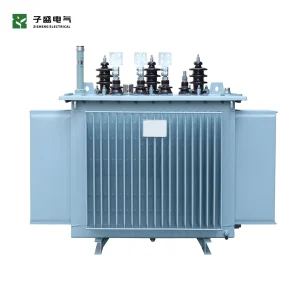
- Oil-immersed transformers
(Fully sealed corrugated tank / traditional conservator tank designs) - Dry-type transformers
(Cast resin / non-encapsulated designs) - Amorphous alloy transformers
(Preferred choice for high-efficiency projects) - Grounding transformers and neutral grounding resistor cabinets
- Package substations
(Integrated with medium and low voltage switchgear)
Technical Capabilities Cover:
Voltage Levels:
- 11kV;
- 13.8kV;
- 33kV;
- Other voltage levels available according to project requirements.
High Temperature Design:
- 50°C / 55°C ambient temperature verification
Corrosion Protection Levels:
- C4 to C5-M according to ISO 12944
Protection Ratings:
- IP54;
- IP55;
- IP65.
Efficiency Levels:
- IE2;
- IE3.
Manufacturing Standards:
- IEC 60076 series
👉 You can also leave your technical questions directly. Our engineering team will review and respond to each inquiry.
About ZISHENG ELECTRICAL
Zisheng are a professional 19+ years manufacturer in producing Oil-Immersed Transformers, Compact Substation, Pad Mounted Transformers, Pole Mounted Transformers and Dry Type Transformers. We own the certificates of ISO/CE/IEC 60076 and TUV Rheinland.
Transformers undergo rigorous FAT and type testing, support voltage/capacity customization. Welcome to consult for Catalog and Product. you can contact us at email [email protected].