مشروع محولات التعدين في غرب إفريقيا: مراحل التحميل، وواجهات المولدات، والخدمات اللوجستية عن بُعد
Zisheng Electric treats a West Africa mining transformer project as a coordinated power-system package rather than a single nameplate selection. Mine expansion stages, large motors, variable-speed drives, generator operation, dust exposure, remote access and the route to site can all influence transformer rating, impedance, cooling, accessories and delivery scope. If these inputs are separated across different procurement documents, the transformer may satisfy one requirement while creating operational or installation problems elsewhere.
This project-planning guide explains the information that owners, EPC contractors and mining electrical teams should align before issuing a transformer purchase order. It does not assume one regional grid voltage, frequency or utility rule. Those items must be confirmed for the specific country, utility connection point and mine license area.
Define the West Africa Mining Transformer Project Duty
The starting point is an operating philosophy. A mine rarely has one steady load. Crushing, grinding, pumping, ventilation, dewatering, conveying and workshop demand can start in stages, cycle with production or remain essential during an outage. Future process trains may be added after the first transformer is energized. The electrical design should therefore describe normal production, start-up, reduced production, maintenance and emergency states.
A connected-load total is not the same as transformer demand. The load list should identify running power, power factor, starting method, duty cycle and simultaneity for each major load. It should also distinguish nonlinear loads, direct-on-line motors, soft starters, variable-frequency drives and UPS systems. These details influence voltage drop, harmonic heating, protection settings and generator compatibility.
| مدخلات المشروع | Information to provide | Transformer decision affected | المخاطر في حالة الإغفال |
|---|---|---|---|
| Operating cases | Normal, start-up, standby, maintenance and expansion load states | Rating, overload margin and redundancy | Oversizing or loss of production capacity |
| المحركات الكبيرة | kW, starting current, start sequence and allowable voltage dip | Impedance and voltage regulation | Failed starts or process trips |
| Nonlinear loads | Drive topology, harmonic study and filters | Thermal design and neutral arrangement | Unexpected heating and nuisance protection |
| Power sources | Utility, generator, solar, storage and transfer philosophy | Vector group, earthing and energization duty | Incompatible protection or unstable transfer |
| بيئة الموقع | Temperature, altitude, dust, humidity, corrosion and flooding | Cooling, enclosure and accessory specification | Derating or accelerated deterioration |
| اللوجستيات | Port, roads, bridges, gradients, cranes and site access | Shipping split, mass and dimensions | Delivery delay or unsafe handling |
Convert the Mine Load List Into Operating Scenarios
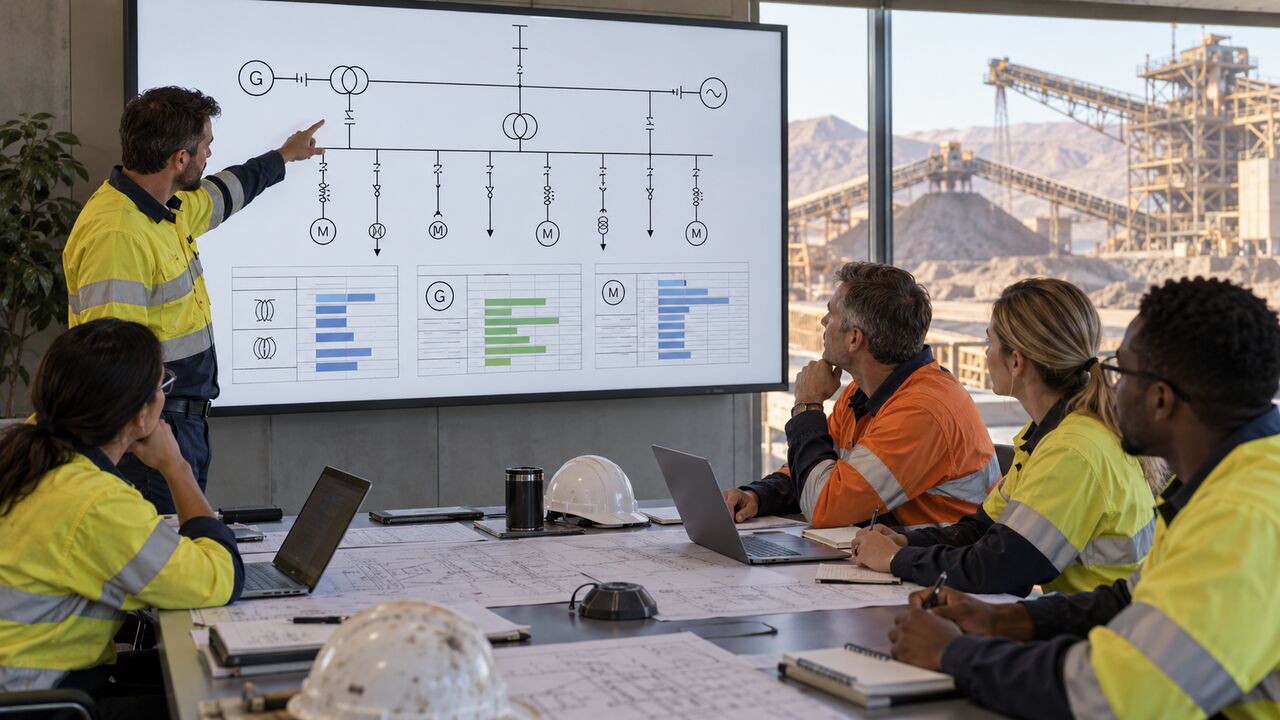
Group loads by process area and electrical bus. For each scenario, calculate expected running demand and identify the largest credible step change. Starting a large crusher motor can be more demanding than the steady production load. Restarting several auxiliaries after an outage may create a different duty again. The sequence should be reflected in the motor-control and plant-control philosophy.
Where production continuity is critical, evaluate the consequence of losing one transformer or one incoming feeder. A two-transformer arrangement may allow maintenance flexibility, but the remaining unit must not be assumed capable of carrying every process load without an approved load-shedding plan. Redundancy claims should be tied to actual operating cases.
For additional regional procurement context, the industrial transformer procurement guide explains why grid, generator and motor interfaces need a common data basis. The principles are relevant across projects, but country-specific requirements still need local confirmation.
Check Motor Starting and Transformer Impedance Together
Transformer impedance affects both fault current and voltage drop. A higher value can help limit short-circuit current but may increase the voltage depression during motor starting. A lower value can improve regulation while raising switchgear duty. The EPC study should evaluate the transformer, upstream source, cables, motors and starting method as one network.
Do not select impedance from a familiar data sheet without checking downstream equipment ratings and process tolerance. The acceptable voltage dip should be defined at the motor and at sensitive control loads. Sequential starting, reduced-voltage starters or variable-frequency drives may reduce the step, but each option changes cost, harmonics and control complexity.
A technical comparison similar to the مراجعة مناقصة المحولات الصناعية helps normalize bidder assumptions. Ask each supplier to state the impedance basis, tolerances, tap position and guaranteed losses used in the proposal.
Coordinate Utility, Generator and Renewable Sources
Some mines operate with a utility supply, others with local generation, and many evaluate hybrid arrangements. The transformer specification should identify every intended source and switching condition. Confirm system voltage and frequency from the utility or approved project source; do not copy values from a neighboring country or previous mine.
Generator operation requires attention to transformer energization, available short-circuit power, neutral earthing, protection coordination and restoration sequence. If solar or battery systems connect to the same network, power-flow direction and voltage-control responsibilities must be defined. The transformer may experience different loading and reactive-power conditions during daytime, night operation and generator islanding.
Example source-interface checklist
Hypothetical checklist — replace with project-approved study results.
- Confirm utility connection voltage, frequency and permitted operating range.
- Record generator ratings, subtransient data and energization sequence.
- Define neutral earthing and earth-fault protection for each source state.
- Identify reverse-power or export conditions from renewable generation.
- Confirm automatic transfer, manual transfer and black-start scenarios.
- State which loads are shed when generation capacity is limited.
Specify Environmental Conditions From Site Data
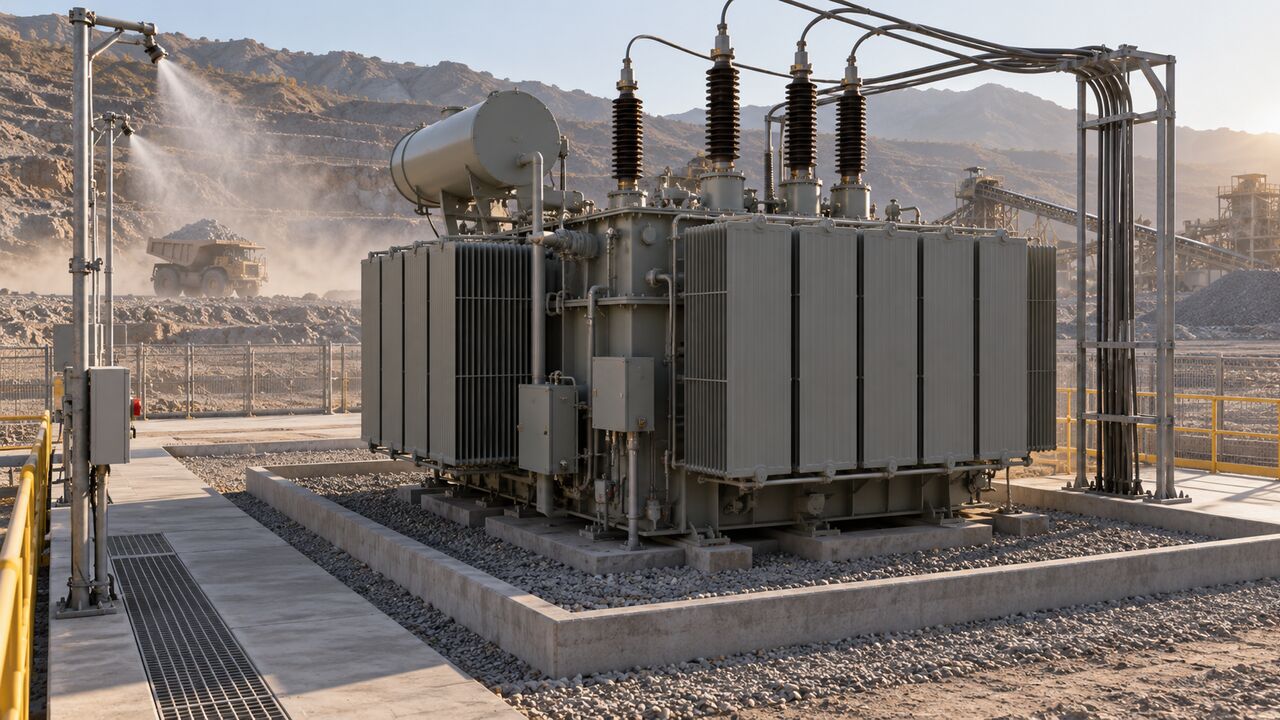
“Tropical” or “mining duty” is not a complete environmental specification. Provide maximum and minimum temperatures, daily temperature profile, altitude, humidity, dust characteristics, rainfall, flood level, lightning exposure and corrosion category where available. Coastal and inland mines can require different materials and maintenance strategies. The site survey should also record airborne process dust and any conductive contamination.
Cooling performance depends on ambient temperature, altitude, airflow and radiator cleanliness. Dust accumulation can reduce heat transfer and restrict fan operation. The layout should provide clearance for cleaning and inspection. Select cabinet protection, breathers, seals, paint system and external hardware according to the documented environment, not a generic regional label.
The transformer yard needs drainage, oil containment, security and safe access during the rainy season. Raised equipment levels may be required where the approved flood assessment identifies a risk. These are civil design decisions, but they affect cable lengths, terminal heights and maintenance access.
Plan Remote-Site Maintenance and Spares
Remote mining operations should define response strategy before selecting accessories. A sophisticated monitor has limited value if communications, calibration support or spare sensors are unavailable. Decide which alarms need local indication, control-room transmission and historical trending. Align protocols, auxiliary voltage and signal lists with the mine control system.
Develop the spare-parts list from failure consequence and lead time. Typical discussions may include cooling fans, temperature devices, gaskets, gauges, relays, oil-treatment connections and special tools, but the final list must match the selected design. Store sensitive items in controlled conditions and maintain identification by transformer serial number and drawing revision.
Integrate Transport Into the Transformer Design

Remote access can govern the equipment envelope. Complete a route survey from the receiving port or inland depot to the foundation. Record bridge capacities, road width, turning radius, gradient, overhead obstacles, culverts, seasonal access and available cranes. The survey should use the packed transport configuration, not only the assembled transformer dimensions.
If accessories ship separately, define preservation, package numbering and the erection sequence. Radiators, bushings and conservator components need protection against moisture, contamination and handling damage. The site should have clean storage areas and the tools required for assembly. A transport shock recorder can provide useful evidence where required by the project, but its acceptance criteria and review responsibility should be agreed before shipment.
Build FAT Around Project Risks
The inspection and test plan should distinguish routine electrical tests, design evidence, accessory functional checks and project-specific inspections. Review the transformer identification, approved drawings, nameplate, wiring, alarms, cooling controls, dimensional interfaces and packing readiness. For motor-intensive networks, guaranteed impedance and losses should be traceable to the bid evaluation.
The owner or EPC witness should receive procedures and drawings early enough to comment. Hold points, witness points, notice periods and report formats belong in the purchase order. A failed item should follow an agreed nonconformance process rather than being deferred informally to site.
Depending on the approved rating, relevant product options may include a محول طاقة مغمور بالزيت بقدرة 10 ميجا فولت أمبير، 33/11 كيلو فولت, ، أ 66kV three-phase power transformer, or a 400kVA oil-immersed transformer for smaller auxiliary loads. Final selection must follow the project load flow, fault study and utility requirements.
Procurement Package for a West Africa Mining Transformer Project
A complete enquiry should include the single-line diagram, transformer data sheet, load list, motor schedule, operating cases, short-circuit study basis, harmonic information, protection philosophy, utility data, generator data, site conditions, layout, route survey, inspection plan and required documentation. State the preferred shipping split, spare-parts philosophy and site-support scope.
The technical bid tabulation should show deviations openly. Compare rating, impedance, losses, temperature-rise basis, vector group, tap range, cooling, dimensions, mass, accessories, monitoring, tests, documentation and delivery assumptions on the same basis. Commercial comparison without normalization can hide major scope gaps.
Prepare Commissioning and the First Production Ramp
Commissioning should verify more than insulation and protection checks. Confirm phase sequence, tap position, neutral connection, cooling controls, alarm signals, SCADA points, earthing, oil levels and mechanical assembly. Record source voltage before energization and compare secondary voltage under representative load. Any difference from the study basis should be reviewed before large motors are started.
The first production ramp is an opportunity to validate the design assumptions. Start major loads in the approved sequence and monitor bus voltage, transformer current, temperature indications and protection events. Where variable-frequency drives or harmonic filters are involved, confirm their operating configuration rather than assuming the commissioned state matches the study. A staged ramp allows the team to identify a weak interface before the full process is dependent on the transformer.
Commissioning records should identify the actual tap position, protection settings, cooling mode, ambient condition, energized auxiliary circuits and load at every observation point. That operating context turns measurements into evidence. A temperature or voltage reading alone cannot show whether the transformer, the motor-starting sequence or a temporary generation arrangement caused a deviation. The owner should also confirm how alarms and trips reach the plant control system, who is authorized to change settings, and which critical spare components are on site before production becomes dependent on the transformer.
Handover documents should include final settings, test reports, as-built drawings, accessory manuals, spare-parts records and baseline operating data. Assign responsibilities for oil sampling, cooling-system inspection and alarm response. Remote technical support is most effective when the site can provide consistent records, photographs and event data. These steps turn procurement evidence into an operating maintenance baseline.
Plan the first planned outage before commercial operation. Identify inspections that require de-energization, safe access to cable boxes, torque verification points and spare materials. Confirm how production will be maintained while the transformer is unavailable. A practical outage plan tests whether the selected redundancy and spare-parts strategy can actually support the mine, rather than existing only as statements in the tender.
Request a Mining Transformer Project Review
A successful West Africa mining transformer project connects the process load profile with electrical studies, environmental design, logistics, FAT and remote maintenance. Zisheng Electric can review oil-immersed power transformers and distribution transformers against the approved project interfaces without assuming unverified local conditions.
Send the drawings, data sheets, load list, technical specification, single-line diagram, grid parameters, generator data, environmental conditions and installation-site information. “Our engineering team will review the requirements and respond to project inquiries within 24 hours.”
عن شركة ZISHENG ELECTRICAL
زيشينغ هي شركة متخصصة ذات خبرة تمتد لأكثر من 19 عاماً في التصنيع والإنتاج المحوّلات المغمورة بالزيت, المحطات الفرعية المدمجة, المحوّلات المركبة على القواعد, المحوّلات المثبتة على الأعمدة و المحوّلات الجافة. نحن نمتلك شهادات ISO/CE/IEC 60076 وTUV Rheinland.
تخضع المحولات لاختبارات FAT واختبار المواصفات النوعية بشكل صارم، وتدعم تخصيص الجهد/السعة. نرحب باستشارتكم بشأن كتالوج و المنتج. يمكنك الاتصال بنا عبر البريد الإلكتروني [email protected].