Transformer Low-Load Operation for Seasonal Plants in South America
Transformer low-load operation can shape the lifetime cost of a seasonal processing plant even when the harvest peak determines its nameplate rating. Zisheng Electric helps procurement teams separate those two decisions: the transformer must support production and credible contingencies, while its energized hours and operating configuration determine what happens during the long periods between campaigns.
For an agroindustrial plant in South America, a single annual average can conceal months of concentrated production, cleaning and maintenance, followed by a small but essential standby demand. Refrigeration, security, communications, drainage and fire-system auxiliaries may remain necessary when conveyors stop. The engineering question is which transformers must remain energized to supply those loads reliably, and what evidence supports changing that arrangement.
Start with an operating calendar, not an average percentage
Divide the year into meaningful plant states. A useful schedule distinguishes full production, partial processing, cleaning, maintenance, storage and shutdown. Assign hours and measured or forecast apparent power to each state. Identify which loads are essential and which can be disconnected under an approved operating procedure.
Check whether the calendar adds up to the period being evaluated. Overlapping production and maintenance entries can double-count energy, while an omitted standby period can make a low-loss offer appear less valuable than it is. Use a consistent treatment of leap years and planned outages; the calculation period should be explicit rather than hidden in a spreadsheet formula.
Annual energy consumption divided by operating hours does not describe peak current or the distribution of load. Nor does average kW directly give transformer loading in kVA. Include power factor and the relevant current measurements. Where drives or other nonlinear equipment are significant, a simple sinusoidal-load estimate requires additional review of harmonic heating and the supplier’s loss assumptions.
Separate seasonal demand from the utility connection
The site may reduce production without changing its utility supply arrangement. Confirm metering location, supply ownership, operating permissions and the consequences of isolating a transformer. A plant-owned breaker is not necessarily available for unrestricted switching under the connection agreement or the owner’s safety rules.
South America is not one electrical system or one climate. Obtain the actual point-of-connection voltage, frequency, permitted variation, earthing arrangement and utility interface requirements for the specific project. This article assumes none of those values from a country name. The project team should retain the utility’s written data as a controlled design input.

A practical model for transformer low-load operation
For an initial comparison, divide transformer losses into no-load losses while energized and load-related losses. A screening expression is P approximately equals P0 plus Pk times k squared, where P0 is the specified no-load loss, Pk is the load loss at its stated reference condition, and k is the loading fraction under a consistent electrical basis.
This approximation is useful for comparing operating states, but it is not a complete thermal model. Actual losses depend on voltage, frequency, temperature, current waveform and the offered design. Cooling auxiliaries and other station consumption must be added when applicable. The US Department of Energy distribution-transformer technical support document provides background on no-load and load losses; it is cited for the technical principle, not as a claim about current South American regulations.
For each state, multiply estimated loss power by the hours in that state. Sum the results to obtain the estimated transformer loss energy over the chosen period. Keep purchased energy supplied to production equipment separate from transformer losses. Combining them in one total without explanation makes it difficult to see what the equipment selection actually changes.
Use guaranteed data on a comparable basis
Request the offered transformer’s guaranteed no-load loss and load loss, their reference conditions and the applicable test basis. Do not compare one supplier’s guaranteed value with another supplier’s illustrative brochure value. Confirm that rating, voltage ratio, tapping basis and other relevant conditions are aligned before treating the difference as an economic advantage.
Loss tolerances and contractual treatment also matter. The purchaser should state how guaranteed values, measured factory results and any contractual adjustment will be handled. A calculation based on optimistic nominal figures can produce a precise-looking answer with a weak procurement basis.
Worked comparison: one unit or two energized units
Consider a hypothetical plant with two identical transformers. Each has an illustrative no-load loss of 2 kW and rated-load loss of 12 kW. During an offseason state lasting 4,000 hours, total demand equals 20 percent of one unit’s rating. These numbers are calculation inputs only, not product guarantees, utility data or results from a customer installation.
With one unit supplying that demand, the estimated loss is 2 + 12 × 0.20² = 2.48 kW. With both units energized and sharing equally, each carries 10 percent load, giving a combined estimate of 2 × (2 + 12 × 0.10²) = 4.24 kW. The difference is 1.76 kW, or 7,040 kWh over the illustrative 4,000-hour state.
| Operating state | Energized units | Load fraction per unit | Estimated combined loss | Main engineering question |
|---|---|---|---|---|
| Offseason, one unit supplies demand | 1 | 0.20 | 2.48 kW | Can essential loads tolerate the transfer and contingency arrangement? |
| Offseason, equal sharing | 2 | 0.10 | 4.24 kW | Does immediate redundancy justify the additional energized loss? |
| Illustrative higher demand, one unit | 1 | 0.80 | 9.68 kW | Are rating, starting and thermal constraints satisfied? |
| Same higher demand, equal sharing | 2 | 0.40 | 7.84 kW | Is parallel operation permitted and technically compatible? |
At the higher illustrative demand, two energized units have lower estimated combined losses because the reduction in load-related loss outweighs the second unit’s no-load loss. The preferred state therefore cannot be selected by a rule such as “always run one transformer.” Evaluate the actual load distribution and the full operating constraints.
Under the simplifying assumptions above, the two estimates become equal when total loading, expressed relative to one unit’s rating, equals the square root of 2P0/Pk. That is a screening crossover, not an automatic switching setpoint. Unequal transformers, unequal load sharing, cooling stages, tariffs and reliability requirements change the decision.
Keep continuity of supply in the economic comparison
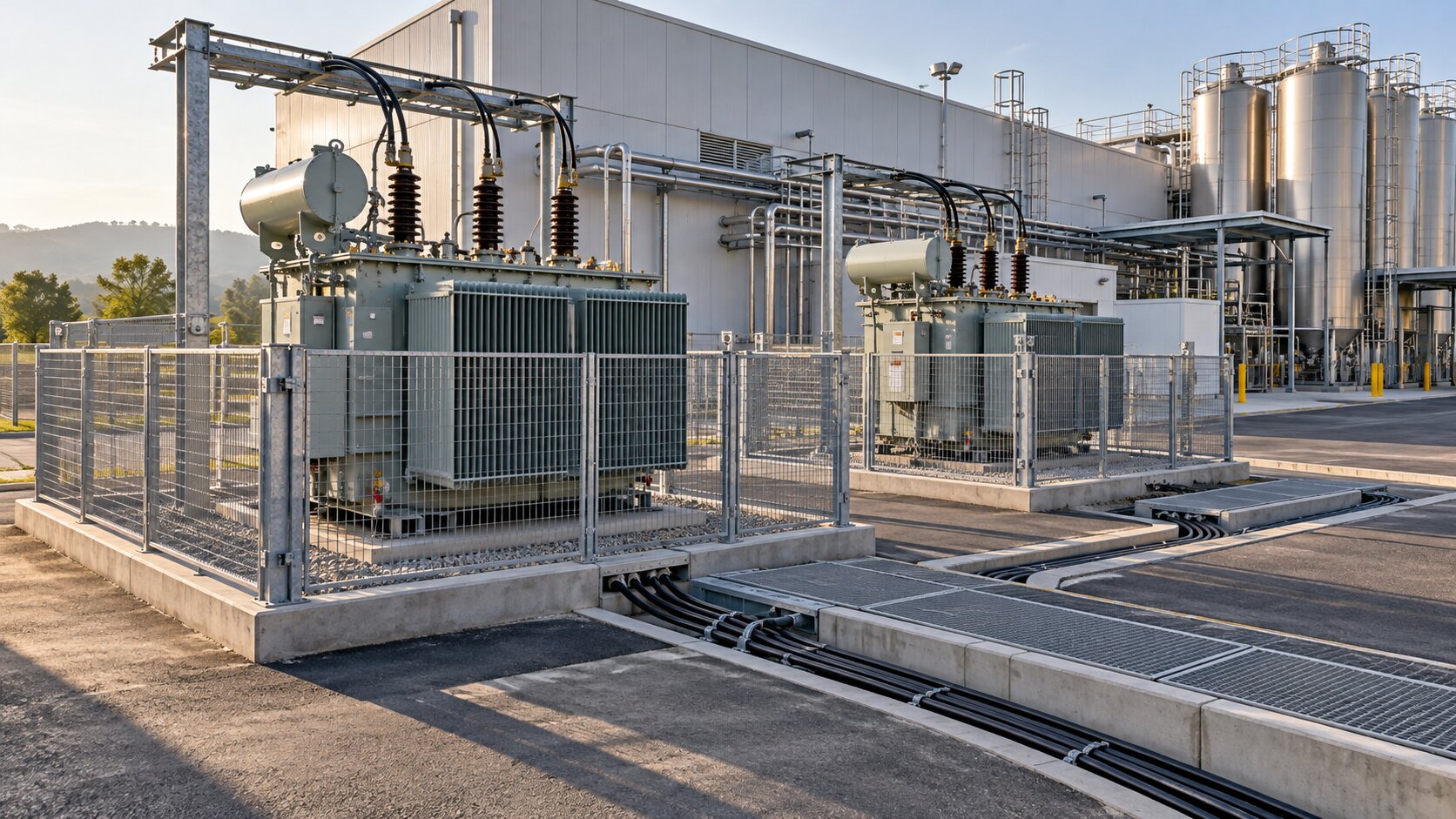
An unenergized spare is not the same as immediately available redundancy. Identify the time and actions required to restore supply after the operating unit becomes unavailable. Include switching authorization, interlocks, protection settings, operator availability and the ability of essential loads to tolerate the interruption.
Cold storage, control systems and process preservation may have very different interruption limits. A small essential load can carry a large consequence. The loss-energy saving should be compared with the plant’s continuity requirement, rather than used to redefine that requirement after equipment is purchased.
Where a bus coupler or transfer scheme is proposed, distinguish open-transition transfer from parallel operation. Check transformer compatibility and protection coordination for every permitted configuration. No operating instruction should create an unintended utility backfeed or a parallel path that the approved design does not allow.
Avoid frequent switching based on a narrow energy margin
The crossover calculation does not justify changing state whenever demand moves slightly above or below a line. Switching has operating and maintenance implications. Use the owner’s approved philosophy to define stable seasonal states, responsibility and restoration arrangements. Evaluate the consequences of energization and restarting connected loads before accepting a proposed schedule.
If the forecast savings are small compared with uncertainty in the load calendar or loss data, further measurement may be more valuable than additional switching complexity. Present that uncertainty honestly. A range of plausible annual outcomes is often more useful to an EPC purchaser than one unexplained payback figure.
Match the South American site conditions to each state
Offseason does not necessarily mean mild weather. The plant may face its wettest period while production is reduced, or dusty maintenance activity while equipment remains energized. Confirm the site’s temperature profile, altitude, humidity, salt exposure where relevant, drainage and dust conditions. Tie each input to cooling, insulation coordination, enclosure protection and maintenance access.
محولنا tropical transformer cooling guide explains how ambient conditions, airflow and auxiliary availability affect the cooling review. For a seasonal plant, use that information to check both the harvest peak and the standby configuration. A reduced electrical load does not eliminate corrosion, condensation or blocked-airflow concerns.
Transport and installation constraints also influence the choice between one larger unit and multiple smaller units. Check route limits, lifting access, foundation space, cable routes and replacement logistics with actual project data. A theoretically efficient arrangement may be difficult to maintain if the site cannot remove a unit without interrupting the remaining supply.
For the broader process-load specification, see our Brazil sugar mill transformer guide. The present calculation should remain a separate operating-state study, linked to that specification rather than replacing motor-starting, cogeneration or peak-duty assessments.
Verify the peak before accepting the offseason benefit
The transformer still has to support its agreed production duty. Check maximum demand, major motor starts, load steps, voltage performance, harmonic content and credible contingencies. A design selected mainly to reduce no-load loss must not leave the plant unable to restart production or operate through an approved contingency.
IEC 60076-7:2018 addresses loading of mineral-oil-immersed power transformers in relation to temperature and thermal ageing. Use the applicable manufacturer-supported assessment where cyclic or emergency loading is proposed. Do not transfer its scope automatically to dry-type or alternative-liquid equipment, and do not treat a low annual average as permission to exceed an instantaneous or thermal limit.
The operating study should state what happens when a cooling stage, transformer or auxiliary supply is unavailable. Record any load restriction and the time basis for it. The procurement team can then compare offers with the same service requirement rather than comparing differently constrained ratings.

Measure the first campaign and revise the forecast
Plan metering so the owner can distinguish plant demand from the contribution of each transformer and operating state. Record timestamps, energized status, relevant voltage and current data, major production changes and cooling operation. Confirm instrument ratios and data quality before interpreting the trend.
During commissioning, verify the approved transfer logic, indications and interlocks using the agreed test method. During the first production campaign and subsequent standby period, compare measured demand with the forecast. If the seasonal schedule changes, revise the loss-energy estimate and the operating-state review together.
Avoid attributing every change in the utility bill to transformer efficiency. Production volume, refrigeration duty, tariff changes and other plant equipment can dominate the total. A useful acceptance record distinguishes factory-verified transformer losses from estimated annual savings and later site measurements.
Put the operating assumptions into the enquiry
Ask bidders to return a comparable schedule of rating, guaranteed losses, cooling auxiliaries, permitted operating configurations and maintenance requirements. Include the expected hours in each load state and identify uncertain inputs. Request sensitivity cases for a shorter campaign or a longer standby period where those outcomes are credible.
Spare-parts and service planning should follow the selected arrangement. Define access to compatible protection components, cooling auxiliaries and service support, together with the practical replacement strategy. The presence of two units does not remove a common limitation in switching equipment, auxiliary supplies or site access.
Zisheng Electric can review the duty for 400 kVA oil-immersed transformers و 35 kV–46 kV power transformers where those product families fit the confirmed project requirements. Final selection depends on the actual voltage, rating, environment and operating study.
Transformer low-load operation is most useful as a documented choice among technically acceptable states. Send Zisheng Electric your single-line diagram, load calendar, interval demand data, essential-load list, transformer data sheets, technical specifications, utility parameters, site conditions and installation drawings. Our engineering team will review the requirements and respond to project inquiries within 24 hours.
عن شركة ZISHENG ELECTRICAL
زيشينغ هي شركة متخصصة ذات خبرة تمتد لأكثر من 19 عاماً في التصنيع والإنتاج المحوّلات المغمورة بالزيت, المحطات الفرعية المدمجة, المحوّلات المركبة على القواعد, المحوّلات المثبتة على الأعمدة و المحوّلات الجافة. نحن نمتلك شهادات ISO/CE/IEC 60076 وTUV Rheinland.
تخضع المحولات لاختبارات FAT واختبار المواصفات النوعية بشكل صارم، وتدعم تخصيص الجهد/السعة. نرحب باستشارتكم بشأن كتالوج و المنتج. يمكنك الاتصال بنا عبر البريد الإلكتروني [email protected].