Transformer for Coastal West Africa: Corrosion, Humidity and Cooling Specification
A transformer installed near a tropical coastline faces a combination of salt-bearing moisture, high humidity, solar heating, wind-driven rain and difficult maintenance access. The correct response is not to add a coastal label to a standard data sheet. Zisheng Electric approaches a transformer for coastal West Africa by converting the actual site exposure into decisions on enclosure sealing, coating, hardware, insulation, cooling, auxiliaries and inspection.
West Africa covers many climates, grid arrangements and utility practices. This guide therefore does not assume one national voltage, frequency or approval route. Those values must be confirmed for the project location and connecting utility. The engineering focus is the coastal exposure that procurement teams can define and verify before manufacture.
Define the Coastal Site Before Selecting the Transformer
Distance from the shoreline alone does not define corrosion severity. Wind direction, surf, elevation, industrial emissions, rainfall, building ventilation and cleaning practices influence the amount of salt and moisture reaching the equipment. A transformer behind a wall may still receive airborne chlorides, while equipment farther inland can be exposed by strong seasonal winds. Procurement documents should provide an environmental description rather than a vague “marine duty” note.
The site schedule should state maximum and minimum ambient temperatures, daily temperature range, relative humidity, altitude, rainfall exposure, flood level, solar radiation basis, pollution category used for insulation selection and whether the transformer is indoors or outdoors. If a coastal substation is inside a building, the room ventilation design and the possibility of condensation during shutdown are as important as the external climate.
Operating data is equally important. Provide expected continuous loading, peak duration, harmonic-producing loads, motor starting duty, planned overload philosophy and the availability of standby capacity. Harmonics increase winding and stray losses; frequent load cycles change the thermal pattern; long periods at light load can leave cabinet heaters and ventilation arrangements as the main protection against moisture. These conditions must be reflected in the transformer loss evaluation and thermal review rather than handled as generic site notes. The related guide to transformer voltage regulation for African industrial plants shows how tap range, impedance and motor starting also enter the review.
| Site input | Engineering decision | What procurement should request | Risk if unspecified |
|---|---|---|---|
| Salt and industrial pollution exposure | Coating system, materials and insulator creepage | Declared corrosion category/design basis and coating schedule | Early rusting, tracking or flashover risk |
| Temperature and solar load | Thermal rating and cooling margin | Temperature basis, loading profile and temperature-rise guarantees | Accelerated insulation ageing or loss of usable capacity |
| Humidity and condensation | Cabinet sealing, heaters, ventilation and drains | Enclosure protection, heater controls and anti-condensation details | Terminal corrosion, insulation leakage and control faults |
| Rain, drainage and flood level | Plinth height, cable entry and foundation drainage | GA drawing coordinated with civil levels and trench details | Water ingress, submerged glands or inaccessible equipment |
| Maintenance capability | Finish repair, spares and inspection intervals | Touch-up procedure, spare seals, heaters and consumables | Small coating damage develops into structural corrosion |
Corrosion Protection for a Transformer for Coastal West Africa
The coating specification should describe surface preparation, primer, intermediate and finish coats, nominal dry-film thickness, colour and repair procedure. Naming only a paint colour gives no evidence of durability. The manufacturer should control surface cleanliness and environmental conditions during application, then record thickness and visual inspection results. Edge coverage, welds, lifting lugs, radiator connections and bolted interfaces deserve particular attention because water and salt can accumulate there.
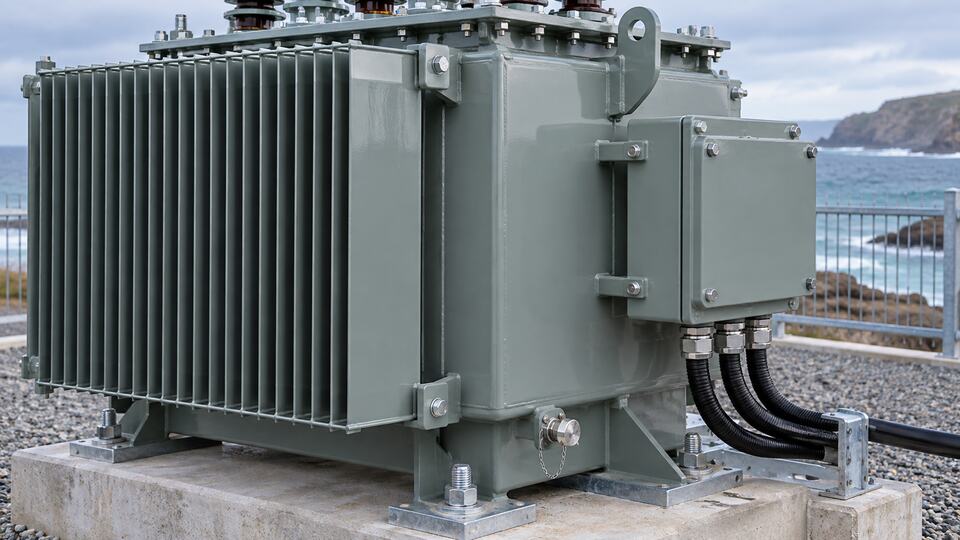
Fasteners, hinges, latches and gland plates must be selected as a system. A stainless component is not automatically compatible with every coated carbon-steel surface; galvanic couples and damaged coatings can concentrate corrosion. The specification should identify materials or protective finishes for exposed hardware and require isolation measures where dissimilar metals meet.
Quality control should continue after painting. Inspectors should check for thin film at sharp edges, pinholes, runs, damaged bolt holes and uncoated contact areas. The acceptance record should identify calibrated thickness instruments and the locations measured. If a coating is damaged during radiator assembly or final wiring, repair must follow the approved preparation and curing process. A quick cosmetic topcoat over salt or oil contamination can hide the defect while leaving the corrosion mechanism in place.
Removable radiators and valves create additional interfaces. Gaskets must suit transformer oil, temperature and expected service life. Flange faces should be protected during transport, and assembly instructions should define bolt tightening and leak checks. Drain and sampling valves should remain accessible after bund walls, fences and cable routes are installed.
Insulation and External Clearances
Salt deposits on bushings reduce surface insulation performance when they become wet. The required creepage distance and insulator profile should be based on the approved pollution assessment and applicable standard, not copied from an inland project. The EPC team should also verify phase-to-phase and phase-to-earth clearances against the project insulation coordination.
Porcelain and composite insulators have different handling, cleaning and ageing considerations. The selection should account for utility practice, mechanical loads, contamination, maintenance methods and availability of replacements. Bushing terminal connectors need compatible materials, controlled contact pressure and protection against water traps.
The cable box or termination enclosure must match the actual cable system. Confirm conductor material, number of parallel cables, termination type, stress-control space, gland diameter, bending radius and earthing arrangement. A sealed box can still trap humidity introduced during installation, so commissioning procedures should include dryness and condensation checks before energization.
Surge arresters, if included in the package or installed nearby, require the same interface discipline. Their rated voltage and protective characteristics come from the insulation coordination study, while mounting height, lead length, earth connection and clearances come from the physical design. Long or poorly routed leads can reduce the benefit of a correctly selected arrester. The final layout should therefore show arresters, transformer terminals and the shortest practical earth path together.
Thermal Design in Humid Coastal Conditions
High humidity does not directly increase winding temperature in the same way as high ambient temperature, but it affects corrosion, condensation and the performance of auxiliary equipment. The thermal calculation must use the specified ambient profile, solar exposure and loading cycle. A coastal plant with cyclic process loads may require a different margin from a continuously loaded distribution transformer.
Radiator arrangement should preserve natural airflow and maintenance access. Walls, acoustic barriers, adjacent transformers and future extensions can recirculate hot air. If fans are used, confirm supply voltage, redundancy, staging logic, ingress protection and alarm contacts. Fan motors and terminal boxes should be suitable for the same environment as the transformer, not an unspecified general-purpose duty.
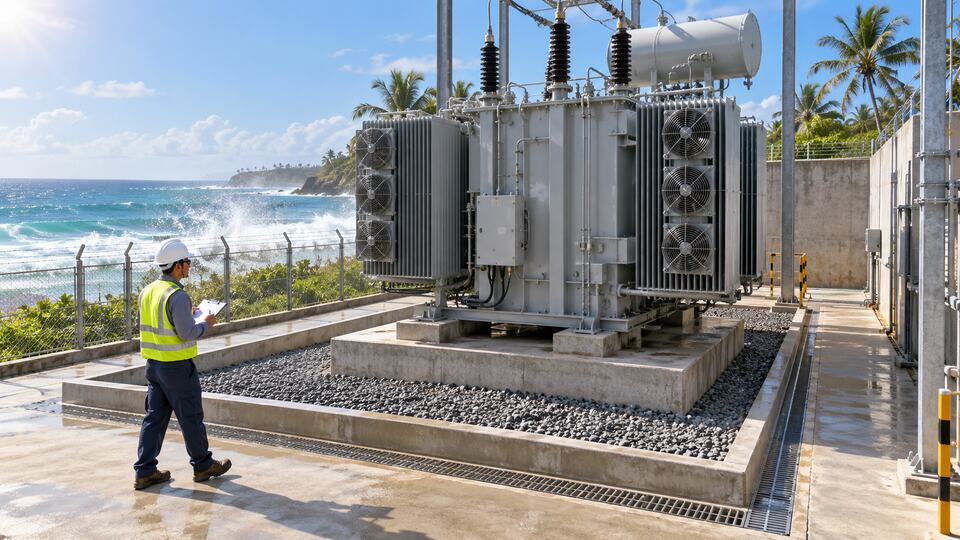
Civil and electrical layouts must be reviewed together. The transformer should not sit in a low point where water collects. Cable trenches need drainage or sealing appropriate to the site, and the foundation should place valves and cabinets above the design flood level. Fire separation, oil containment and access routes remain project-specific requirements and should be coordinated with the applicable authority.
Preventing Condensation in Marshalling Cabinets
Marshalling kiosks, tap-changer drive boxes and cooler control panels are common weak points in humid service. When a cabinet cools below the dew point, moisture can form on terminals and electronic devices. A higher enclosure rating helps prevent direct ingress but does not eliminate condensation from air already inside.
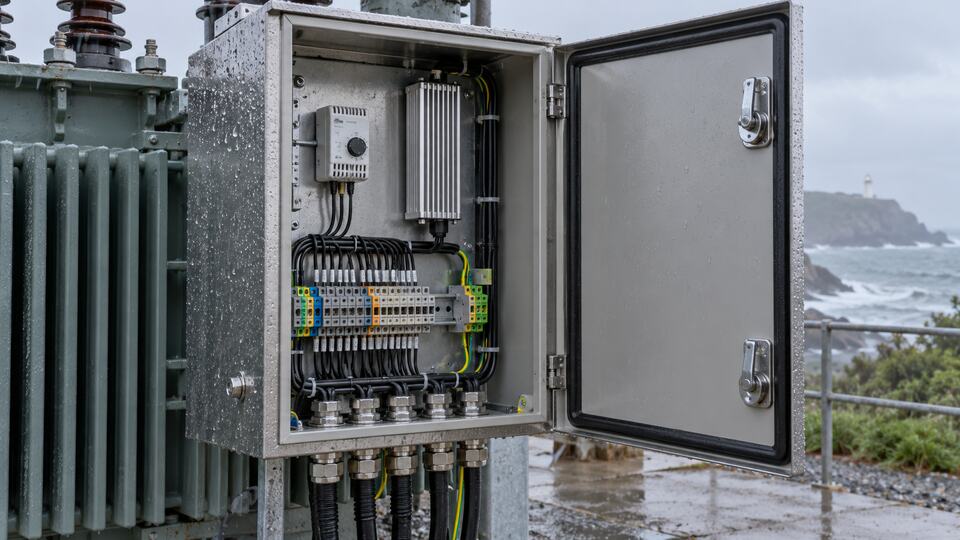
Specify a controlled anti-condensation arrangement: correctly sized space heaters, thermostat or hygrostat control where required, durable door gaskets, downward-facing or sealed cable entry, drains or breathers approved for the enclosure concept, and terminal materials resistant to the environment. Heater circuits should be energized during storage and installation when the site procedure requires them. The EPC temporary-power plan must therefore include auxiliary supplies before the transformer is commissioned.
Terminal blocks should be accessible without removing major devices. Spare terminals and cable-entry space should match the I/O schedule. The FAT should simulate heater, fan and alarm functions, but site commissioning must also confirm gland sealing, cable dressing and insulation after field cabling.
Transport, Storage and Installation Controls
Coastal projects can involve port handling, unpaved routes and extended outdoor storage. The logistics plan should confirm shipping mass and dimensions, lifting points, centre of gravity, accessory packing, impact monitoring if specified, oil level during transport and preservation requirements. Transport covers must not trap water against coated surfaces. The West Africa mining transformer project guide provides additional questions for remote transport and generator interfaces.
On arrival, inspect the tank, radiators, bushings, cabinets and crates before removing evidence of shipping damage. Record coating chips and repair them with the approved system. Check desiccant condition, pressure or sealing indicators, accessory identification and impact records. If storage will be prolonged, the supplier’s preservation instructions should define heater supply, inspection frequency, oil or gas condition and rotation of auxiliary motors where applicable.
Installation teams should avoid creating new corrosion paths. Cutting or welding on coated steel requires controlled repair. Cable supports and identification plates should use approved materials, and field holes should be sealed. After assembly, verify that drain paths remain open and that no packing material blocks radiator airflow. A final freshwater cleaning procedure may be appropriate after exposure to salt during transport, but the method must be compatible with the transformer, bushings, cabinets and coatings.
Illustrative receiving checklist
- Compare nameplate, packing list and approved drawings.
- Photograph all sides before unloading and after placement.
- Inspect coating at lifting lugs, corners, flanges and tie-down points.
- Confirm cabinet doors, gaskets, glands and heaters are undamaged.
- Check radiators, valves and blanking plates for leakage or deformation.
- Verify bushings and terminals are dry, clean and correctly packed.
- Record storage conditions and energize preservation heaters as instructed.
FAT and Documentation for Coastal Service
The transformer FAT should follow the approved inspection and test plan and applicable project standard. For coastal duty, add verifiable construction checks: coating records, dry-film thickness reports, enclosure inspection, gasket and gland review, heater and thermostat operation, fan staging, alarm contacts and material certificates where required. Routine transformer electrical tests do not replace these environmental checks. For the cooling review, compare the approved arrangement with the practical checks in tropical mining transformer cooling.
Documentation should include the final data sheet, general arrangement, foundation loads, cable box drawing, terminal diagram, coating specification, nameplate, packing list, preservation instruction, installation manual, recommended spares and test reports. Any deviation accepted during manufacture should appear in the final record so the commissioning team does not work from obsolete information.
Procurement Questions to Close Before Award
- What measured or specified coastal pollution and corrosion basis applies at the site?
- Which ambient temperature, solar exposure, altitude and loading profile govern the rating?
- What coating system and exposed hardware materials are included?
- What bushing creepage and external clearances have been selected?
- How are cabinets protected against both direct ingress and internal condensation?
- Are radiator airflow, civil drainage and maintenance clearances coordinated?
- What preservation steps apply during port handling and prolonged site storage?
- Which environmental construction records are included in the FAT dossier?
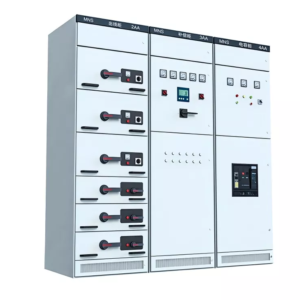
For a reliable transformer for coastal West Africa, Zisheng Electric can review 132–138 kV power transformers, three-phase oil-immersed power transformers and medium-voltage switchgear against the actual site and utility interface. Provide the single-line diagram, transformer data sheet, load list, technical specification, grid voltage and frequency, environmental report, civil layout, cable schedule and installation conditions. Our engineering team will review the requirements and respond to project inquiries within 24 hours.
About ZISHENG ELECTRICAL
Zisheng are a professional 19+ years manufacturer in producing Oil-Immersed Transformers, Compact Substation, Pad Mounted Transformers, Pole Mounted Transformers and Dry Type Transformers. We own the certificates of ISO/CE/IEC 60076 and TUV Rheinland.
Transformers undergo rigorous FAT and type testing, support voltage/capacity customization. Welcome to consult for Catalog and Product. you can contact us at email [email protected].