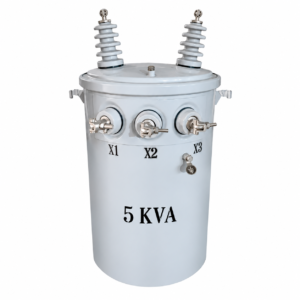
Thông số kỹ thuật về tiếng ồn của máy biến áp cho các dự án đô thị tại Trung Đông
A useful transformer noise specification starts with the people and spaces that need protection. Zisheng Electric can review transformer construction and cooling arrangements against a purchaser’s acoustic brief, but a catalogue sound figure alone cannot establish whether a neighboring apartment, hotel room or office will remain acceptable. For an urban Middle East project, the transformer, its ventilation openings and the surrounding building need to be assessed together.
This guide is for EPC engineers and procurement teams comparing acoustic offers before room layouts are fixed. It separates the manufacturer’s equipment guarantee from the consultant’s site prediction and the owner’s acceptance test. No universal regional noise limit is assumed: the applicable authority, land use, measurement location and assessment period must be confirmed for the actual project.
Start the transformer noise specification at the receiver
Mark the nearest noise-sensitive locations on the general arrangement. A property boundary is one receiver; an upper-floor bedroom facing a ventilation grille is another. The shortest plan distance may not describe the most exposed location. Elevated windows, reflective courtyards and building openings can change the path between the source and the listener.
Define when the requirement applies
Identify normal daytime service, quiet overnight operation and any permitted contingency condition. An installation may run at modest load at night while the transformer remains energized. Procurement should therefore avoid treating low load as an assurance of low sound. Ask the acoustic consultant to identify the relevant operating cases and whether additional assessment of tonal characteristics is required.
Allocate responsibility for confirming the local criterion. Record its source, revision, receiver height and time period in the project acoustic schedule. A tender statement saying only “comply with local regulations” leaves bidders pricing different obligations. Where the criterion is still pending, mark it as an open design input and keep acoustic approval as a hold point.
Separate sound power, sound pressure and site acceptance
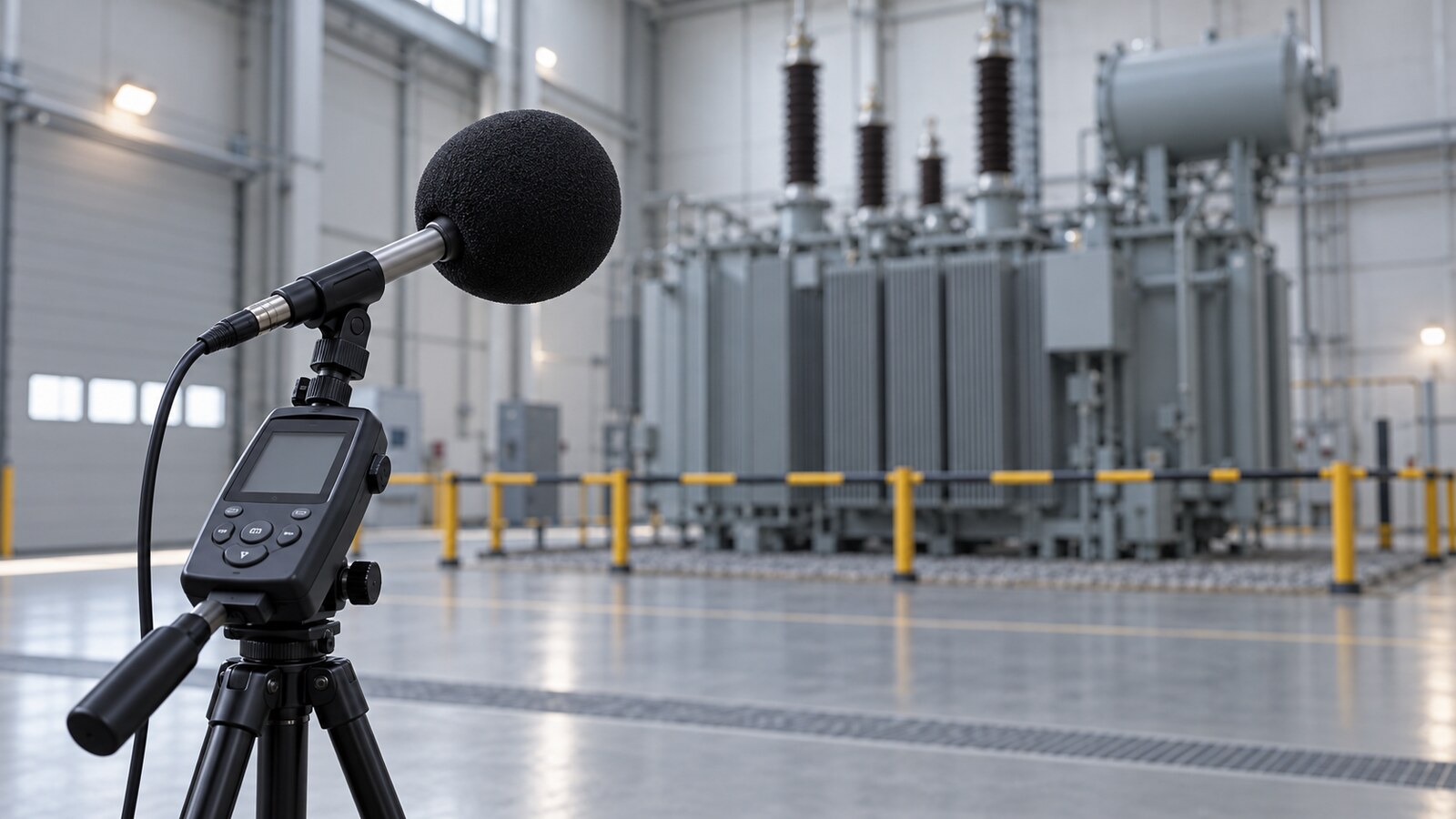
Sound power describes the acoustic output of a source under stated conditions. Sound pressure describes the sound at a measurement position and depends on the surrounding space. Both may be expressed in decibels, but they are not interchangeable guarantees. A bid with a sound-pressure value at an unspecified distance cannot be fairly compared with a bid giving a measured sound-power value.
IEC 60076-10:2016 describes measurement methods used to determine transformer and associated cooling-device sound power from sound-pressure or sound-intensity measurements. Its published scope primarily concerns factory measurements. Reference the agreed edition and test conditions in the purchase order; do not present a factory result as a prediction of an occupied room.
The GSO catalogue entry for GSO IEC 60076-10:2022 provides a relevant regional standards reference. A catalogue listing does not, by itself, establish the legal limit or mandatory contractual edition for every Gulf project. The purchaser still needs the applicable project and authority requirements.
Ask for frequency information when the receiver is sensitive
A single overall weighted value is convenient for a bid summary, but it can conceal differences that matter to an acoustic enclosure or building partition. Request the frequency-band information needed by the acoustic designer. The designer should identify the required bands and operating conditions rather than asking the supplier for an undefined “noise spectrum.”
A bid comparison table that exposes missing assumptions
| Procurement item | Chứng cứ cần yêu cầu | Decision it supports |
|---|---|---|
| Guaranteed quantity | Sound-power or sound-pressure designation, weighting and units | Reject comparisons between unlike acoustic quantities |
| Electrical operating condition | Applied voltage, frequency, tap position and stated load condition | Check that the guarantee covers the specified duty |
| Cooling condition | Natural cooling and each required fan or pump operating state | Identify the governing overnight or contingency case |
| Measurement arrangement | Agreed method, measurement surface or positions, background treatment and uncertainty reporting | Make the factory result reproducible and auditable |
| Building interface | Room layout, louver positions, barriers and adjacent sensitive spaces | Give the acoustic consultant usable source and path inputs |
| Acceptance responsibility | Separate factory guarantee and site receiver criteria | Prevent a dispute over which party owns building attenuation |
Use this table before comparing prices. A more expensive low-sound offer may remove the need for a large attenuator; alternatively, a layout change may be more effective than tightening the equipment guarantee. Compare the total installed solution, including civil space, ventilation energy, access and verification costs.
Include cooling operation in the acoustic duty
Core-related sound, load-related sound and cooling auxiliaries do not follow the same operating pattern. The enquiry should identify which sources are included in each guarantee. If fans are supplied by another contractor, their acoustic contribution still belongs in the overall plant assessment. An equipment package boundary is not an acoustic boundary.
Coordinate the hot-weather case
For a site whose confirmed ambient and load profile require forced cooling, a fan-off guarantee may not describe the controlling condition. Obtain the actual project temperature basis, transformer losses and ventilation design. Do not assign a single temperature to the whole Middle East: inland, coastal, enclosed and conditioned installations have different design inputs.
Ask the supplier to describe fan staging and the conditions that call for additional cooling. The controls should protect thermal performance first. Quiet-mode operation is only acceptable where the manufacturer has confirmed the corresponding permissible duty and the owner can enforce it. Silencing a fan alarm or preventing required cooling is not an acoustic remedy.
Treat the room and ventilation openings as part of the design
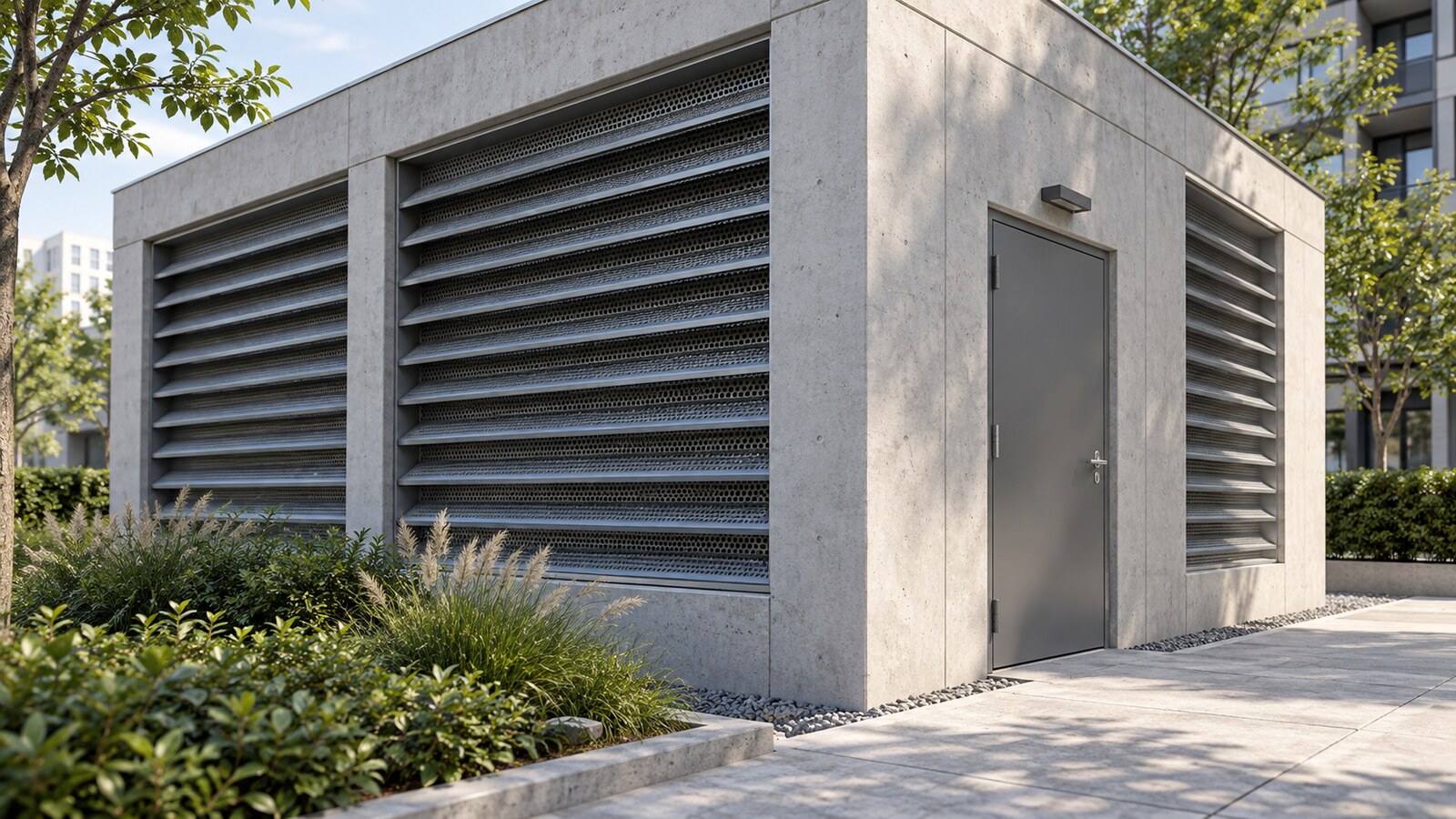
A room can shield surrounding spaces, but doors, louvers, cable penetrations and roof openings create transmission paths. Closing those paths without checking ventilation can increase transformer temperature. The civil, mechanical and electrical teams should review one coordinated arrangement showing airflow, acoustic treatment and equipment removal access.
Deep acoustic louvers and duct attenuators introduce resistance to airflow. Require the mechanical designer to check the selected component against the ventilation duty, available pressure and maintenance condition. A brochure attenuation figure is insufficient if the installed opening area or airflow differs from the tested arrangement.
Our guide to dry-type transformer installation requirements explains the wider room and ventilation interfaces. Use it alongside the acoustic brief, especially where a transformer is located within an occupied building. A room that meets access requirements can still need separate assessment of sound transfer.
Keep service access in the acoustic arrangement
Show how doors open, filters are cleaned and equipment is removed. Removable acoustic panels need a repeatable fixing and sealing detail. If routine inspection requires panels to remain open, document that operating condition. A design that depends on a barrier being present should make its correct reinstatement easy to inspect.
Check structure-borne paths before specifying isolation mounts
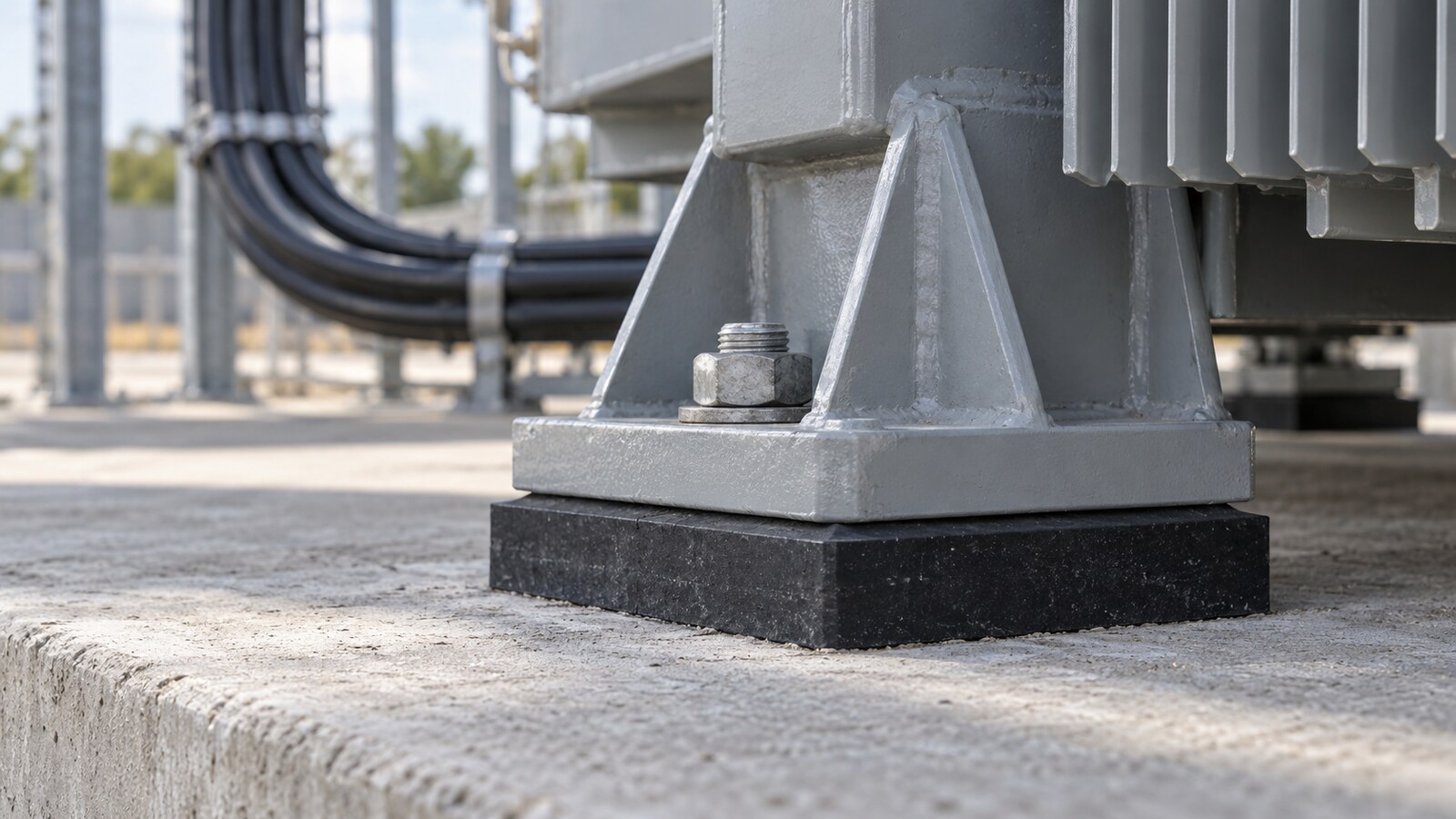
Vibration can enter a building through supports and rigid connections. An isolation mount should be selected for the equipment mass distribution, support geometry and structural behavior; a generic rubber pad is not a complete engineered isolation system. Ask the structural and acoustic specialists to coordinate support loading, stability and the mounting manufacturer’s limits.
Connections can bypass an otherwise suitable mount. Cable restraints, rigid bus connections, pipes and enclosure attachments should be reviewed for unintended transmission paths while retaining their electrical and mechanical functions. Flexible interfaces require proper current rating, fault-duty consideration and installation detail. Acoustic treatment must not compromise protective bonding or equipment restraint.
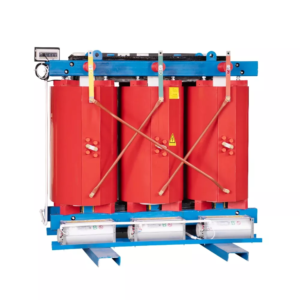
For a compact urban installation, it may be worth comparing the room implications of Zisheng Electric SC(B) series dry-type transformers with the site arrangement for an oil-immersed transformer configuration. Neither construction should be declared acoustically suitable from its name alone. Request the proposed design’s guaranteed data.
Write a factory test requirement that can be witnessed
Agree the test plan before manufacture reaches the acceptance stage. It should identify the unit, electrical condition, cooling configuration, measurement method, instrument records and information to appear in the report. State how the agreed limit, measurement uncertainty and any contractual tolerance will be evaluated. Avoid adding an acceptance allowance after a marginal result appears.
Record background and configuration changes
The report should make clear which auxiliaries were operating and whether they were fitted in their final arrangement. Ask how background sound was assessed and what corrections or limitations apply under the agreed method. If temporary connections or a different fan arrangement were used, the purchaser needs an engineering explanation of their relevance to the delivered configuration.
Retain the raw measurement schedule and the final calculation summary with the equipment record. These documents give the site acoustic consultant more useful evidence than a single number copied into a completion certificate. They also support investigation if the installed result differs from the prediction.
Keep the site test separate from the factory guarantee
At site, the question is whether the complete installation satisfies the receiver criterion under the agreed operating condition. The test plan should record transformer loading, cooling state, other nearby plant, doors and louvers, weather where relevant, and measurement positions. The assessment method and required access should be agreed before neighboring spaces are occupied.
Where several sources operate together, an acoustic specialist should design a safe test sequence that can distinguish their contributions. Do not subtract decibel values as though they were ordinary arithmetic quantities. If isolation of a source is impractical, document the limitation and use an agreed assessment approach rather than claiming an unmeasured result.
Keep acoustic requirements visible in projects with substantial auxiliary equipment. The discussion of railway depot transformer specifications, for example, places transformer decisions within a wider operating system. The same coordination principle applies when ventilation fans, chillers and neighboring electrical rooms share an urban boundary.
A hypothetical offer comparison
Consider two offers for the same electrical duty. The first gives only a sound-pressure figure measured beside the unit with cooling fans stopped. The second supplies sound-power data for the required cooling states and frequency-band information for the building assessment. Even if the first number looks lower, the offers are not yet comparable. Ask both suppliers to return the same acoustic schedule before ranking them.
The consultant may then find that a revised louver orientation reduces exposure at an upper-floor receiver while preserving service access. That is a project design decision, not evidence that either transformer is universally quieter. Record the accepted arrangement and rerun the assessment if the room or operating pattern changes. This example illustrates a review method; it is not a completed Zisheng Electric project or a promised attenuation result.
Close the enquiry with an accountable acoustic schedule
Before award, resolve three questions: what the manufacturer guarantees, what the building design must achieve, and how the owner will accept the installed result. Put the answers in separate rows of the enquiry schedule with named responsible parties and required evidence. That division makes corrective action much clearer if the site layout changes.
Change control matters after award. Moving a louver toward a sensitive facade, changing the number of operating units or selecting a different cooling package can invalidate an earlier assessment. Route those changes through the acoustic review before release for construction. Preserve the original source data so that the consultant can update the prediction efficiently.
For a project-specific transformer noise specification, send Zisheng Electric the drawings, transformer datasheets, load list, technical specifications, single-line diagram, grid parameters, environmental conditions and installation-site conditions. Include receiver locations, the verified acoustic criteria and proposed room ventilation. Our engineering team can review relevant dry-type and oil-immersed transformer configurations against that package. Our engineering team will review the requirements and respond to project inquiries within 24 hours.
Giới thiệu về ZISHENG ELECTRICAL
Zisheng là nhà sản xuất chuyên nghiệp với 19 năm kinh nghiệm Máy biến áp ngâm dầu, Trạm biến áp gọn, Biến Áp Gắn Trên Tấm, Máy biến áp gắn cột và Biến Áp Kiểu Khô. Chúng tôi sở hữu các chứng chỉ ISO/CE/IEC 60076 và TUV Rheinland.
Máy biến áp trải qua kiểm tra FAT và kiểm tra loại nghiêm ngặt, hỗ trợ tùy chỉnh điện áp/công suất. Chào mừng bạn đến tư vấn về Danh mục và Sản phẩm. bạn có thể liên hệ với chúng tôi qua email [email protected].