
Transformer Demand Logging for African Factory Expansion: Monitoring Windows, Data Quality and Bid Inputs
Transformer demand logging gives an African factory expansion team a defensible record of what the existing installation actually supplies. A transformer nameplate establishes a rating; it does not describe the factory’s production cycle, coincident demand, source changes or unused equipment. Before requesting a larger transformer, the owner and EPC contractor should agree what must be measured, which operating conditions must be represented, and how the evidence will enter the procurement specification.
This guide addresses an existing industrial plant adding production capacity. Its purpose is to turn monitoring results into usable bid inputs. It does not prescribe a universal logging duration or convert a single maximum reading into a transformer rating. The project electrical engineer must still evaluate thermal duty, motor starting, harmonics, fault levels, protection and verified site conditions.
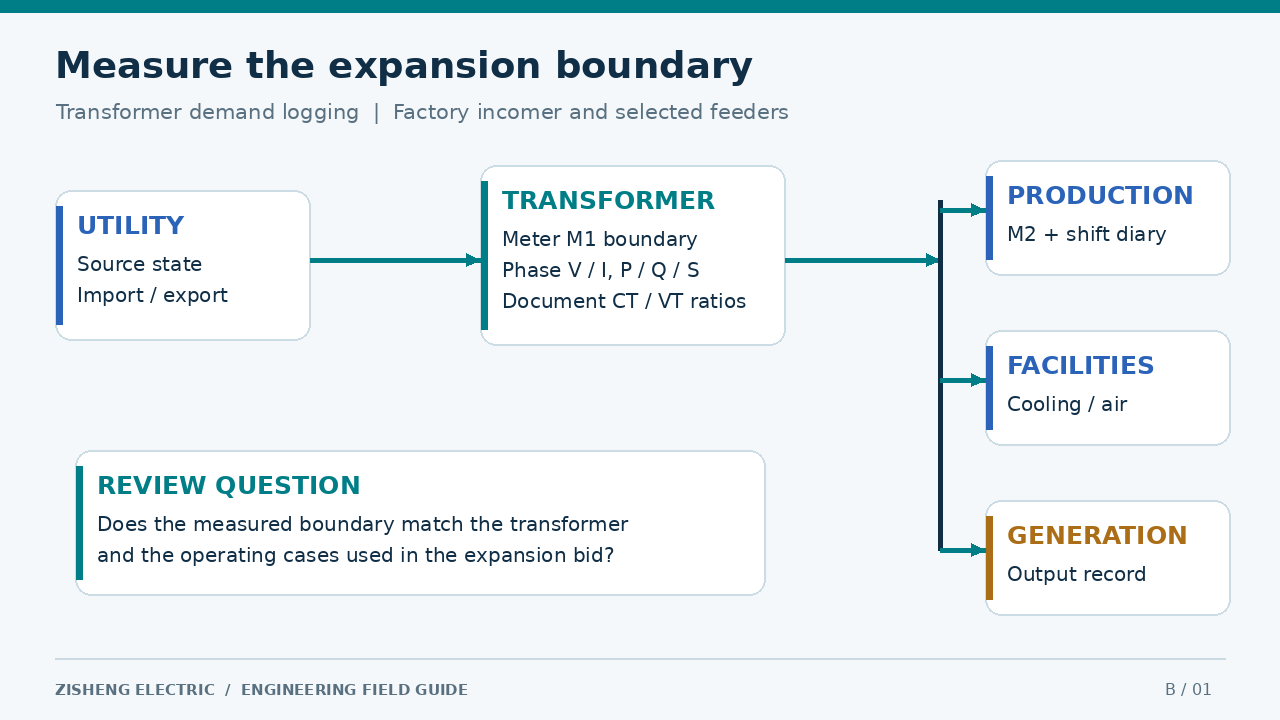
Define the decision before selecting the logger
Write the procurement question in one sentence: can the existing transformer support the proposed production schedule, or is a different supply arrangement required? Then identify the decisions that monitoring can inform. These might include the normal running demand, the coincidence of major loads, the duration of high loading, the contribution of local generation and the difference between weekday and maintenance operation. Each question should have a corresponding measurement and an accountable reviewer.
Separate three categories of evidence. Recorded operating data describes the existing plant during an identified period. Equipment data describes installed and proposed machines. Engineering assumptions describe conditions that were not observed. Mixing these categories produces apparently precise conclusions with weak foundations. A planned second shift, for example, belongs in the future operating scenario until a comparable shift has actually been recorded.
Use a controlled single-line diagram
Mark transformer boundaries, incomers, bus sections, ties, generators, solar connections and major outgoing feeders on the same revision of the single-line diagram. Identify normally open connections and the intended states during monitoring. A meter upstream of several transformers cannot allocate demand to one transformer without additional evidence. Likewise, a meter measuring net utility import may conceal factory demand supplied by generation behind that meter.
Choose monitoring locations that answer the question
Start at the electrical boundary relevant to the proposed purchase, then add selected feeder measurements where aggregation would hide important behavior. Record meter identity, location, phase association, voltage reference, current transformer ratio, voltage transformer ratio where applicable, and the direction treated as positive power. The survey drawing should connect each data channel to a physical circuit and equipment tag.
Installation requires an approved method, suitable instruments and qualified personnel. Existing instrument circuits must be reviewed for suitability before connecting another device. Do not improvise access to energized conductors or disturb current transformer secondary circuits. The monitoring plan should identify safe installation and removal arrangements, responsible personnel and any required outage before the production timetable is agreed.
For an industrial estate with several tenants, the related transformer phase load balancing guide addresses distribution between phases. The demand campaign here answers a different question: how measured operating patterns support an expansion decision over time.
Make the transformer demand logging window representative
A convenient week is not automatically a representative week. Build an operating calendar with production, maintenance and facilities teams. Include shift changes, cleaning cycles, compressor operation, refrigeration recovery, batch processes and scheduled shutdowns where they apply. Identify seasonal or campaign production that cannot be observed within the available programme. These missing conditions should remain explicit limitations in the report.
Agree the minimum events and operating states that the campaign must capture, rather than declaring success when a fixed number of days has elapsed. A plant running below target output during maintenance may need a later supplementary campaign. If procurement cannot wait, the engineer should document the unobserved cases and use separately justified scenarios. Low recorded demand during interrupted production is not evidence of spare capacity at full output.
Attach an event diary to the data
Operators should record major machine starts, production changes, outages, generator transfers and unusual process interruptions with timestamps. Preserve the applicable time zone and any clock adjustments. A high current interval without an event diary may be difficult to interpret; a dated entry identifying a planned process restart can explain why that interval deserves additional study. Keep factual observations separate from operators’ explanations until the data is reviewed.

Distinguish interval demand from short-duration behavior
The reporting interval, demand calculation method and raw sampling capability are different settings. Schneider Electric’s PM2200 demand calculation documentation explains power demand as energy accumulated over a specified period divided by that period, with the selected method determining how the calculation updates. Record those settings so another reviewer can reproduce the interpretation.
An interval average can be useful for sustained loading comparisons but may smooth a brief motor start or voltage disturbance. Where those events influence the expansion decision, specify suitable event recording or a separate study using motor and network data. Do not claim that an ordinary demand trend proves acceptable starting performance. The voltage regulation and motor-starting review describes the related design inputs.
Capture quantities appropriate to the question: phase currents and voltages, active and reactive power, apparent power, power factor and energy may all be relevant. Retain the instrument’s definitions and aggregation method. Harmonic assessment needs suitable measurements and interpretation; a basic energy logger does not establish a complete harmonic spectrum. State instrument capability limits in the survey scope before anyone relies on the resulting charts.
Validate the records before calculating expansion headroom
Keep the original export unchanged and perform analysis on a traceable copy. Check channel labels, units, scaling, timestamps, missing intervals and configuration changes. Compare selected readings with available independent records under compatible conditions. A plausible-looking graph is not enough: reversed polarity, incorrect ratios or a changed clock can create a smooth but misleading result.
Classify gaps rather than silently interpolating them. A communication outage, instrument restart and genuine zero-load period are different events. A blank interval during the factory’s busiest shift weakens the evidence more than a gap during a documented shutdown. Report coverage by relevant operating state, including the missing high-duty cases, so reviewers understand what the dataset can support.
Reconcile the energy boundary
Where an upstream meter and several downstream meters are available, compare them over aligned time windows. Explain expected differences in coverage, losses, unmetered circuits and instrument uncertainty. Do not force exact agreement by adjusting data. If generator or solar power crosses a different boundary, show it explicitly. The relationship between factory consumption and utility import depends on the actual topology and operating state.
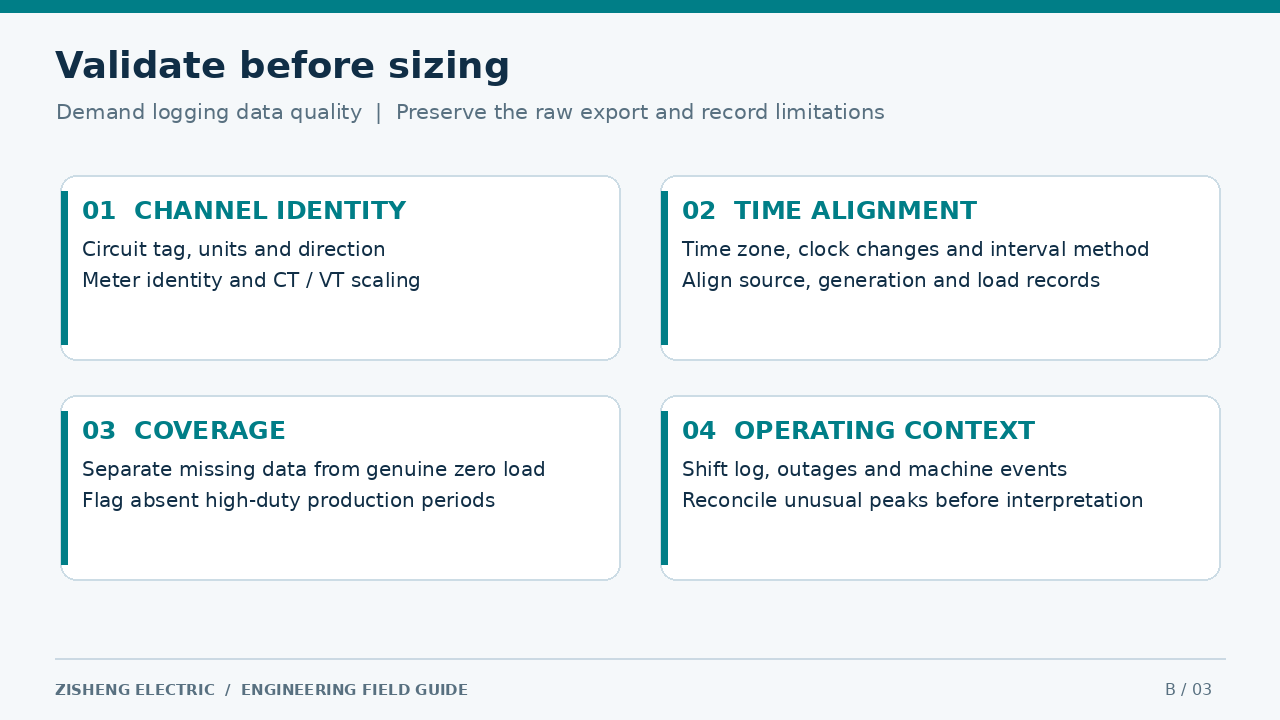
Use a decision table to control the bid basis
| Observed issue | Cần có bằng chứng | Procurement decision | Unresolved limitation |
|---|---|---|---|
| High sustained loading | Validated load duration, ambient context and operating calendar | Evaluate thermal duty and rating options | A single peak does not establish duration |
| Brief starting disturbance | Motor data, event record and source assumptions | Request starting and voltage-drop assessment | Interval demand alone is insufficient |
| Generation masks import | Aligned generation and load measurements | Define separate grid and generator cases | Net import is not gross load |
| Missing production campaign | Process schedule and justified future scenario | Hold the assumption open or extend monitoring | Observed weeks cannot prove unseen duty |
| Nonlinear load expansion | Drive data and suitable harmonic information | Review transformer heating and network interaction | Total kW does not describe waveform duty |
| Inconsistent meter totals | Ratios, boundaries, time alignment and raw exports | Resolve data quality before bid comparison | Do not hide disagreement with correction factors |
Build future cases without double counting
Map each proposed machine to its electrical supply, operating sequence and expected coincidence with existing loads. Distinguish new equipment from replacement equipment that removes an existing load. Identify whether auxiliaries are included in package ratings or listed separately. These details prevent adding the same consumption twice or omitting cooling and compressed-air services needed by the new process.
Use the measured existing profile as one input to the future scenario. Apply documented assumptions for production growth, diversity and redundancy rather than an unexplained blanket percentage. Evaluate normal operation, the intended contingency arrangement, restart after interruption and planned later stages separately. Spare capacity should be described against each relevant condition; it is not one number valid for every operating state.
Transformer selection must also account for voltage ratio, frequency, impedance, losses, cooling, ambient conditions, altitude, installation and protection coordination. A larger nameplate does not automatically solve every system constraint. The engineer should explain which finding drives the recommended rating or architecture and which matters remain outside the measurement campaign.
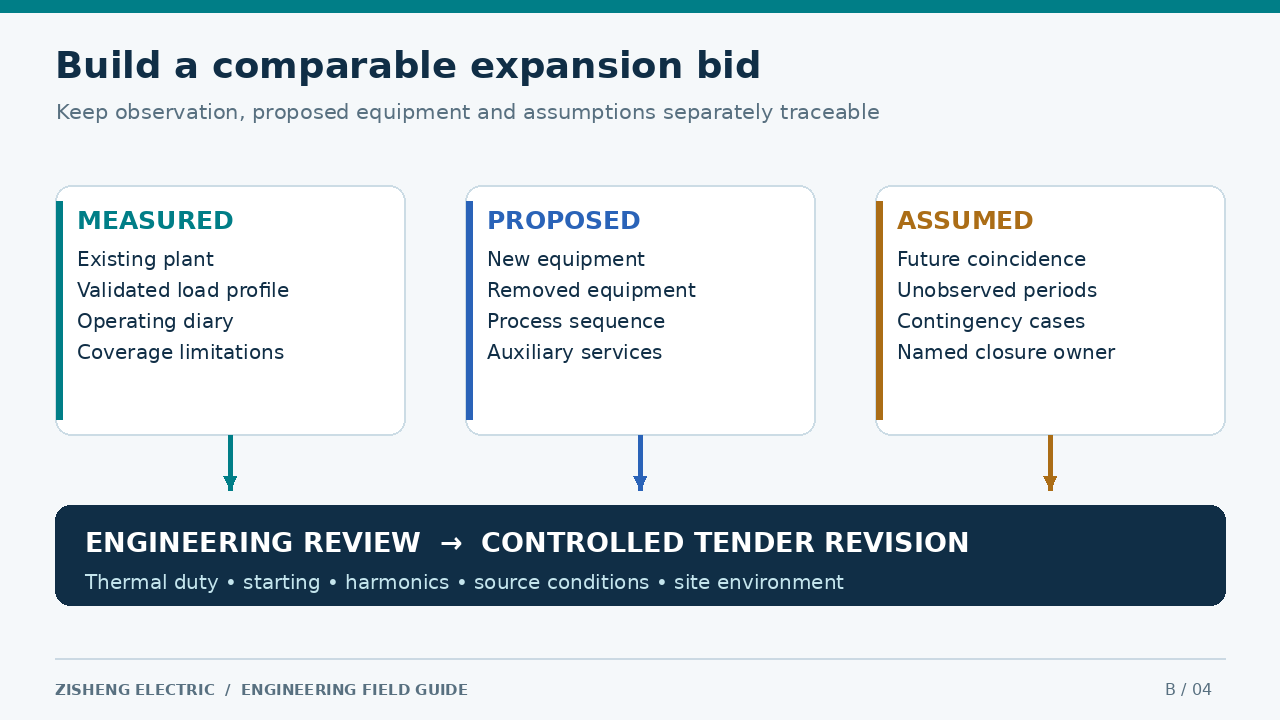
Illustrative factory expansion review
Consider a hypothetical food-processing factory adding a packaging line and refrigeration capacity. This is an illustrative planning example, not a Zisheng delivery reference. The first survey covers normal daytime production but misses the most demanding recovery period after a weekend shutdown. Utility import also falls during daytime solar generation, making the incomer trend appear less demanding than the factory’s total consumption.
The team records the solar contribution on an aligned basis, confirms the meter configuration and adds a monitored recovery period. It collects the new refrigeration equipment’s running and starting data and documents which existing equipment will be retired. The resulting tender separates present measured duty, future process loads and restart assumptions. Bidders can then assess the same operating cases instead of applying incompatible diversity allowances.
If the additional monitoring cannot be completed before enquiry issue, the missing recovery case remains a named assumption with an owner and closure date. Commercial comparisons can proceed against that provisional basis, but the unresolved input must be addressed before design release. This makes uncertainty visible without inventing a measured result.
What to send with the transformer enquiry
Prepare a concise cover sheet identifying the facility, project stage, measurement boundary, campaign dates, operating states covered and outstanding limitations. Attach the approved single-line diagram, meter configuration records, raw data exports, event diary, quality review, load-duration interpretation, proposed equipment schedule and future operating cases. Provide verified environmental information and the required installation arrangement as separate design inputs.
Ask bidders to acknowledge the same dataset revision and identify assumptions, exclusions and additional information needed. Keep clarification responses in the technical bid register. When the production plan or equipment list changes, revise the affected scenario and inform every bidder using it. An attractive graph is useful communication; a controlled evidence package is what makes the offers comparable.
Questions to resolve before design release
Has the campaign captured the operating states that matter? Are meter ratios, directions, intervals and clocks documented? Are missing periods visible? Are generation and load boundaries consistent? Are proposed loads and retired loads reconciled? Has the engineer assessed thermal, starting, harmonic and contingency requirements independently of the recorded peak? Each answer should point to evidence or an explicitly open action.
For a transformer demand logging review with Zisheng Electric, share the single-line diagram, validated monitoring summary, raw-data availability, proposed load schedule, source information and project constraints. These inputs support a focused discussion of transformer options and the remaining engineering work before a procurement decision is finalized.
Giới thiệu về ZISHENG ELECTRICAL
Zisheng là nhà sản xuất chuyên nghiệp với 19 năm kinh nghiệm Máy biến áp ngâm dầu, Trạm biến áp gọn, Biến Áp Gắn Trên Tấm, Máy biến áp gắn cột và Biến Áp Kiểu Khô. Chúng tôi sở hữu các chứng chỉ ISO/CE/IEC 60076 và TUV Rheinland.
Máy biến áp trải qua kiểm tra FAT và kiểm tra loại nghiêm ngặt, hỗ trợ tùy chỉnh điện áp/công suất. Chào mừng bạn đến tư vấn về Danh mục và Sản phẩm. bạn có thể liên hệ với chúng tôi qua email [email protected].