Transformer Cooling Fan Rotation Verification for Gulf Industrial Plants
Các sản phẩm của Zisheng Electric transformer cooling fan rotation verification as a specific acceptance task, with evidence for each fan rather than one tick against an entire radiator bank. For Gulf industrial buyers, a running indication can be reassuring while concealing an incorrectly assembled fan, an unsuitable replacement motor or a blocked discharge path. The useful question is whether the installed equipment produces the intended airflow under the approved operating arrangement.
This guide is for EPC engineers, plant maintenance teams and procurement staff buying transformers with forced-air cooling stages. It covers the evidence to request, the boundary between factory and site checks, and the information needed after fan replacement. It does not prescribe a universal rotation direction or authorise work on energised equipment. The transformer and fan manufacturers’ approved instructions, the site’s electrical safety procedures and the responsible engineer’s test plan govern the work.
Define transformer cooling fan rotation verification before ordering
A purchasing specification that asks only for “fans tested” leaves several questions unanswered. Was every fan operated? Was its direction observed from a defined side? Was airflow compared with the radiator arrangement? Was the fan tested on its final supply and wiring, or on temporary factory leads? These distinctions determine how much site work remains after delivery.
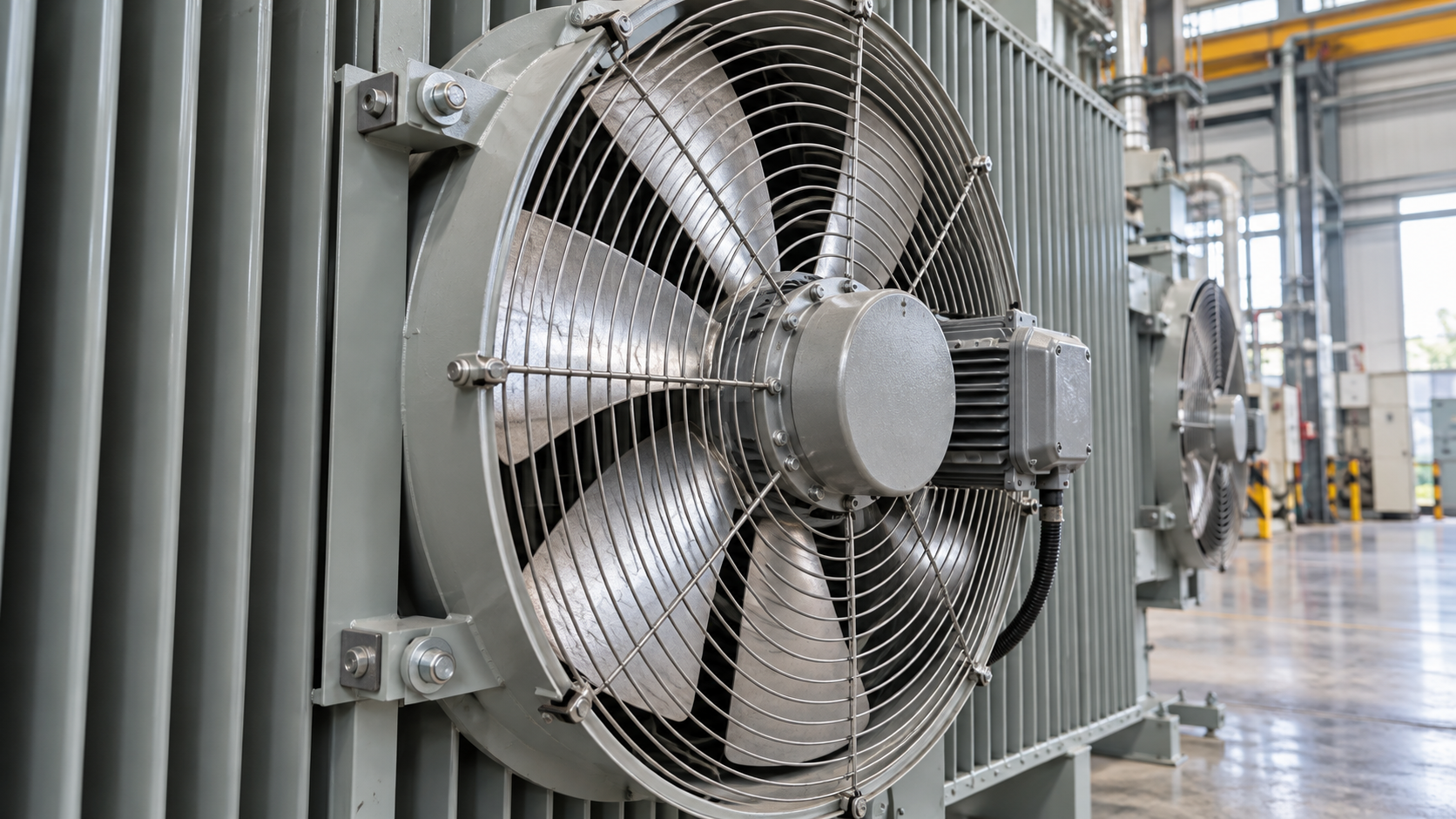
Ask for a fan register showing transformer identification, cooling group, fan position, motor identification, electrical supply and the drawing that defines installation orientation. Include a clear reference view. Clockwise from the motor end is counterclockwise from the opposite side; an unqualified direction in a report is ambiguous. The approved drawing should connect the rotation reference to the required air path through the cooling assembly.
Keep this scope separate from a general thermal review. The site’s load profile and cooling-stage ratings establish why forced cooling is needed. Individual fan checks establish whether the installed hardware behaves as intended. Neither replaces the other, and a successful rotation check cannot establish a transformer temperature-rise guarantee.
Separate three observations that are often combined
A command is not a mechanical observation
A controller output or contactor auxiliary contact can demonstrate that a command path changed state. It does not, by itself, prove that the motor is turning. A disconnected motor circuit, a tripped protective device or a mechanical problem can produce different outcomes despite a valid control command. Specify what the word “running” means in the supplied monitoring scheme.
Rotation is not a complete airflow result
A fan can rotate while the assembled blade, motor, guard or mounting arrangement differs from the approved design. The purchaser therefore needs both the observed direction and confirmation that the assembly identity and orientation are correct. Airflow assessment must use a method suitable for the installed equipment; visual appearance alone is not a quantitative performance measurement.
Do not ask a witness to reach through a guard or hold loose material beside rotating blades. Inspection access, automatic-start prevention and the separation of observation from hands-on work belong in the approved procedure. If safe observation is impossible in the final arrangement, resolve that issue before accepting a test method that cannot actually be performed.
Build a fan-by-fan acceptance record
The following table converts a broad purchase requirement into reviewable evidence. It is a procurement framework, not a substitute for the equipment manufacturer’s test procedure. Acceptance limits, instruments and operating conditions must be agreed for the actual supply.
| Check | Evidence to record | Decision supported |
|---|---|---|
| Fan identity | Position tag, motor and fan references, approved drawing revision | Confirm that the tested assembly is the supplied assembly |
| Reference direction | Viewing side, specified arrow and observed direction | Resolve orientation ambiguity before release |
| Air path | Intake and discharge orientation, obstruction observations, agreed measurement results where specified | Identify installation or component discrepancies |
| Electrical operation | Actual supply conditions, motor observations and protection settings checked against approved data | Confirm compatibility with the plant auxiliary supply |
| Group control | Fan membership, manual and automatic commands, individual failure indications | Verify that the intended cooling group responds |
| Restoration | Final operating mode, temporary connections removed and outstanding actions | Prevent a test configuration becoming the operating configuration |
A group-level result is useful only when it can be traced to its members. If one fan fails a check, identify that unit and preserve the other results. Repeating a complete test without retaining the original discrepancy hides the correction history and makes later investigation harder.
Connect the Gulf site conditions to the test specification
A regional label does not define a plant’s auxiliary voltage, frequency or environmental duty. Request the actual auxiliary-board data, expected voltage variation, supply-transfer arrangement, site elevation and approved ambient-temperature basis. Those inputs affect motor compatibility and the conditions under which acceptance evidence is meaningful. Do not infer them from the main transformer voltage ratio or from another project in the same country.
For a dusty industrial location, inspect the intake and discharge boundaries that will exist after construction. Nearby walls, acoustic barriers, equipment and accumulated process material can influence airflow. A factory test in an open bay does not verify the final site layout. The installation team should record those differences and decide whether additional site checks are needed.
Where coastal salt exposure, high humidity or condensation is part of the approved site basis, address motor enclosure selection, connections, protective finishes and storage. A fan that remained outdoors in its transport packaging may need inspection before installation even if it passed its factory test. These are project-specific decisions; the article does not assign a universal environmental category or maintenance interval to the Gulf region.
Transport and installation also affect traceability. Radiator and fan assemblies removed for shipment should retain their designated positions and packing references. Site assembly records should identify any replacement, rewiring or bracket change. Otherwise the factory report may describe a different physical configuration from the one being commissioned.
Allocate factory and site responsibilities explicitly
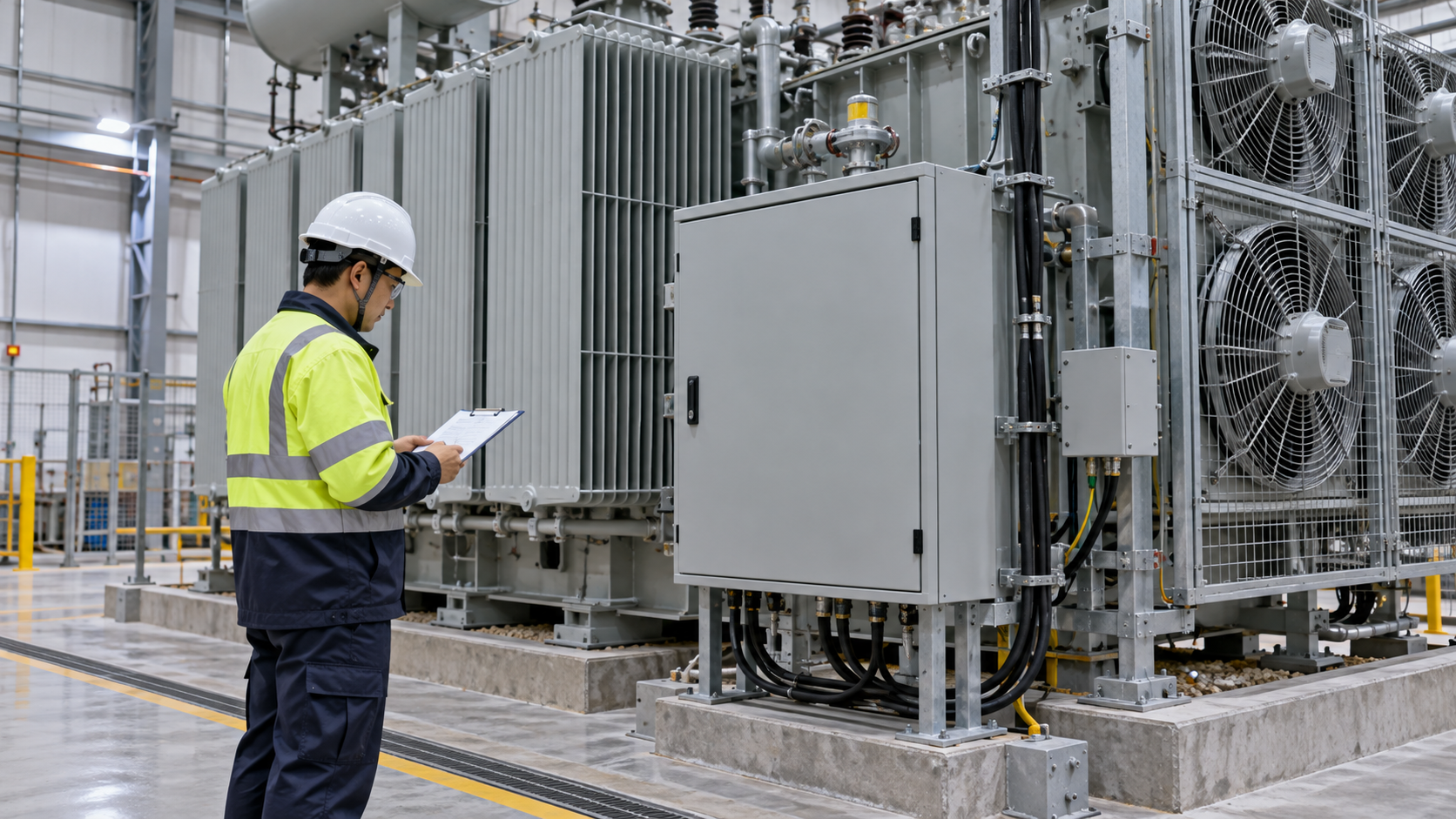
At factory acceptance, the buyer can request verification of fan identity, orientation, connection arrangements and defined operating functions. The procedure should say which checks apply to every fan and which apply to a cooling group. If only part of the assembly is present, document that limitation instead of describing the entire cooling system as accepted.
The site team then closes the installation-dependent items: final cable connections, permanent auxiliary supply, reassembled fan locations and the completed surroundings. A witness signature is more useful when it states which configuration was observed. Keep the final drawing revision beside the test record so that a later reviewer can understand the arrangement without reconstructing it from photographs.
For coordination of the supply boundary, use the related guidance on transformer auxiliary power supply design. Temperature-derived commands should also be reconciled with the approved winding-temperature indication and contact interfaces. These supporting reviews inform the test plan without turning fan verification into a complete protection-system commissioning procedure.
State what the test does not prove
A direction check is not a sound-power test, a motor endurance test or a guarantee of cooling capacity at every ambient condition. If the contract requires measured airflow, vibration, sound or auxiliary consumption, give each item its own method and acceptance basis. A general video of rotating fans cannot replace measurements that were explicitly specified.
Likewise, a successful test on one supply source does not automatically cover every restoration sequence. Where the plant uses a standby source, the responsible design team should identify which transfer and restart cases must be demonstrated. Keep the scope proportionate to the actual control design and the operating consequences of cooling loss.
Respond to discrepancies without losing the evidence
If the observed direction or air path disagrees with the approved information, stop acceptance of that item and establish the cause under the site procedure. Check the reference view, assembly identification and drawing revision before deciding that wiring is wrong. A disagreement can originate in documentation, installation or component substitution.
Any physical correction belongs to qualified personnel working under the approved isolation and verification process. Do not treat a generic instruction to exchange conductors as a universal repair method; motor type, control arrangement and manufacturer instructions matter. The buyer’s role is to require a documented correction and a relevant repeat test, with the final arrangement reflected in the records.
Keep the discrepancy number, original observation, authorised action and repeat result together. If the change affects other fans or a shared group circuit, assess the extent of the repeat checks. Closing one defective item should not create an assumption that every connected unit remains correct after a shared connection has been altered.
Make replacement fans a controlled purchasing item
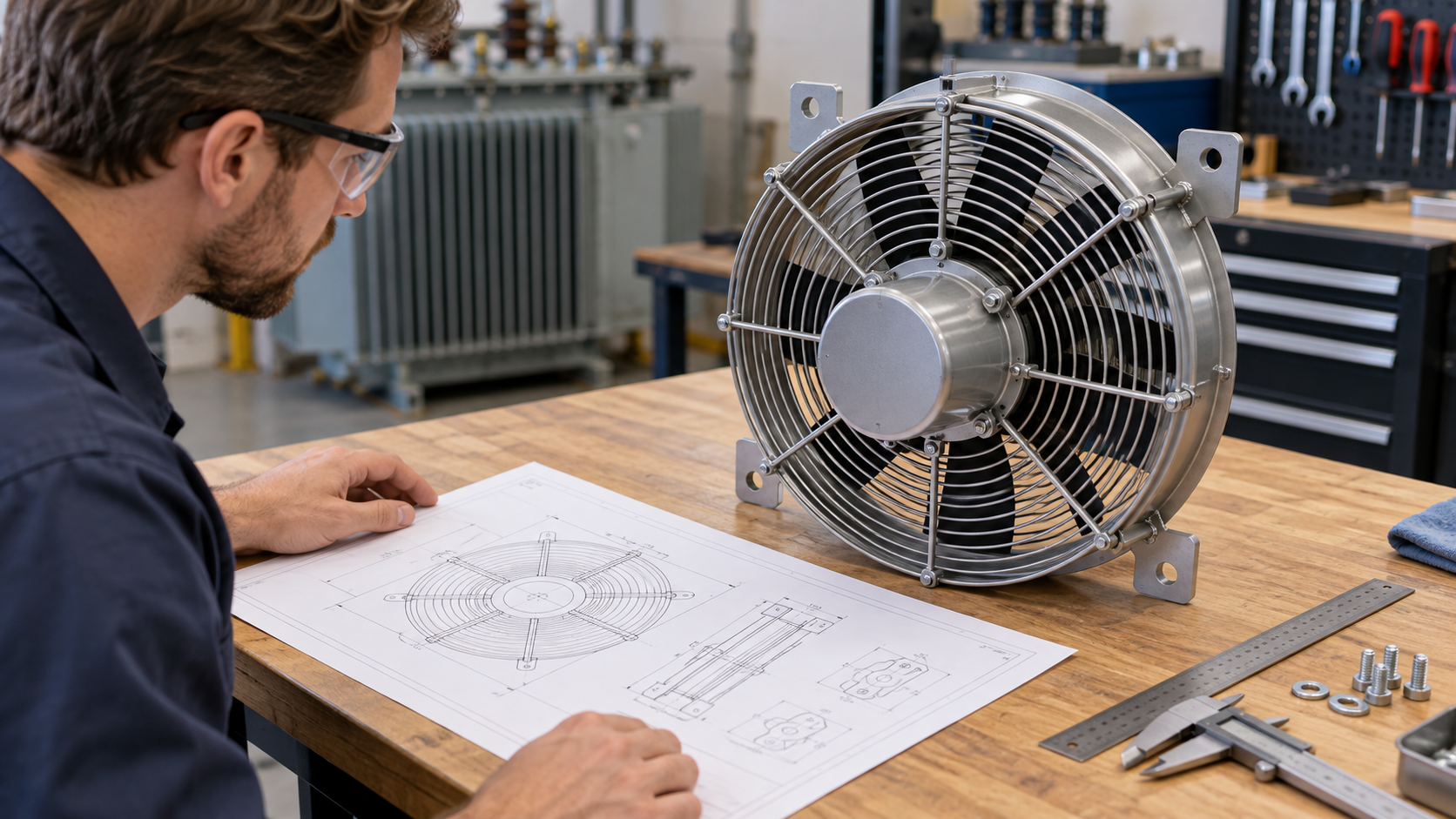
A spare fan with similar outside dimensions may have a different blade arrangement, motor characteristic, mounting orientation or connection requirement. Request an approved interchangeability statement covering the complete assembly and its application. Matching motor power alone is not enough to establish that the replacement provides the intended air movement.
The spare-parts register should connect the accepted replacement to the transformer serial number and fan position. Include handling, storage, preservation and inspection instructions supplied for that component. Buyers serving several Gulf plants should resist creating a common spare solely because two fan guards look alike. Standardisation needs engineering approval and a clear list of the installations it covers.
Plan the return-to-service evidence at the same time as the purchase. After replacement or relevant rewiring, the affected verification items need to be repeated under the approved procedure. A spare purchased without its installation instructions can shift a modest component saving into a much larger commissioning delay.
Compare offers on the same verification scope
Ask each bidder whether its price includes individual fan records, factory witnessing, site supervision and repeat checks after shipping assembly. State who supplies test instruments and who approves the method. A low component price can exclude the evidence needed for owner acceptance, while a more complete package may already include the records and technical support. Keep these differences visible in the bid comparison instead of resolving them after the equipment arrives.
For distributor orders, preserve the destination project requirements even when several transformers share a purchase order. Different auxiliary supplies or fan options require separate configuration references. A common commercial line item should not erase the technical differences that the installation team needs to see.
Review the evidence before releasing the cooling system
The final review should find a complete fan register, agreed reference directions, traceable observations, closed discrepancies and the restored operating configuration. Confirm that outstanding work is assigned to a named party and that any operating restriction has been approved by the responsible engineer. A document marked “accepted with comments” is incomplete if no one can identify what those comments prevent.
For the owner, retain the original manufacturer documents alongside the installed records. This allows maintenance teams to distinguish the original arrangement from later changes. It also gives the purchaser a practical basis for evaluating future spare offers without relying on an ageing photograph or an unverified catalogue description.
Zisheng Electric can discuss transformer cooling fan rotation verification within enquiries for 10MVA 33/11kV oil-immersed power transformers và 66kV three-phase power transformers. The offered cooling configuration and project requirements must be confirmed for the selected equipment. Send drawings, data sheets, load lists, technical specifications, single-line diagrams, grid and auxiliary-supply parameters, environmental conditions and installation-site conditions, together with any existing fan register or replacement proposal. Our engineering team will review the requirements and respond to project inquiries within 24 hours.
Giới thiệu về ZISHENG ELECTRICAL
Zisheng là nhà sản xuất chuyên nghiệp với 19 năm kinh nghiệm Máy biến áp ngâm dầu, Trạm biến áp gọn, Biến Áp Gắn Trên Tấm, Máy biến áp gắn cột và Biến Áp Kiểu Khô. Chúng tôi sở hữu các chứng chỉ ISO/CE/IEC 60076 và TUV Rheinland.
Máy biến áp trải qua kiểm tra FAT và kiểm tra loại nghiêm ngặt, hỗ trợ tùy chỉnh điện áp/công suất. Chào mừng bạn đến tư vấn về Danh mục và Sản phẩm. bạn có thể liên hệ với chúng tôi qua email [email protected].