IEC 60076-4:2026 Transformer Impulse Testing: What EPC Buyers Should Update
For EPC teams buying power transformers, a revised test standard is not a library update; it can change the language used in specifications, the evidence expected at FAT, and the questions that must be closed before a test laboratory is booked. Zisheng Electric has therefore reviewed the publication of IEC 60076-4:2026 transformer impulse testing from a procurement and project-execution perspective. The new edition was published by the International Electrotechnical Commission on 9 July 2026. It covers guidance for lightning impulse and switching impulse testing of power transformers and reactors, including wave shapes, test circuits, interpretation and failure detection.
This article does not reproduce the standard or replace the purchased document. It explains what an EPC contractor, owner’s engineer or industrial buyer should update in the tender, drawing review and inspection plan after a new edition appears. The practical message is simple: do not add “IEC 60076-4 latest edition” to a data sheet and assume every commercial, design and laboratory interface has been resolved.
Why IEC 60076-4:2026 Transformer Impulse Testing Matters to Buyers
Impulse tests are used to demonstrate the dielectric performance of a transformer insulation system under specified transient stresses. That sounds like a factory issue, but the acceptance basis begins much earlier. The system voltage, insulation levels, winding terminals to be tested, neutral treatment, test sequence, chopping arrangement when applicable, and required records all affect design and quotation.
The IEC listing identifies IEC 60076-4:2026 as Edition 2.0 and gives its title as Power transformers – Part 4: Lightning impulse and switching impulse tests of power transformers and reactors. Buyers should confirm the exact edition in the official IEC catalogue or through their authorized standards service. A catalogue entry confirms publication and scope; it does not disclose all technical clauses. Project teams should obtain the standard legally before changing detailed procedures or acceptance criteria.
The update matters most when a tender was written against an earlier edition, a project specification says only “IEC 60076,” or multiple parties use different document baselines. In those situations, a supplier may price one sequence while the consultant expects another. The problem normally appears late—during test-procedure review—when design is frozen and the laboratory slot is already reserved.
A Procurement Impact Table for the 2026 Edition
| Điểm quyết định | What the buyer should request | Tầm quan trọng | Công bố bằng chứng |
|---|---|---|---|
| Applicable edition | Exact standard number, year and project precedence | “Latest” can change between bid and FAT | Approved standards register and deviation list |
| Test applicability | Terminal-by-terminal matrix for lightning and switching impulse tests | Transformer voltage class and winding arrangement affect the required programme | Approved test schedule linked to the data sheet |
| Test levels | Specified withstand levels and the source used to select them | Rated voltage alone does not define every insulation requirement | Approved data sheet and insulation coordination inputs |
| Wave and circuit | Proposed impulse generator circuit, measuring chain and earthing arrangement | Test feasibility and record quality depend on the complete circuit | Laboratory procedure and calibration records |
| Failure detection | Channels, traces, comparison method and decision process | A pass/fail statement without interpretable records is weak evidence | Signed oscillograms, settings and test report |
| Witnessing | Hold/witness points, remote access rules and retest authority | Unclear roles create delay when an abnormal trace appears | Approved ITP and FAT attendance record |
The table is deliberately written as a document-control tool. It prevents a standards change from remaining a note in the technical bid while the laboratory procedure, inspection and test plan, and contractual acceptance criteria continue to reference a different baseline.

Do Not Confuse Rated Voltage with the Insulation Test Programme
A common procurement shortcut is to ask for an impulse level based only on the transformer’s nominal voltage ratio. That is insufficient. The project must establish the system highest voltage, insulation coordination basis, terminal arrangement, neutral insulation, surge arrester coordination, altitude assumptions where relevant, and the owner’s specific requirements. A 33/11 kV industrial transformer and a 132/33 kV grid transformer will not use the same decision path even if both are described broadly as IEC transformers.
The specification should state which document governs if the owner’s standard, national requirement and IEC document differ. It should also identify whether a requirement is a routine, type or special test for the purchased unit under the project contract. Commercial teams need that classification before bid close because the test may affect cost, manufacturing sequence and delivery date.
Zisheng Electric recommends linking the insulation schedule to the guaranteed technical particulars rather than leaving levels inside an isolated test clause. This lets design, sales, the EPC engineer and the test laboratory work from the same approved values. For a broader view of production controls, buyers can review the transformer factory testing process và IEC transformer manufacturing process.
Update the Technical Specification Before the RFQ
Name the document baseline
Write the edition explicitly. If a project decides to retain an earlier edition because the contract, utility approval or design freeze already relies on it, record that decision. If the 2026 edition is adopted, update every related reference. A specification cover sheet, data sheet, ITP and test procedure with different revisions are an avoidable source of claims.
Define the hierarchy of requirements
A useful clause identifies the order of precedence among the purchase order, project specification, owner standard, approved data sheet and IEC documents. It should also state that contradictions require written clarification, not silent selection by the vendor. This matters in international EPC work, where the consultant may issue an IEC-based specification but the utility connection agreement adds separate conditions.
Ask for a compliance matrix, not a generic declaration
“Complies with IEC 60076” is too broad for technical evaluation. Ask bidders to identify the applicable parts, editions, deviations and supporting deliverables. For IEC 60076-4:2026, the response should connect each project requirement with the proposed test or document. The bid evaluator can then separate a genuine technical exception from a simple missing statement.
Translate the Standard into an Executable FAT Plan
An FAT plan should explain what will happen, who will witness it, what instruments and records will be used, and what happens after an abnormal indication. The sequence must fit the transformer’s production plan. Some tests may need external laboratory capacity or a specific impulse generator. Waiting until the final FAT agenda to check availability is risky.
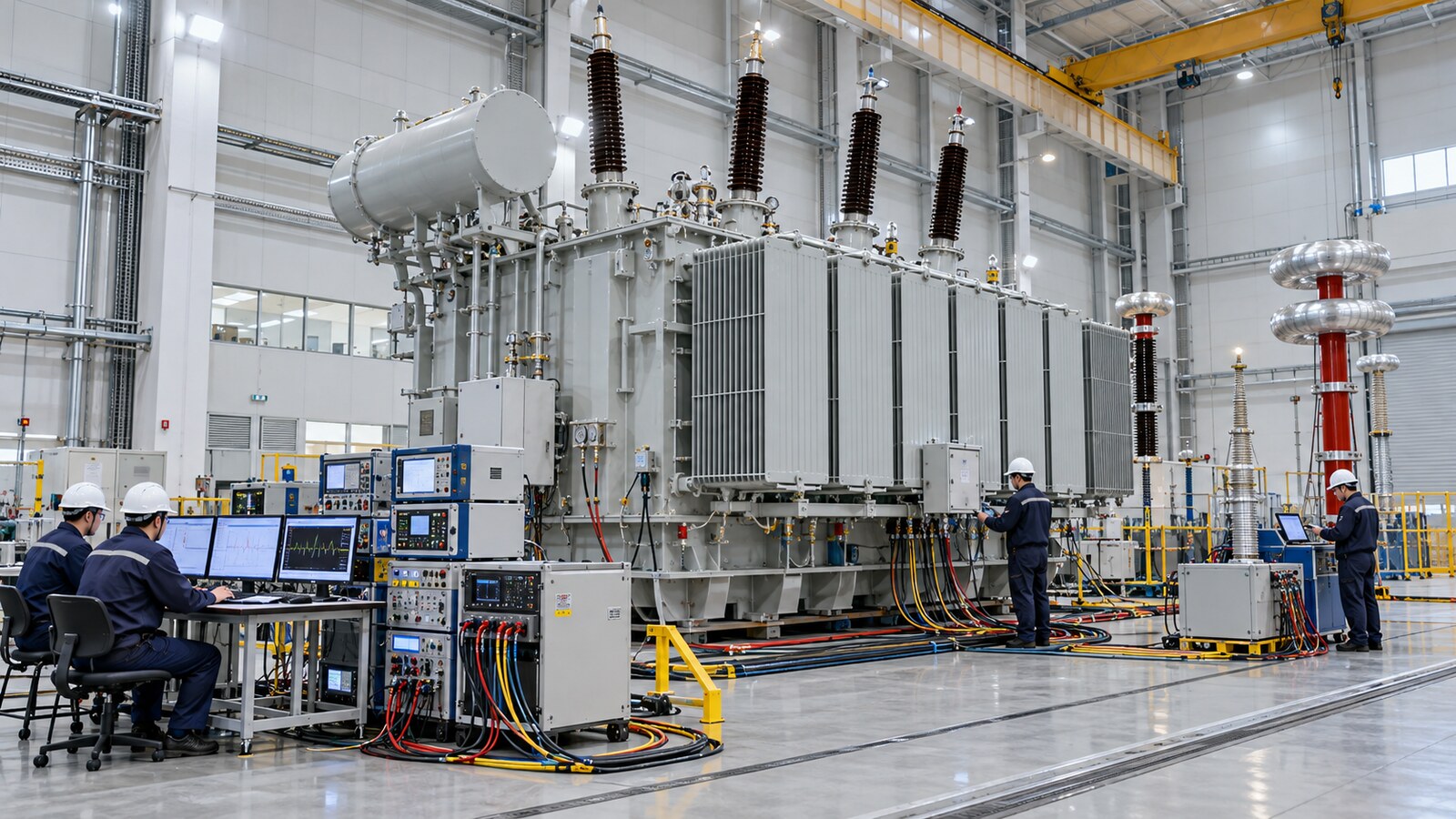
The supplier’s procedure should identify the tested terminal, connections on non-tested terminals, earthing arrangement, measuring channels, applied sequence and recording format. Project reviewers should focus on traceability. The report must connect the tested transformer serial number, approved design data, equipment calibration status and recorded traces.
This is where a general power transformer design and manufacturing workflow becomes relevant. Impulse performance is not created in the laboratory. Winding geometry, internal clearances, lead routing, shielding, insulation processing and assembly discipline all contribute. The test confirms the completed design and workmanship against the specified programme; it cannot compensate for missing design inputs.
How to Review Oscillograms Without Turning the FAT into an Argument
EPC representatives do not need to operate the impulse generator, but they do need a pre-agreed review process. The parties should know which current and voltage records will be captured, how reference and full-level traces will be compared, and who has authority to pause testing. If an unusual trace appears, the team should preserve the raw records and document the circuit condition before changing connections.

A commercial acceptance sheet containing only “pass” is not enough for a high-value transformer. Request the signed test report, oscillograms or equivalent recorded waveforms, test levels, polarity, sequence, environmental and equipment details required by the approved procedure, and a list of any interruptions or repeated applications. The final document package should distinguish a planned repeat under the procedure from a repeat caused by an unexplained event.
Remote witnessing also needs discipline. A camera view of a control desk cannot replace readable instrument records. If remote FAT is permitted, define which screens, traces and nameplate identifiers will be visible, how files will be shared securely, and how the witness will approve or reject each hold point. These controls complement, rather than replace, the physical test report.
What Changes for High-Voltage and Medium-Voltage Purchases
For high-voltage projects, impulse-test planning usually has a larger effect on design review, laboratory scheduling and witness arrangements. Buyers evaluating a 110 kV or 115 kV power transformer, a 132 kV or 138 kV power transformer, or a 220 kV or 230 kV power transformer should establish the insulation and test schedule before technical bid normalization.
For medium-voltage industrial units, the programme may be different, but ambiguity is still costly. Imported equipment may be offered against the manufacturer’s normal design when the owner expected a project-specific insulation level or witness point. The solution is not to specify the highest possible test indiscriminately. It is to provide correct system data and select the applicable requirements through engineering review.
Five Release Gates for EPC Document Control
- Bid gate: Applicable standards, editions, test classification and commercial inclusions are stated.
- Design gate: Insulation levels, terminal details and coordination inputs are approved without unresolved conflicts.
- Procedure gate: The impulse-test method, sequence, records and acceptance workflow are approved before the laboratory booking becomes critical.
- FAT gate: The correct unit, calibration records, approved procedure and witness authorization are confirmed before energizing the test circuit.
- Shipment gate: Signed reports, traces, deviations and close-out records are included in the manufacturing record book.
Each gate should have an owner and a due date. “For information” submissions are not substitutes for approvals when the next manufacturing step depends on the decision. The same logic applies to related instruments and alarms; the article on transformer winding temperature indicator interfaces shows how a small unresolved item can affect both FAT and site commissioning.
Questions to Send with the RFQ
- Which edition of IEC 60076-4 is included in the offer, and are there any deviations?
- Which windings and terminals are included in the proposed impulse-test programme?
- Which test levels and insulation coordination inputs were assumed?
- Is the work performed in-house or by an external laboratory?
- What lead time is needed for laboratory booking and witness notice?
- Which raw traces and signed records will be included in the final dossier?
- How will an abnormal indication, interruption or retest be controlled and approved?
These questions create comparable bids. Without them, one supplier may include a complete witnessed programme while another has priced only its normal production tests. The commercial comparison will look attractive but will not be technically equivalent.
Conclusion: Make the 2026 Edition a Controlled Project Input
IEC 60076-4:2026 transformer impulse testing should be treated as a controlled engineering input, not a late note on the FAT agenda. EPC buyers need an explicit edition, a terminal-by-terminal test schedule, agreed records, clear witnessing rules and a document hierarchy that resolves project-specific requirements. That work protects both technical acceptance and delivery planning.
Zisheng Electric can review the transformer configuration and prepare a project-specific technical proposal for oil-immersed distribution and power transformers. For a meaningful review, send the available drawings, data sheets, load list, technical specification, single-line diagram, grid parameters and environmental conditions. Our team can use those inputs to confirm equipment selection, insulation and test interfaces, and the document package required for your procurement process.
Giới thiệu về ZISHENG ELECTRICAL
Zisheng là nhà sản xuất chuyên nghiệp với 19 năm kinh nghiệm Máy biến áp ngâm dầu, Trạm biến áp gọn, Biến Áp Gắn Trên Tấm, Máy biến áp gắn cột và Biến Áp Kiểu Khô. Chúng tôi sở hữu các chứng chỉ ISO/CE/IEC 60076 và TUV Rheinland.
Máy biến áp trải qua kiểm tra FAT và kiểm tra loại nghiêm ngặt, hỗ trợ tùy chỉnh điện áp/công suất. Chào mừng bạn đến tư vấn về Danh mục và Sản phẩm. bạn có thể liên hệ với chúng tôi qua email [email protected].