Transformer Terminal Box Condensation Control for Gulf Industrial Sites: Seals, Heaters and Acceptance
At Zisheng Electric, terminal-box details are reviewed as part of transformer procurement because a sound main tank does not guarantee a reliable secondary connection. Transformer terminal box condensation control matters at Gulf industrial sites where humid air, daytime heating, night cooling, washdown and long periods without auxiliary power can all affect an enclosure. A dry factory inspection is only one snapshot. The useful question for an EPC team is whether the installed box will stay serviceable through storage, energization and the first maintenance cycle.
This guide focuses on the low-voltage and auxiliary terminal enclosures associated with an oil-immersed transformer. It separates water exclusion from condensation prevention, then turns that distinction into drawings, purchase requirements and acceptance evidence. Project-specific climate data and the owner’s enclosure specification remain the governing inputs; no single IP number or heater wattage is suitable for every site.
Why transformer terminal box condensation control is a procurement issue
Condensation occurs when a surface falls below the dew point of the air touching it. That can happen inside a nominally sealed enclosure. Warm moist air may enter when the door is opened, through imperfect glands, or during pressure changes. Once the box cools, water can form on the door, gland plate, terminals or instrument wiring. The immediate symptom may be a film of moisture; the later consequences can include corrosion, tracking risk, poor contact surfaces and hard-to-diagnose alarm faults. An enclosure can therefore pass a water-entry inspection and still have an internal moisture problem.
For Gulf projects, assess the actual location rather than applying a regional stereotype. A sheltered inland room, a coastal outdoor bay and an open industrial washdown area expose equipment differently. Ask for the site’s ambient and humidity profile, washing practice, prevailing dust and salt exposure, expected shutdown duration, and whether auxiliary power is available before energization. These inputs determine the enclosure strategy and the inspection interval. The general dew-point relationship is described by ASHRAE’s HVAC reference; the project still needs its own measured or specified conditions.
Start with the interface drawing, not an IP label
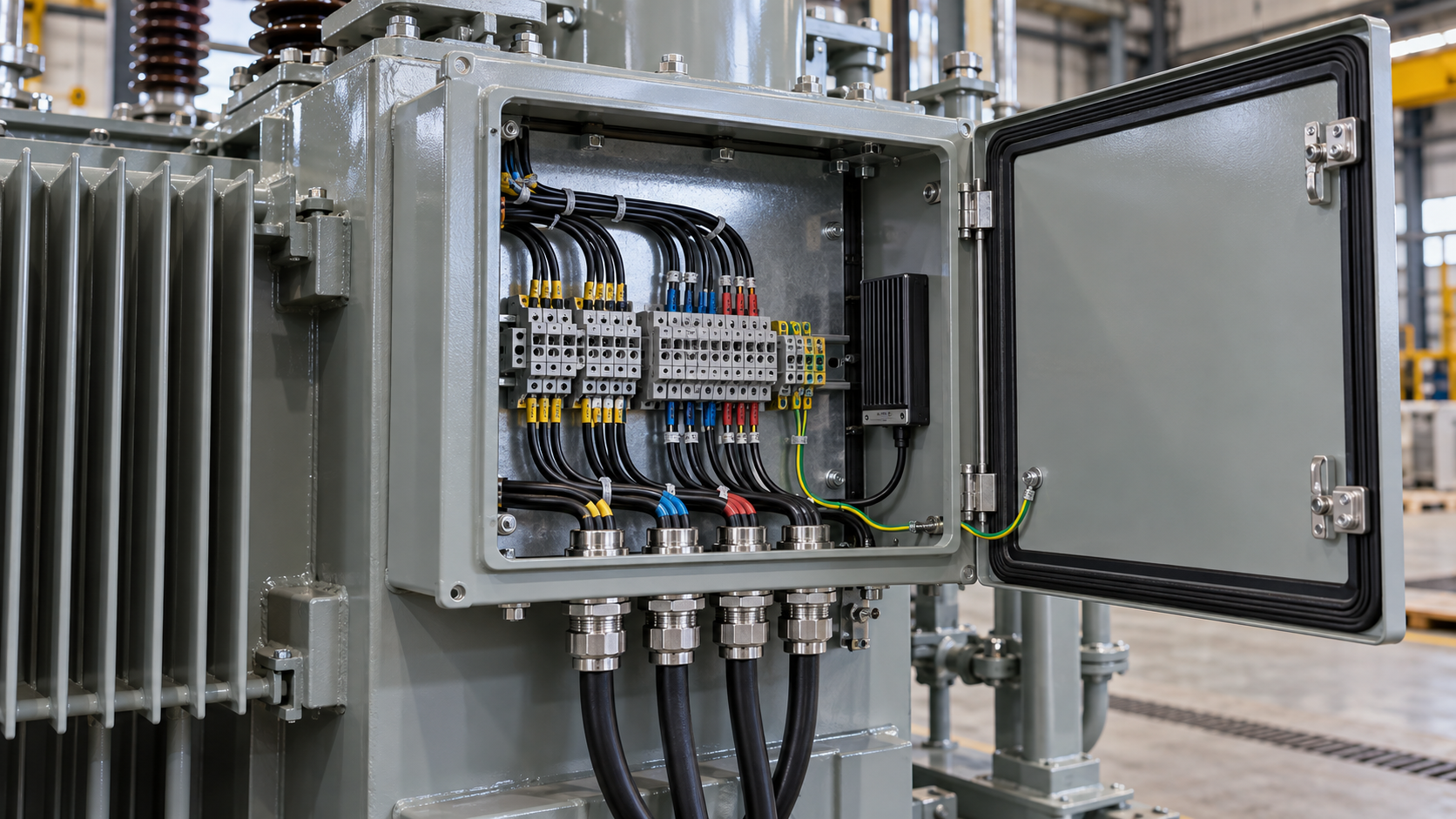
The enclosure boundary includes the door seal, hinge and latch compression, gland plate, every cable entry, any breather or drain, and the mating surfaces of accessories. A catalogue photograph rarely shows the final cable arrangement. The EPC cable schedule may add entries after the transformer has been ordered, and a field-drilled hole can defeat an otherwise sound box. Freeze the number, size and direction of incoming cables with the transformer supplier and installation contractor. Show spare entries explicitly and seal them with approved blanks, not improvised plugs.
IEC 60529 classifies degrees of protection provided by enclosures against access and ingress. It is a useful common language for specifying an assembled enclosure, but an IP designation by itself does not establish that internal condensation cannot occur. Specify the installed configuration and the evidence required after glands and accessories are fitted. Ask whether the declared rating covers the complete box, including gland plate and fitted devices, and who will verify the field entries.
Where the enclosure is part of a larger transformer package, also check how the transformer purchase specification addresses accessory interfaces. IEC 60076-1 is the general power-transformer standard; it should not be treated as a substitute for an explicit terminal-box moisture-control requirement. Keep the purchase schedule specific.
Convert exposure into a terminal-box decision matrix
The table below is a practical review tool, not a universal pass/fail code. Set acceptance values in the project specification. It makes ownership visible before the supplier completes drawings and before the contractor cuts a gland plate.
| Site condition or interface | Design decision | Доказательства, которые необходимо запросить | Release risk if unresolved |
|---|---|---|---|
| Humid storage before auxiliary supply | Define temporary preservation and heater power source | Storage procedure, supply boundary, inspection log | Moisture can accumulate before commissioning |
| Outdoor splash, cleaning or wind-driven rain | Confirm enclosure orientation, seal and cable entry arrangement | As-built gland drawing and enclosure test basis | Installed assembly may differ from rated sample |
| Dust or salt-laden air | Review gasket material, exposed metal and maintenance access | Material schedule and replacement part list | Seal deterioration may go unnoticed |
| Heater and thermostat or humidistat | Define control philosophy, supply and failure alarm | Wiring diagram, functional test and circuit label | Heater may be installed but unavailable in service |
| Bottom gland plate and cable bend | Coordinate cable count, bend radius and drip path | Scaled interface drawing and site walkdown record | Late drilling or unsupported cable load can compromise sealing |
| Drain or breather, if specified | Reconcile moisture relief with required ingress protection | Approved device detail and maintenance instruction | Unreviewed opening can admit contaminants |
Seal the installed cable route as a system
Glands need to suit cable outside diameter, armour arrangement where relevant, enclosure material and the required environmental boundary. The installer needs enough room to tighten them without stressing the cable or crushing an adjacent seal. A gland plate that looks generous on a general arrangement drawing may be crowded after the actual cable schedule is applied. Review the full cable bundle, including spare and future circuits. Where cables rise into the box, provide a route that does not guide water toward the entry. Where they descend, check the support and drip arrangement without assuming every installation can use the same geometry.
Door seals deserve the same attention as cable glands. A continuous gasket must seat uniformly on a clean surface; latch settings should provide repeatable compression without damaging the seal. Ask for accessible replacement parts and instructions. If the box is likely to be opened frequently during commissioning, define a post-work closure check rather than accepting a one-time factory inspection. This is particularly important where several contractors share the box for protection, metering and control wiring.
The broader site interface can be reviewed alongside coastal transformer procurement checks. That article addresses exposure and site data at package level; here the decision is the integrity of the terminal enclosure after site wiring.

Choose an anti-condensation method with an operating plan
Heaters need a real supply and a clear control state
An anti-condensation heater is often proposed, but its name does not prove performance. Review its location, electrical supply, protective device, control sensor, switching logic and whether it remains energized during transformer shutdown. The aim is to keep vulnerable surfaces above the local dew point without overheating wiring or defeating other equipment limits. A thermostat or humidistat can be appropriate, but the setpoint and sensor position need project review. Do not copy a wattage from another transformer size or enclosure volume.
Record the auxiliary circuit in the single-line diagram and terminal schedule. If the heater comes from a station service panel, identify who supplies that panel during construction, outage and permanent operation. If loss of heater power matters to the owner, include an alarm or an inspection action that can actually be maintained. The commissioning team should prove the control response, not just measure continuity at the heater terminals.
Breathers, vents and drains are trade-offs
A breather or drain may help in a particular installation, yet it creates an opening in the enclosure system. Review the device’s placement, protection against splash and dust, and how it affects the specified degree of protection. A bottom drain cannot compensate for a damaged door gasket. A sealed box may be preferable for one exposure while a controlled venting arrangement is preferable for another. The owner, supplier and EPC engineer should approve the chosen strategy on the same drawing.
Do not add a vent on site merely because moisture is seen after a door was left open. First identify the source: trapped construction moisture, water entry, a non-operating heater or a temperature cycle. The remedy differs. A temporary drying operation may be needed before the permanent controls are judged.
Account for storage, shipping and first energization
Terminal boxes can be dry when packed and wet when opened months later. Preserve seals and blanking plugs during shipment. On receipt, inspect impact damage, door alignment, packaging condition and evidence of water. Store loose glands and accessories in identified protected packaging. If the transformer is held outdoors before site cables are installed, define who inspects the box, how often it is opened, and how the moisture-control supply is provided. Transformer warehouse storage guidance offers a broader receiving and preservation framework; the terminal box needs its own specific record.
Before energization, verify that all temporary shipping covers have been replaced by the approved installed configuration. Check each unused entry, the drain or breather configuration, seal cleanliness and heater operation. Photograph the completed gland plate and record cable identification. If a box is opened after this hold point, repeat the closure check. A signoff before final cable work is only an interim inspection.
Build acceptance around observable evidence
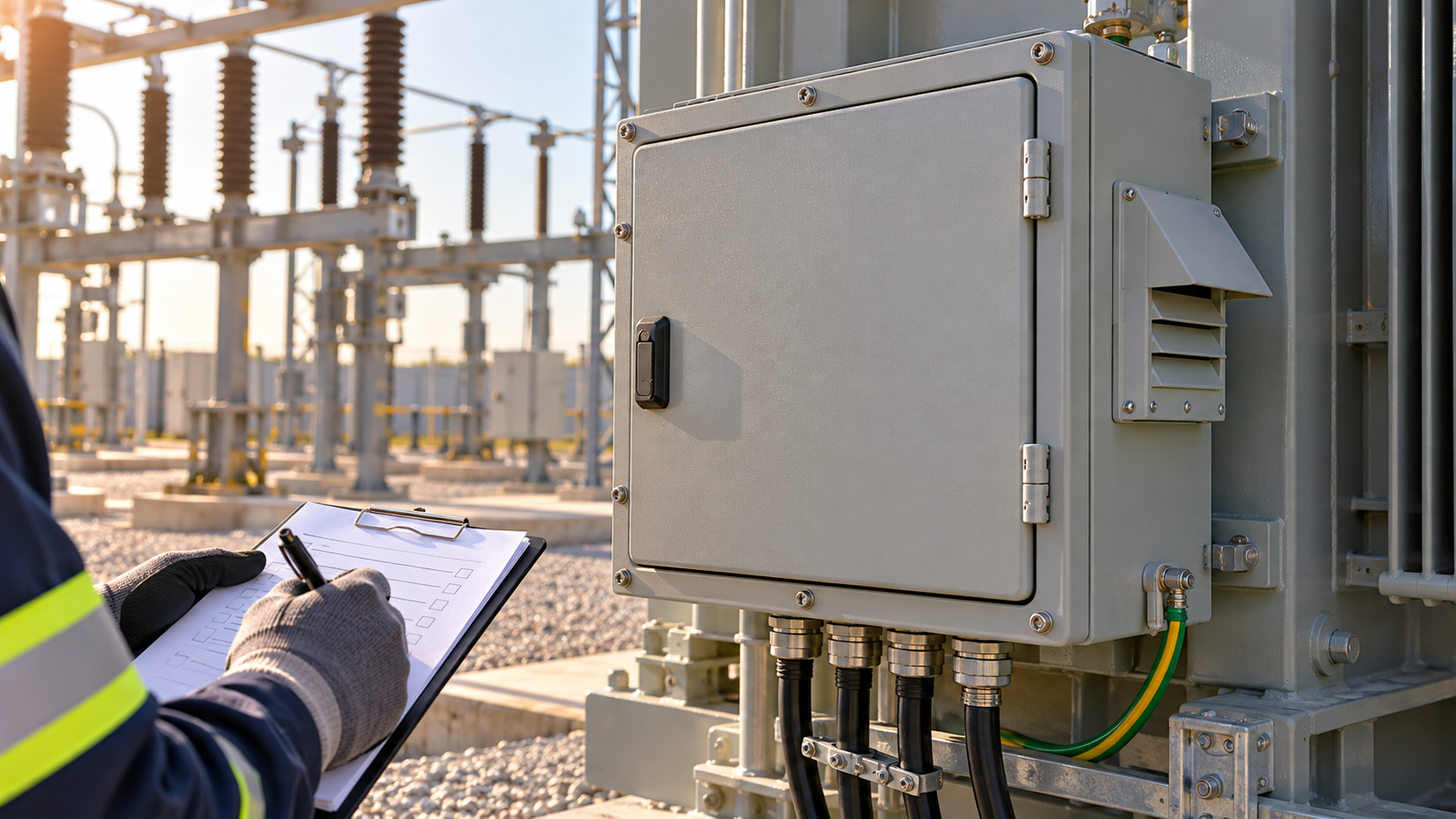
The FAT can confirm enclosure construction, dimensional interfaces, wiring continuity and heater functional behavior as far as the factory setup permits. It cannot replicate every installed cable or local weather pattern. Separate factory evidence from site acceptance. At site, record the as-built cable entries, door and gasket condition, auxiliary supply voltage, control response and any observed moisture. Record ambient conditions when relevant; a dry box on a hot afternoon is weak evidence of performance through a cool humid morning.
The inspection form should identify the exact enclosure, not just the transformer serial number. Give the team a defect route: classify moisture source, isolate affected circuits where needed, photograph findings, correct the cause, dry and clean using an approved procedure, then retest. A single successful wipe-down is not closure. Keep the test boundary clear so that routine visual checks do not encourage unsafe opening of energized compartments.
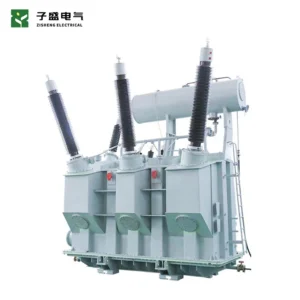
The equipment selection can include a 35 kV to 46 kV power transformer или а 400 кВА масляный трансформатор, but the terminal-box specification must be tailored to the actual arrangement and cable schedule. The product page establishes the equipment family; it does not replace a site-specific enclosure drawing.
Make the purchase order and handover package usable
For procurement, request a general arrangement showing each terminal enclosure and its opening direction, a gland plate drilling plan, cable entry schedule, enclosure material and finish, sealing details, heater and control schematic, accessory list, and maintenance access envelope. State the intended exposure and the acceptance basis. If the owner has a preferred IP classification, provide it with the installation assumptions; ask the supplier to identify any exception. Avoid a vague line that says only “weatherproof terminal box.”
For handover, collect the approved and as-built drawings, factory checks, site closure and heater test records, photos of the finished entries, spare gasket and heater references, and the first inspection interval. Assign the party that owns future cable modifications. When protection or metering circuits are added later, the same drawing and seal review should be reopened. The lesson from dry-type transformer installation requirements is that enclosure performance depends on its installed surroundings; the same interface discipline applies to an oil-immersed transformer’s auxiliary box.
Before releasing a bid, ask the EPC designer to mark each open item with an owner and closeout date. The supplier can then price the correct enclosure, and the site team can inspect against a drawing rather than a verbal expectation. This reduces change orders for late cable entries and prevents an enclosure detail from becoming an outage problem.
Discuss the terminal-box design with Zisheng Electric
Для transformer terminal box condensation control, Zisheng Electric can review the enclosure arrangement with the selected transformer and its site wiring. Send the drawings, data sheets, load list, technical specification, single-line diagram, grid parameters, environmental conditions and installation-site conditions. Include the cable schedule, gland requirements, auxiliary supply details and anticipated storage period. Our engineering team will review the requirements and respond to project inquiries within 24 hours.
О компании ZISHENG ELECTRICAL
Жишэнг является профессиональным производителем с более чем 19-летним опытом масляных трансформаторов, Компактная подстанция, Трансформаторы в пневматических установках, полевые трансформаторы и Сухие трансформаторы. У нас есть сертификаты ISO/CE/IEC 60076 и TUV Rheinland.
Трансформаторы проходят строгие испытания FAT и аттестацию типа, поддерживают настройку напряжения/емкости. Добро пожаловать на консультацию по Каталог и Продукт. вы можете связаться с нами по электронной почте [email protected].