Transformer Oil Sample Logistics for Remote African Projects: Dispatch, Custody and Laboratory Turnaround
Transformer oil sample logistics can decide whether a remote site receives useful diagnostic information before its next operating decision. Zisheng Electric treats the route from the transformer to the laboratory as part of maintenance planning: the correct sample must arrive intact, with its identity and operating context preserved, at a laboratory prepared to perform the requested tests.
For an African mine, industrial park or renewable-energy project, the difficult interface may be the first road journey, a missed courier collection, an uncertain receiving address or an incomplete request form. Conditions vary between sites and countries. A procurement team should establish the actual route and service availability rather than assume that a laboratory’s advertised turnaround includes collection, customs handling and transport.
This project guide addresses dispatch and laboratory coordination. Sampling itself remains work for trained, authorized personnel following the equipment manufacturer’s instructions, the laboratory’s sampling procedure and the site’s electrical safety controls.
Define the decision before booking the shipment
Start with the reason for testing. A routine condition trend, a commissioning baseline, a check after oil treatment and an investigation following abnormal operation do not necessarily need the same test package or response time. Tell the laboratory what decision the owner must make and when the information is needed. Ask which analyses are appropriate, which containers are required and what sample volume each analysis consumes.
A purchase order stating only “transformer oil test” leaves too much unresolved. The laboratory may receive enough oil for one test but not the full package. The engineer may receive a numerical report without the earlier results needed to interpret a change. Separate the analytical scope from the engineering interpretation and confirm who provides each service.
Keep the project record tied to the correct compartment
Use the transformer’s site tag and serial number together. Where the design has a separate tap-changer oil compartment, identify it explicitly. Record the actual sampling point, fluid type and relevant operating condition. A dispatch coordinator should not rename an unclear sample from memory. Resolve identity at the site before releasing the package.
Physical access and valve identification belong in the earlier design review. Our guide to transformer oil sampling access covers that interface. Once the sample leaves the valve, the logistics plan must preserve the same traceability through every handover.
Build transformer oil sample logistics around the receiving laboratory
Obtain the laboratory’s current sampling kit and submission instructions before mobilizing the field team. Confirm that the chosen laboratory accepts the actual insulating liquid and requested test methods. A kit suitable for routine oil properties is not automatically suitable for dissolved gas analysis. Container material, seals, cleanliness and packaging all affect whether the sample remains representative.
Doble’s technical article A Day in the Life of an Oil Laboratory explains that unsuitable containers and poor sampling can distort results. It discusses airtight glass syringes for DGA and the effects of light exposure on oil samples. The practical procurement implication is to agree the container with the receiving laboratory, not substitute an available bottle on the day.
Request written acceptance criteria for leakage, damaged containers, missing identification and any observed gas space. Do not attempt to repair a questionable sample by transferring it, opening it or expelling gas during dispatch. Ask the laboratory whether it can be used, whether the report needs a qualification, or whether recollection is necessary.
Confirm the service, not just the address
Verify the receiving department, contact name, opening hours, reference number and procedure for urgent arrivals. A laboratory may have a central office and a separate sample receiving location. Tell the courier which entrance and department will accept the parcel. Confirm arrangements around local holidays and weekends at both ends of the route.
For remote projects, reserve replacement kits before the initial consignment leaves. A rejected sample should not trigger a second procurement cycle for an inexpensive but specialized container. Keep kit stock controlled, protected and within any supplier-stated storage limits.
Turn the transport route into an engineering decision table
The following matrix is a planning aid, not a universal shipment specification. Complete it using the site survey, laboratory instructions and carrier acceptance conditions. Assign one owner to each unresolved item and put the evidence in the maintenance work pack.
| Route or sample condition | Why it changes the decision | Required project evidence | Действие по освобождению |
|---|---|---|---|
| Long first-mile road journey | Vibration, handling and delays can compromise an inadequately protected container. | Vehicle arrangements, collection point and laboratory-approved packing method. | Confirm secure transport and an accountable handover before collection. |
| High ambient temperature or exposed storage | Uncontrolled exposure adds uncertainty between sampling and analysis. | Shaded holding location and laboratory advice on time and temperature conditions. | Arrange suitable holding and transport; do not invent a universal temperature limit. |
| Cross-border laboratory service | Carrier acceptance and documentation can delay or prevent delivery. | Fluid identification, current safety data and written carrier/laboratory requirements. | Resolve classification and documentation before sampling. |
| Urgent diagnostic investigation | A fast analytical service has little value if the parcel arrives after receiving closes. | Confirmed dispatch slot, receipt contact and agreed reporting deadline. | Book the complete route and escalation contact as one plan. |
| Missing or conflicting sample identity | The result may be assigned to the wrong asset or compartment. | Matched container label, work order and laboratory request. | Hold dispatch until the site resolves the discrepancy. |
| Damaged seal or leaking package | Sample integrity and transport containment are uncertain. | Condition photographs and laboratory disposition. | Do not simply repackage and conceal the defect; obtain instructions. |
Package for the actual journey and handling sequence
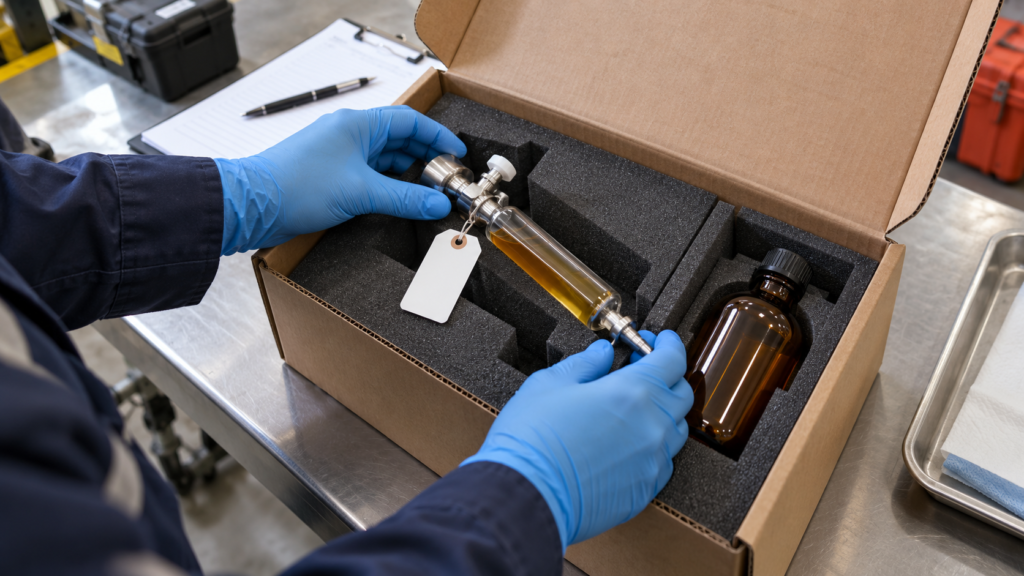
A container should remain supported throughout vehicle loading, parcel sorting and unpacking. Use the receiving laboratory’s approved packaging system, including separation and cushioning of fragile components. Avoid pressure on syringe fittings or unsupported glass ends. Check that the closure and protective insert work together; a rigid outer case alone does not prevent internal movement.
AVO Diagnostics’ oil sample packaging guidance emphasizes closed syringe valves, secure bottle caps, clear labeling and appropriate protective packaging. Follow the selected laboratory’s own details where its kit differs. Packing instructions should travel with the kit to the contractor responsible for dispatch.
Keep submission papers protected from leakage and readable without disturbing the sample unnecessarily. Put a duplicate electronic request into the laboratory’s approved submission channel. The electronic record should match the physical label exactly. An email attachment cannot rescue a parcel whose containers cannot be identified.
Avoid unsupported shipping assumptions
Do not classify every transformer oil sample as ordinary unrestricted cargo. Fluid composition, contamination history, quantity, route and the carrier’s requirements can change the applicable handling. Obtain the fluid information and have the responsible shipper confirm the classification and documents with the carrier. Where the history is uncertain, disclose that uncertainty instead of making a convenient declaration.
The same discipline applies to cross-border movements. Ask the laboratory and appointed logistics provider what they require for the actual origin and destination. This article does not assign a customs code, dangerous-goods classification or universal import permission. Those are shipment-specific decisions that must be settled before dispatch.

Track custody without creating a paperwork bottleneck
A useful custody record answers four questions: what was transferred, from whom, to whom and when? Link the sample identifier to the package reference, then record each transfer that changes responsibility. Include the person who can investigate a missed collection or damaged delivery. A parcel tracking number alone rarely identifies the transformer compartment or the requested test package.
At the site dispatch desk, compare the containers, work order and laboratory request in one check. Record the sampling date and time separately from the dispatch time. Attach relevant operating context supplied by the authorized engineer, such as load condition, oil temperature and recent treatment or maintenance. Do not invent missing readings retrospectively.
When a project involves several contractors, decide which party owns the sample until laboratory acceptance. The sampling contractor may leave before the courier arrives. The warehouse may receive the parcel without knowing it is time-sensitive. Name a receiving deputy so a shift change does not leave the package waiting in an uncontrolled location.
Measure turnaround from the site decision, not the laboratory bench
Break elapsed time into collection preparation, site-to-hub transport, main transit, receiving and registration, testing, interpretation and delivery of the report. Ask the laboratory when its quoted turnaround starts. Arrival at a building, acceptance into the laboratory system and commencement of analysis are different milestones.
For a planned outage, work backward from the decision meeting. Allow time for clarification and a possible replacement sample. For abnormal operation, escalate immediately through the owner’s engineering process; do not assume that an urgent courier booking makes continued operation acceptable. Operating decisions belong to the authorized asset team using the full condition picture.
Compare laboratory options using the total decision timeline and scope. A nearby laboratory offering the required validated tests may provide a more useful response than a distant service with a shorter advertised bench time. Conversely, an unusual fluid or specialist investigation may justify a longer route to the appropriate expertise. Record that trade-off before purchasing.

Close the loop when the laboratory receives the package
Request confirmation of the sample identifiers received, their condition, the accepted test scope and the expected report date. Distinguish courier delivery confirmation from laboratory acceptance. If the receiving team reports a damaged syringe, insufficient quantity or conflicting paperwork, the project coordinator should obtain a documented disposition promptly.
Check the report against the original request before distributing it as an asset record. Confirm transformer identity, compartment, sampling date, test methods, units and any laboratory qualifications. Keep the report linked to the work order and earlier condition history. Where results look inconsistent, discuss sampling and transport conditions with the laboratory as well as possible equipment causes.
Sites considering continuous monitoring still need a laboratory confirmation process. The online DGA retrofit readiness review addresses monitor interfaces; the dispatch plan provides a separate route for a properly identified laboratory sample when the engineering team needs one.
Put responsibilities and costs into the purchase package
Request separate prices for the sampling kit, field collection, transport, analytical package, technical interpretation and urgent handling where available. Clarify which party supplies packing materials, prepares shipping documents and pays for recollection following a rejected sample. These details make competing offers comparable and expose gaps before mobilization.
The handover package should include the approved laboratory contact list, route plan, kit inventory, submission template and escalation procedure. Train the dispatch coordinator as well as the electrical team. Review the route after the first completed shipment using actual dates and recorded problems. A small correction to collection timing may be more valuable than negotiating a marginally faster laboratory service.
For multi-site owners, standardize the identifiers and request format while retaining site-specific transport arrangements. Do not impose a single route on coastal, inland and high-altitude sites without checking access and service coverage. Dust, humidity, seasonal road access and storage conditions are survey inputs, not assumptions about an entire region.
Plan the transformer and the support route together
For a new 10 MVA 33/11 kV oil-immersed transformer package or a Силовой трансформатор 110/115 кВ project, coordinate the sampling interface, fluid documentation and maintenance support plan during procurement. The final equipment rating and configuration must follow the project specification, not the example product designation.
To review transformer oil sample logistics with Zisheng Electric, provide the transformer drawings and datasheets, compartment and sampling-point schedule, fluid information, proposed test package, load list, technical specification, single-line diagram, grid parameters, environmental conditions and installation-site access details. Include the intended laboratory and available transport route so the interfaces can be reviewed together. Our engineering team will review the requirements and respond to project inquiries within 24 hours.
О компании ZISHENG ELECTRICAL
Жишэнг является профессиональным производителем с более чем 19-летним опытом масляных трансформаторов, Компактная подстанция, Трансформаторы в пневматических установках, полевые трансформаторы и Сухие трансформаторы. У нас есть сертификаты ISO/CE/IEC 60076 и TUV Rheinland.
Трансформаторы проходят строгие испытания FAT и аттестацию типа, поддерживают настройку напряжения/емкости. Добро пожаловать на консультацию по Каталог и Продукт. вы можете связаться с нами по электронной почте [email protected].