Island Grid Transformer Specification: Generator Interfaces, Voltage Stability and Salt Exposure
Zisheng Electric works with utilities, EPC contractors and industrial owners that need transformer specifications to reflect the electrical behavior of a small or weak grid—not just the nominal kVA and voltage ratio. An island grid transformer specification must account for generator stiffness, switching steps, renewable variability, salt-laden air, limited spare capacity and the practical difficulty of replacing equipment after delivery. These factors interact. A transformer that appears acceptable on a standard datasheet can still create voltage instability, nuisance protection trips or unacceptable recovery times after a generator or feeder event.
This guide explains how to turn island-grid operating data into procurement requirements. It is written for engineers preparing inquiry documents, evaluating bids or coordinating transformer interfaces with diesel generation, solar-plus-storage systems and local distribution switchgear.
Why an Island Grid Transformer Specification Requires System-Level Inputs
Large interconnected networks usually provide a comparatively stiff voltage source and multiple paths for balancing disturbances. Island systems often have fewer online generators, longer feeders and larger individual load steps relative to available generation. The transformer therefore participates in a system whose source impedance and short-circuit level can change substantially as generators start, stop or operate in parallel.
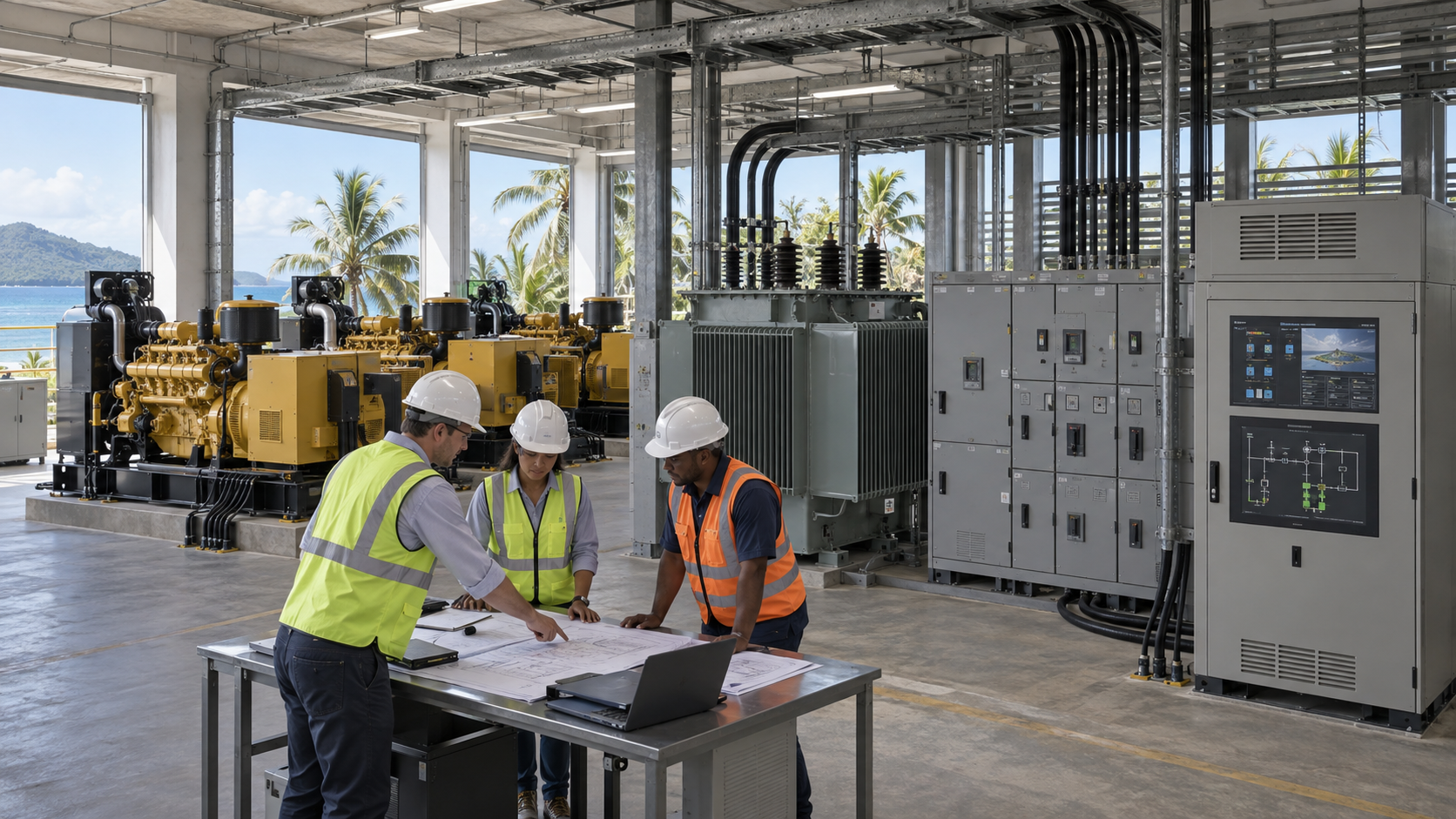
The purchaser should define the credible operating configurations, not only the maximum demand. Minimum generation, night operation, maintenance outages, renewable curtailment and emergency black-start conditions may produce the most demanding voltage or thermal case. Zisheng Electric recommends that these scenarios be captured in a simple operating matrix before transformer impedance, taps, losses or cooling margins are frozen.
Define the Source, Load and Operating Scenarios
Generator data and short-circuit contribution
Provide generator rated power, voltage, frequency, subtransient and transient reactance, grounding method, excitation system characteristics and expected parallel combinations. The transformer manufacturer does not need to perform the complete power-system study unless this is included in scope, but the procurement team must ensure that the selected impedance does not undermine protection sensitivity or motor-starting performance.
Load composition and step changes
A single large motor, desalination train, cold-storage compressor or hotel chiller may represent a significant percentage of the online generation. Record direct-on-line and reduced-voltage starting methods, starting current, acceleration time, cyclic duty and the largest coincident load step. Power-electronic loads should be identified separately so harmonic current and displacement power factor are not hidden inside a single average demand figure.
Renewable and storage interfaces
Solar inverters and battery energy storage can support voltage and frequency, but their controls, current limits and fault contribution differ from rotating machines. The transformer specification should identify whether it serves inverter output, auxiliary loads, conventional distribution feeders or a mixed bus. The actual harmonic spectrum, DC current limits and grounding philosophy remain project-specific and should be confirmed by the system integrator.
Decision Table for the Procurement Datasheet
| Input to confirm | Engineering decision | Risk if omitted |
|---|---|---|
| Online generator combinations and minimum short-circuit level | Transformer impedance and protection sensitivity | Slow fault clearance or excessive voltage dip |
| Largest load and motor-starting sequence | Tap range, voltage-drop allowance and thermal margin | Failed acceleration or nuisance undervoltage trips |
| Renewable/BESS converter data | Harmonic review, winding connection and insulation duties | Unexpected heating or control interaction |
| Ambient temperature, salt exposure and humidity | Cooling rating, coating system and accessory materials | Corrosion, leakage or reduced service life |
| Available lifting, road and port limits | Shipping dimensions, removable parts and site assembly plan | Delivery delay or unsafe handling |
| Critical spare philosophy | Common accessories, bushings, relays and recommended spares | Extended outage after a minor component failure |
Impedance, Taps and Voltage Recovery
Transformer impedance is not a value to maximize or minimize in isolation. A higher impedance can reduce fault current but increases voltage drop during motor starting and load steps. A lower impedance improves regulation but raises available fault current and may change breaker or protection requirements. The procurement team should compare study results for normal, minimum-generation and contingency configurations.
Off-circuit taps may be sufficient where system voltage changes slowly and planned outages are available. An on-load tap changer may be justified when voltage varies across operating modes and continuity is critical, but it introduces additional control, maintenance and spare-part requirements. Specify the regulating objective, control ownership, line-drop compensation philosophy and permissible interaction with generator automatic voltage regulators. Avoid asking two independent controllers to correct the same voltage without a coordinated deadband and time delay.
Thermal Design for Cyclic and Distorted Loads
The nameplate load alone does not describe transformer heating. Island systems may alternate between low nighttime demand and sharp daytime or process peaks. Harmonic currents from variable-frequency drives, rectifiers, UPS systems and inverters add winding and stray losses. The supplier should receive the expected load profile and, where material, a measured or calculated harmonic spectrum.
Specify the ambient design basis and enclosure ventilation conditions. If fans or pumps are used, define alarm contacts, control supply, stage settings and the rating available after loss of one cooling group. For a critical island feeder, dependence on a single auxiliary fan circuit can be a larger reliability risk than a modest increase in initial transformer size.
Coastal Corrosion and Moisture Control
Salt aerosol, high humidity and ultraviolet exposure accelerate corrosion and tracking, especially at fasteners, radiator edges, marshalling boxes and cable-entry points. The site data should state distance from the shoreline, whether the transformer is sheltered, expected wash-down practices and any owner coating standard. Generic labels such as “marine duty” are not sufficiently precise for bid comparison.

Useful specification details include coating system and preparation requirements, fastener materials, sealed cable boxes, breather or conservator arrangement, anti-condensation heaters, cabinet ventilation and terminal material compatibility. These items affect maintenance workload and should be reviewed together rather than as isolated options.
Grounding and Protection Interfaces
Confirm the grounding method for each winding and the location of neutral current transformers or grounding resistors. Protection settings depend on transformer vector group, impedance, source contribution and the sensitivity required for earth faults. The transformer terminal arrangement must also coordinate with surge arresters, cable screen bonding, switchgear CTs and the station earthing grid.
Ask bidders for guaranteed losses, impedance tolerances, temperature-rise basis and accessory contact schedules. During design review, reconcile these values with the protection study and single-line diagram. A mismatch discovered during commissioning is difficult to solve on an island where test resources and replacement hardware may be limited.
Transport, Installation and Spares Strategy
Island logistics can determine the practical transformer configuration. Confirm vessel and port limits, crane capacity, turning radii, bridge restrictions, site gradients and available laydown area. If radiators, conservator, bushings or cable boxes will be removed for transport, the quotation should identify shipping splits, preservation methods, assembly tools, oil-handling requirements and supervision scope.
Spare selection should follow failure consequence and lead time. Common recommendations may include gaskets, fans, control relays, temperature sensors, oil-level devices and one compatible bushing where outage exposure justifies it. The owner should also require final drawings, settings, test reports and an accessory list with manufacturer and model references.
Factory and Site Tests That Support Grid Readiness
Factory acceptance should verify the contractual electrical characteristics and the interfaces needed for installation. The project specification should identify routine tests, any agreed special tests, accessory functional checks, alarm/trip simulation and document review. Test acceptance criteria must be agreed before manufacturing is complete.
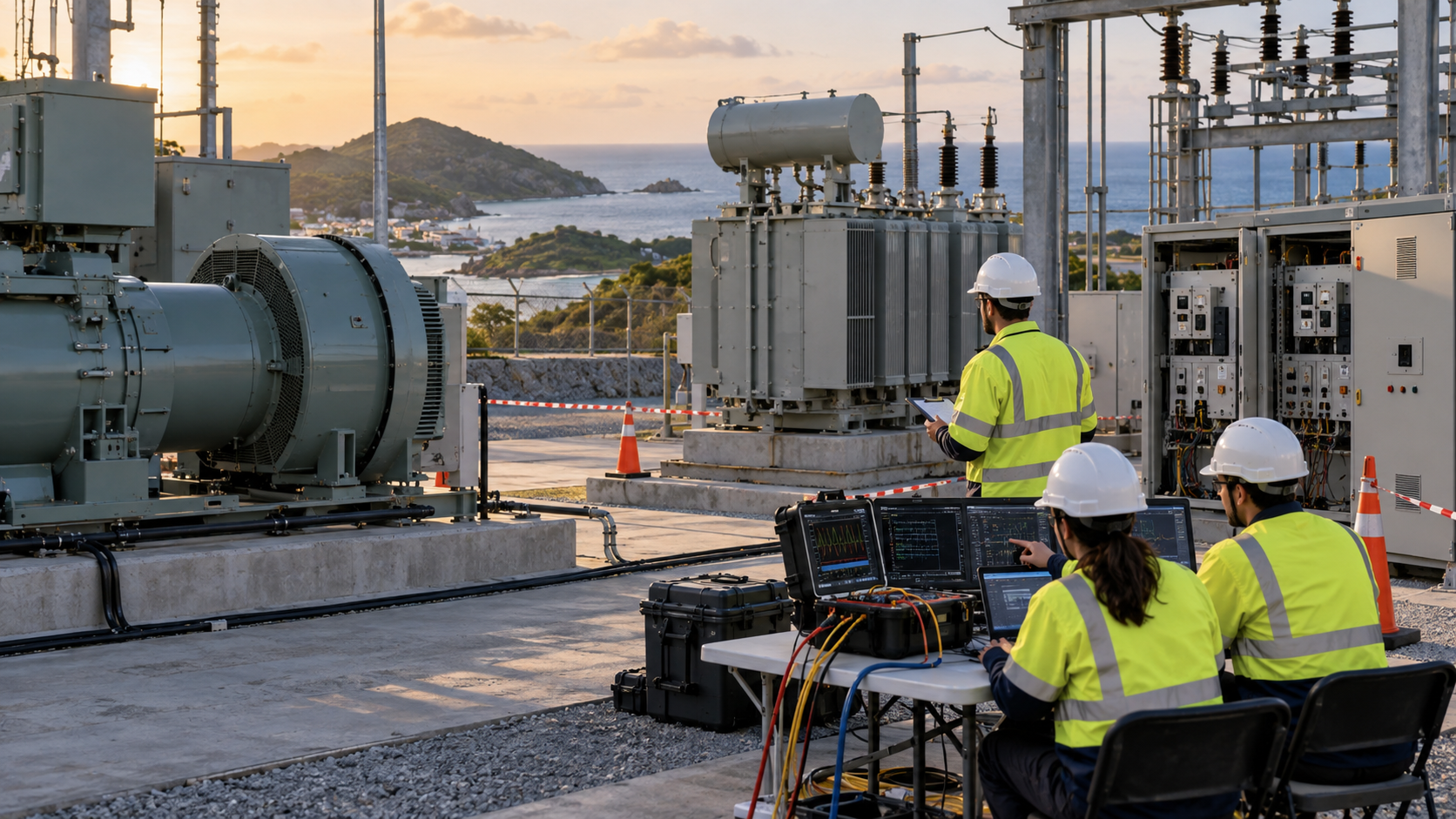
At site, confirm earthing, phase identification, ratio and vector group, insulation condition, oil condition where applicable, protection wiring, cooling controls and mechanical checks before energization. A staged energization plan should identify the initial source, unloaded observation period, load pickup sequence, voltage checkpoints and authority to stop the process. Black-start and restoration procedures must be owned by the utility or system operator and coordinated with generator controls.
How to Issue a Clear Island Grid Transformer Specification
Issue one controlled datasheet supported by the single-line diagram, load list and operating matrix. Mark values as guaranteed, indicative or pending confirmation. Bid clarifications should close technical deviations explicitly; accepting a quotation while leaving impedance, taps, coating, accessories or transport splits “to be confirmed” transfers risk into the manufacturing period.
For related equipment, review Zisheng Electric’s oil-immersed transformer, substation transformer and dry-type transformer options. Further regional procurement considerations are covered in our guides to industrial park transformers, desalination plant transformer selection and pad-mounted transformer procurement.
Request an Engineering Review
A robust island grid transformer specification connects equipment design to the real operating modes of the island network. Send Zisheng Electric the drawings, datasheets, load list, technical specification, single-line diagram, grid parameters, environmental conditions and installation-site constraints. We can review voltage regulation, impedance, taps, cooling, corrosion protection, transport splits, factory tests and documentation before the purchase order is finalized. Our engineering team will review the requirements and respond to project inquiries within 24 hours.
About ZISHENG ELECTRICAL
Zisheng are a professional 19+ years manufacturer in producing Oil-Immersed Transformers, Compact Substation, Pad Mounted Transformers, Pole Mounted Transformers and Dry Type Transformers. We own the certificates of ISO/CE/IEC 60076 and TUV Rheinland.
Transformers undergo rigorous FAT and type testing, support voltage/capacity customization. Welcome to consult for Catalog and Product. you can contact us at email [email protected].