Qatar Airport Transformer Procurement: Terminal Loads, Chiller Restart and Standby Transfer
Airport transformer procurement is easy to underestimate. A terminal expansion may look like a conventional commercial project on the load schedule, yet its electrical system has to serve baggage handling, passenger boarding bridges, security equipment, airfield support, data rooms, retail areas, pumps, ventilation and a large cooling plant. Many of those loads change quickly, and some must transfer to standby power without disrupting critical airport functions.
At Zisheng Electric, we review a Qatar airport transformer enquiry from the complete operating chain: utility or substation source → medium-voltage switchgear → transformer → low-voltage board → motor or electronic load → protection and transfer logic. The transformer rating is only one decision in that chain. The more difficult work is defining which loads operate together, how they restart after an interruption, and what the transformer must tolerate during abnormal but credible operating states.
Start with the airport electrical architecture
A connected-load total does not show the real transformer duty. The EPC team should separate life-safety and operationally critical loads from non-critical commercial loads, then map each group to its normal and emergency source. A transformer may be lightly loaded in normal operation but exposed to a severe step load when a feeder is transferred, a standby unit is returned to service or a cooling train restarts.
For EPC enquiries, our engineers usually ask for the single-line diagram, load schedule, motor list, load classifications, redundancy philosophy and generator operating cases before confirming capacity. If those documents are still developing, the quotation should state the design assumptions clearly. Silent assumptions become expensive during commissioning.
Normal, maintenance and emergency states are different
Review at least the normal operating state, the planned-maintenance state, the loss of one transformer or feeder, and the generator-supported state. The highest connected load is not automatically the highest thermal duty. A contingency state can combine more loads on fewer transformers. Emergency operation may be short, but the voltage drop during motor restart or automatic transfer can still trip downstream equipment.
| État du projet | Risque lié au transformateur principal | Engineering and procurement check |
|---|---|---|
| Terminal load transferred to one remaining source | Contingency loading exceeds the assumed continuous duty | Provide load flow for normal, maintenance and single-failure states; define permitted duration and loading limit. |
| Chiller, pump or fan restart after voltage recovery | Large current step causes excessive voltage dip or protection operation | Submit motor ratings, starting method, acceleration time and restart sequence. |
| Baggage conveyors and boarding-bridge drives | Frequent starts and variable-frequency drives add thermal and harmonic duty | Identify drive topology, current spectrum, duty cycle and simultaneous operation. |
| Standby generator energizes a transformer | Inrush current depresses generator voltage or causes nuisance tripping | Coordinate transformer inrush, generator subtransient data, breaker sequence and protection settings. |
| Phased terminal expansion | Initial low loading makes no-load loss commercially important; later phases remove margin | Compare losses at realistic load points and reserve physical and electrical expansion capacity deliberately. |
Use Qatar connection data that belongs to the project
Country-level assumptions are not enough for transformer design. The applicable Kahramaa requirements, point-of-connection voltage, fault level, earthing arrangement and approved consultant specification must be identified for the actual airport package. Qatar’s published Low Voltage Electricity Wiring Code identifies a nominal low-voltage supply of 415/240 V at 50 Hz. That is a useful interface reference, but it does not replace the project’s approved medium-voltage data or connection agreement.
Frequency affects volts-per-hertz and the core design. Fault level and system X/R ratio influence switchgear ratings and the transformer’s short-circuit duty. Earthing determines neutral insulation, protection philosophy and the treatment of cable screens and earth conductors. The transformer ratio, vector group and neutral arrangement should therefore be frozen with the network study, not copied from an earlier building.
A technically useful enquiry states the source voltage and variation, frequency, highest voltage for equipment, insulation level, system earthing, prospective fault current, required impedance and tap range. If the utility interface is not final, mark the values as provisional and identify the decision date. Procurement can then see the risk instead of pricing a false certainty.
Motor starting must be reviewed as a system event
Airport cooling and ventilation systems can dominate the step-load case. A transformer may carry the running load comfortably and still produce an unacceptable voltage dip when a large motor starts. The result can be contactor dropout, drive undervoltage trips, lighting disturbance or failure of another motor to accelerate.
The calculation needs more than motor kilowatts. Ask for locked-rotor current or converter input current, starting power factor, acceleration time, starting method, number of starts, supply impedance and the loads that remain connected. A variable-frequency drive often reduces direct starting current, but it adds rectifier harmonics and may have its own undervoltage behavior. Soft starters also change the current profile; they do not make the starting study unnecessary.
La Qatar district-cooling transformer procurement guide explains why chiller sequencing and plant restart must be treated as operating cases. For an airport, apply the same discipline across chilled-water plants, air-handling systems, pumping stations and building-management logic.
Electronic loads change the thermal review
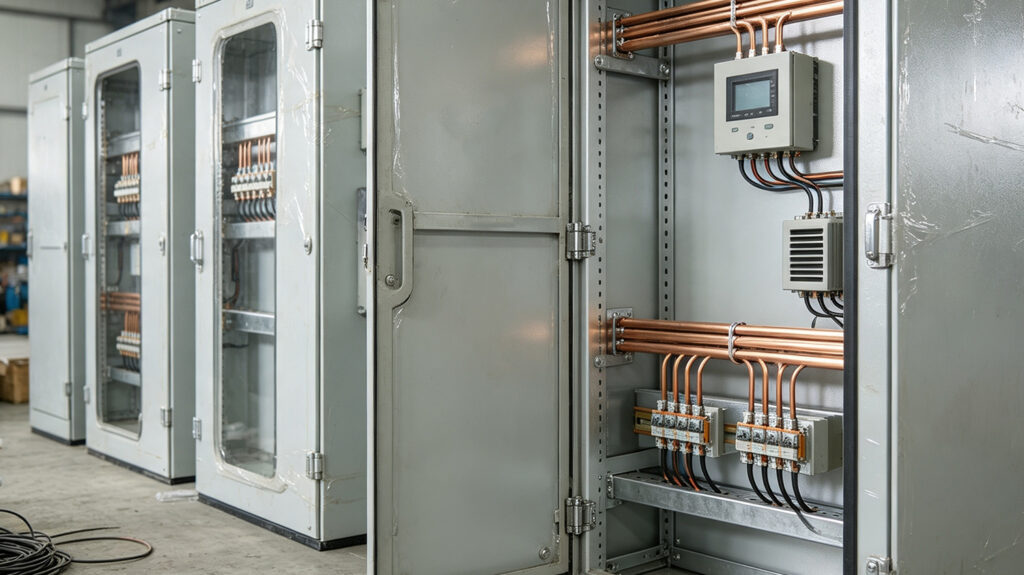
Security systems, flight-information displays, IT equipment, LED lighting, UPS inputs and variable-frequency drives draw non-sinusoidal current. Harmonics increase RMS current and can add winding eddy and structural stray losses. Triplen harmonics can accumulate in a four-wire neutral. A generic statement such as “nonlinear loads included” does not give the transformer designer enough information.
Submit the expected current spectrum, total harmonic distortion, operating load factor, neutral current and duty cycle for the main nonlinear load groups. Distinguish measured vendor data from study assumptions. During our design review, we check whether the harmonic case occurs at full current or only at a low operating point. Heating depends on both the spectrum and the actual RMS current.
The transformer, busduct, neutral conductor, switchboard and protection settings should use one agreed harmonic basis. The UAE critical-power transformer guide provides a related review of UPS harmonics, redundancy and generator operation, although an airport’s load priorities and transfer sequence must be developed independently.
Choose oil-immersed or dry-type from location and risk control
There is no universal airport answer. A cast-resin à sec may suit an indoor electrical room near the load center where oil containment and external fire separation would complicate the layout. The room still needs adequate ventilation, verified enclosure airflow, inspection access, noise control and a removal route.
En plein air transformateur immergé dans l'huile may be preferable for higher ratings or a dedicated substation compound. Its design package must coordinate oil containment, drainage, separation, firefighting interfaces, radiator clearance, cable routes and maintenance access. Moving the transformer outside does not remove the interface work; it changes the disciplines involved.
For a larger airport network, a transformateur de sous-station may feed several terminal or utility substations. Compare options using the complete route from transformer to load. Long low-voltage feeders can make a remote transformer inefficient even if the equipment price is lower.
Qatar climate inputs must be translated into design values
The word “Qatar” does not define a thermal design case. The specification should state maximum ambient temperature, daily and annual averages where required, solar exposure, indoor room temperature, altitude, humidity, airborne dust and any coastal salt exposure relevant to the actual location. An indoor transformer room beside a chilled terminal and an outdoor airfield substation experience different microclimates.
High ambient temperature reduces thermal margin. Solar gain can increase enclosure and tank surface temperature. Dust can restrict air paths and contaminate insulators; salt-bearing moisture adds corrosion and surface-leakage risk. The response may involve cooling capacity, radiator arrangement, enclosure design, filtration, corrosion protection, gasket materials, creepage selection and maintenance access. These choices should trace back to the site data rather than to a marketing label such as “desert type.”
Impedance connects voltage regulation, fault duty and protection
Transformer impedance limits downstream fault current, but it also affects voltage drop during starting and transfer events. A higher value may reduce switchgear duty while worsening motor-start voltage. A lower value can improve voltage regulation but raise prospective fault current beyond an existing board’s rating.
Do not select impedance from a standard datasheet in isolation. Reconcile it with the short-circuit study, motor-starting study, protection coordination and parallel-operation requirement. When transformers operate in parallel, ratio, vector group, tap position and impedance magnitude and angle need coordinated review. Procurement should require guaranteed impedance and the applicable tolerance because the delivered value enters the final studies.
Define FAT around airport interfaces
Routine transformer tests remain essential, but the FAT agenda should also close the interfaces that commonly delay an airport package. Approved drawings, terminal schedules, alarm and trip lists, CT data, auxiliary supply diagrams and cable-box details should be available before the witness date.
| FAT or document item | Pourquoi est-ce important | Preuve d'acceptation |
|---|---|---|
| Rapport, couplage et résistance des enroulements | Confirms connection, tap progression and winding continuity | Signed report covering the specified tap positions and temperature correction. |
| No-load loss, load loss and impedance | Feeds lifecycle-cost, voltage-drop and fault studies | Measured and corrected values compared with guarantees and contractual tolerances. |
| Dielectric routine tests | Checks the agreed insulation duty | Test levels, duration, connections and result recorded against the approved datasheet. |
| Cooling and accessory functional checks | Incorrect contact logic appears later as BMS or SCADA faults | Simulated alarms, trips, fan stages and terminal numbers recorded. |
| GA, cable box and busduct interfaces | Small dimensional errors can block installation | Measured critical dimensions and released drawings with deviations closed. |
| Nameplates and labels | Airport maintenance teams need clear asset and isolation identification | Approved wording, durable labels and photographs tied to equipment tags. |
A successful electrical test does not compensate for an inaccessible cable box, reversed terminal designation or an unapproved change to a marshalling cabinet. At Zisheng Electric, we normally review open technical comments before FAT so the witness event verifies a defined unit instead of becoming a design meeting.
Witness responsibilities also need dates and named reviewers. The transformer supplier should receive the approved FAT procedure, final datasheet and drawing revisions early enough to prepare the test setup. The EPC team should identify which results require immediate acceptance, which documents can follow in the final manufacturing record and who has authority to release shipment. Without that agreement, a technically satisfactory test can still leave the unit waiting in the factory while comments circulate between consultant, contractor and owner.
Build the procurement package around decisions
Pour un Qatar airport transformer quotation, send the single-line diagram, load schedule, motor list, harmonic data, normal and emergency operating cases, generator information, short-circuit study, protection philosophy, site conditions, room or compound layout, cable or busduct details, monitoring I/O list and required FAT scope. State the project stage and identify provisional inputs.
Zisheng Electric can supply oil-immersed transformers, dry-type transformers and substation equipment matched to the actual airport distribution architecture. Capacity, voltage level, environmental conditions and technical specifications should be reviewed together. Notre équipe d'ingénieurs examinera vos besoins et répondra à vos demandes concernant le projet dans un délai de 24 heures.
À propos de ZISHENG ELECTRICAL
Zisheng sont un fabricant professionnel avec plus de 19 ans d'expérience dans la production Transformateurs immersés dans l'huile, Sous-station compacte, Transformateurs montés sur socle, Transformateurs montés sur poteau et Transformateurs à sec. Nous possédons les certificats de ISO/CE/IEC 60076 et TUV Rheinland.
Les transformateurs subissent des tests de FAT rigoureux et des essais de type, prenant en charge la personnalisation de la tension/capacité. Bienvenue pour consulter pour Catalogue et Produit. vous pouvez nous contacter par email [email protected].