Core Type vs Shell Type Transformer: 5 Buying Checks
Core-type transformers place windings around the magnetic core legs. Shell-type transformers arrange the core around the winding package. Choosing a core type vs shell type transformer therefore starts with construction, but the purchase decision must rest on the performance and interfaces of the offered design. Neither label, by itself, proves lower losses, a smaller footprint or better fault withstand.
For an industrial power-transformer enquiry, Zisheng Electric recommends comparing the same electrical duty, documented guarantees and site constraints before accepting a construction preference. This guide helps procurement engineers separate a useful design requirement from an unsupported sales comparison.

Core Type vs Shell Type Transformer: What Changes?
The magnetic core provides a path for alternating magnetic flux. The windings transfer energy through that changing flux. Both constructions use these same operating principles; the difference is their physical arrangement.
In a typical core-type design, cylindrical winding assemblies surround core legs. In a shell-type design, the magnetic structure surrounds a winding assembly, with return paths around it. These are broad descriptions, not a manufacturing drawing. Phase arrangement, winding geometry, insulation layout and the number of core limbs depend on the specific design.
Hitachi Energy describes these distinctions in its separate core-type et shell-type transformer references. A supplier’s published advantages apply to its designs and stated applications; they are not automatic guarantees for every transformer using the same construction.
Core type and shell type also differ from oil-immersed and dry-type classifications. The first pair describes the magnetic and winding arrangement. The second describes the insulation and cooling approach. Keep these fields separate in an enquiry so bidders understand which requirement is mandatory.
Compare the Guarantees Before the Construction Label
| Point de décision | Ce qu'il faut demander à chaque soumissionnaire | Why it affects selection |
|---|---|---|
| Losses and efficiency | No-load and load-loss guarantees, reference conditions and tolerances | A construction name cannot establish the operating cost of a particular offer. |
| Short-circuit duty | Specified fault conditions and the agreed design-verification evidence | Mechanical adequacy depends on the complete winding and support design. |
| Cooling and rating | Rated output for each cooling stage and the corresponding thermal limits | Different cooling equipment or operating conditions can make nominal ratings misleading. |
| Transport and installation | Shipping dimensions, mass, disassembly scope and assembled envelope | A smaller active part does not necessarily produce an easier site delivery. |
| Service support | Inspection access, repair strategy, spares and competent service provision | Lifecycle practicality depends on the actual equipment and available support. |
Use one comparison basis throughout. A bid with additional fans, different loss guarantees or a different tap range is not directly comparable merely because its rated apparent power is the same. Apparent power, expressed in kilovolt-amperes or megavolt-amperes, describes the voltage-current rating; it does not capture all operating constraints.
Fault Withstand Needs Evidence
Statements such as “shell type is always stronger” or “core type is unsuitable for heavy industrial duty” are too broad for procurement approval. Electromagnetic forces, winding support, conductor arrangement, clearances and manufacturing control all contribute to the finished transformer’s behaviour.
Give bidders the project fault-duty requirements and ask how the offered design will be verified under the contractually applicable standard. Agree what evidence is acceptable: a design review, relevant test evidence, calculations or a specified test programme. A reference test must be assessed for its relevance to the offered design; it is not interchangeable with a test on that exact unit.
Do not turn a construction preference into a substitute for this review. If an owner mandates one design family, record that requirement and its technical reason. If alternatives are allowed, evaluate each against the same acceptance criteria and resolve deviations before order placement.
Check the Whole Delivery Envelope
Transport comparisons should use the manufacturer’s proposed shipping arrangement. Ask whether bushings, radiators, conservator equipment or other assemblies travel separately, and identify the site work needed to restore the service configuration.
A route study may impose limits on overall height, bridge loading, turning space or lifting operations. The foundation review needs the relevant installed loads and support details. These cannot be inferred from a sketch showing the core and windings.
On a constrained industrial site, terminal positions can be as decisive as tank dimensions. Compare cable-box access, bus connection geometry, cooling-equipment clearance and the path needed for future component replacement. A technically compliant transformer can still create costly interface changes if these details arrive after the civil design is frozen.
Environmental requirements also belong in the common enquiry. State altitude, ambient conditions, contamination exposure and any special enclosure requirements. Projects in Central Asia or Latin America require the applicable owner, utility and local requirements to be confirmed individually; the country name does not establish a universal transformer configuration.
Use a Common Bid Sheet
Consider a hypothetical industrial expansion where two technically acceptable suppliers propose different constructions. The useful comparison is not a generic list of advantages. It is a common schedule showing whether each offer satisfies the same duty and where its obligations differ.
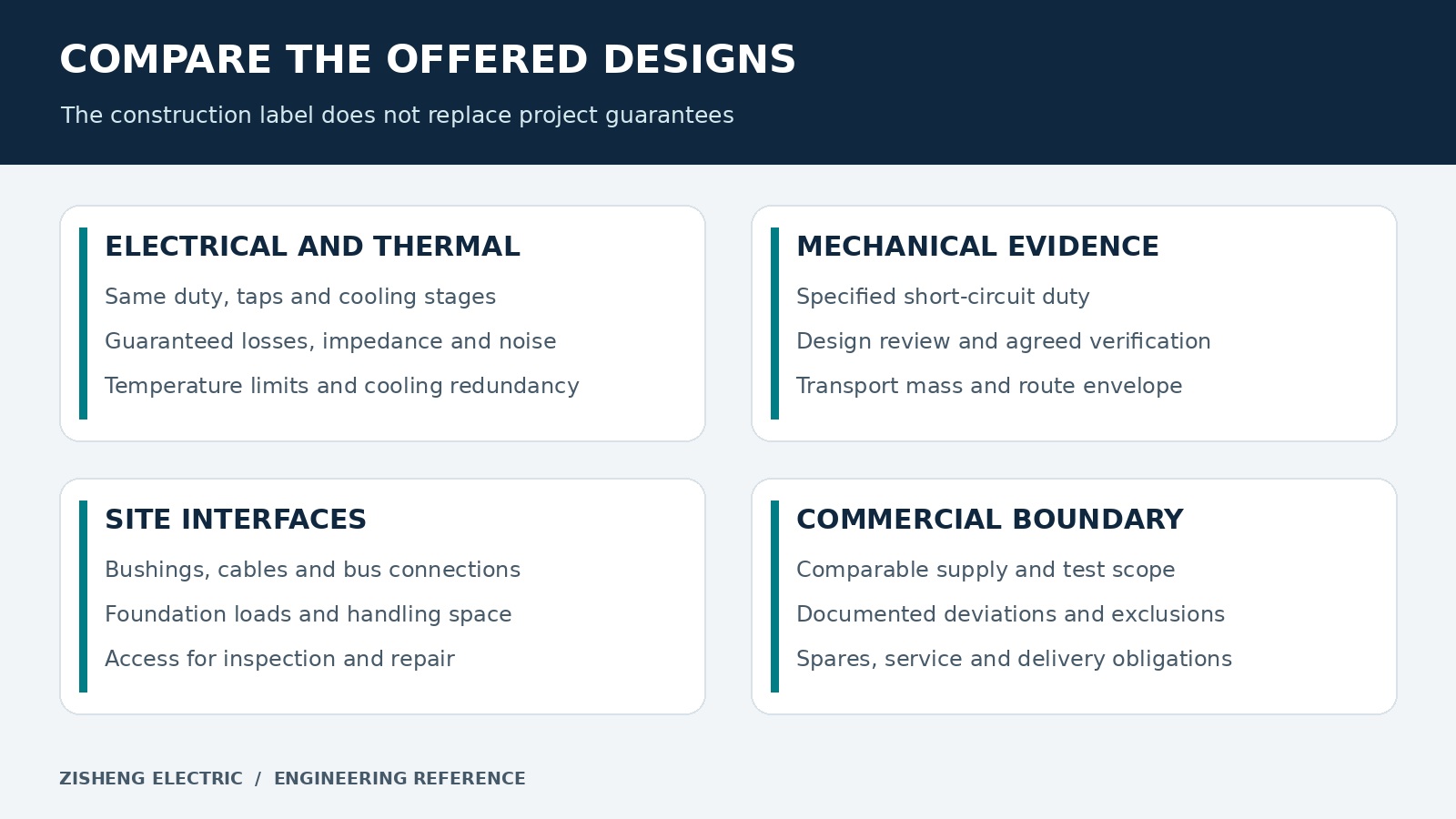
- Freeze rated output, winding voltages, frequency, connection arrangement, tap requirements and cooling stages.
- Obtain comparable guaranteed losses, impedance, temperature limits and sound requirements with their stated conditions.
- Close the short-circuit verification approach and the inspection and test scope.
- Compare shipping and installed envelopes, foundation interfaces and assembly responsibilities.
- Price documented deviations, required site changes, service support and spare-parts obligations.
There is no measured result or real delivery behind this example. Its purpose is to show how a buyer can evaluate alternatives without assigning an invented efficiency advantage or fault rating to either construction.
For the wider terminology behind these fields, see our power transformer guide. Le Gamme de transformateurs à bain d'huile provides a starting point for discussing a project configuration; availability of a particular construction must be confirmed in the supplier’s technical proposal.
Questions Buyers Commonly Ask
Is a shell-type transformer always more efficient?
No. Compare the offered loss guarantees under the same reference conditions and at the relevant operating duty. Core and winding materials, geometry and design choices matter. A generic construction description is insufficient to calculate an energy-cost difference.
Should an existing core-type unit be replaced by the same construction?
It may simplify some technical reviews, but it does not establish interchangeability. Confirm terminal locations, impedance requirements, protection interfaces, transport restrictions and installation details. The replacement decision should follow the owner’s approved specification and the actual offered drawings.
Discuss the Offered Design with Zisheng Electric
Send the required rating, winding voltages, frequency, duty, site limitations and any owner-mandated construction preference. If you are comparing two offers, include their guarantee schedules and drawings. The practical next step is a documented review of compliance and interfaces, followed by confirmation of the construction and scope available for your project.
À propos de ZISHENG ELECTRICAL
Zisheng sont un fabricant professionnel avec plus de 19 ans d'expérience dans la production Transformateurs immersés dans l'huile, Sous-station compacte, Transformateurs montés sur socle, Transformateurs montés sur poteau et Transformateurs à sec. Nous possédons les certificats de ISO/CE/IEC 60076 et TUV Rheinland.
Les transformateurs subissent des tests de FAT rigoureux et des essais de type, prenant en charge la personnalisation de la tension/capacité. Bienvenue pour consulter pour Catalogue et Produit. vous pouvez nous contacter par email [email protected].