
Transformer Nameplate Approval for Latin American EPC Imports: Data, Drawings and Release Gates
A technically sound transformer enquiry can still have a weak document trail. The rating has been selected, the supplier has offered a unit, and the EPC team expects to release manufacture. Yet the data sheet, general arrangement, proposed nameplate, test schedule and local handover package describe slightly different equipment. For an imported transformer on a Latin American industrial project, transformer nameplate approval is a practical control point: it ties the machine the buyer ordered to the machine that will be tested, shipped, installed and maintained.
This guide is for EPC contractors, industrial owners and distributors managing a project-specific procurement package. Latin America is a broad region with different utilities, codes, languages and site conditions. No voltage, frequency, certification or nameplate wording should be assumed from a regional label. Obtain the actual connection requirements and approved project specification before freezing the purchase order.
Why transformer nameplate approval belongs before factory release
The plate is a compact identity record, but it cannot carry the entire contract. It should agree with the approved technical data and with the equipment as built. A mismatch in winding voltages or tap range may affect connection and regulation. A different impedance declaration can change the basis of a fault or voltage study. An accessory may be fitted yet absent from the maintenance documents. Each discrepancy has a different owner and consequence.
Transformer nameplate approval should therefore be a controlled comparison, not a glance at an artwork file. Ask the manufacturer for a proposed nameplate drawing early enough to resolve substantive changes before engraving or final assembly. Record the exact equipment tag, drawing revision, approval status and outstanding comments. The EPC electrical lead can then compare it with the single-line diagram and study assumptions, while the purchaser checks contractual identity and the site team checks readability and access.
For an imported production line, nameplate review must also follow the machine’s real supply duty. Our transformer frequency compatibility review explains why a voltage change alone cannot settle an equipment frequency mismatch. The transformer plate must reflect the approved transformer design; it cannot certify the suitability of a connected machine.
Set one document baseline
Start with a revision-controlled set: purchase specification, completed transformer data sheet, single-line diagram, load list, approved deviations, general arrangement, terminal or cable-box drawing, schematic and inspection plan. Identify the revision used for the offer and the revision accepted for manufacture. If an owner issues a new drawing after award, classify the change and determine whether the supplier’s design and price must be revisited. An email saying “use the latest drawing” gives neither team a safe baseline.
El technical deviation register guide gives a method for tracing accepted exceptions through drawings and order attachments. Here the narrower task is to prove that each accepted decision reaches the final plate and handover file.

Build a decision matrix for transformer nameplate approval
Use a matrix with an owner, evidence and release gate. The entries below are prompts, not a universal list of required plate fields. The governing product standard, contract and responsible authority determine the final content and format.
| Artículo de reseña | Compare against | Por qué es importante | Closure evidence and owner |
|---|---|---|---|
| Equipment identity and serial reference | Purchase order, tag schedule, packing list | Prevents test records or spare parts being assigned to the wrong unit | Manufacturer’s plate artwork and final serial-number cross-reference; purchaser verifies |
| Rated power and cooling designation | Approved data sheet and load study | Changes the continuous-duty basis and auxiliary dependencies | Approved rating schedule and cooling drawings; electrical lead verifies |
| Winding voltages, connection and taps | Single-line diagram, network data and tap schedule | Affects terminations, regulation and energization checks | Design review comments closed with manufacturer; system engineer verifies |
| Frequency and impedance declaration | Approved enquiry and system study | Frequency affects design duty; impedance informs fault and voltage calculations | Guaranteed data and applicable test evidence reconciled; study engineer verifies |
| Insulation and terminal identification | Insulation coordination and connection drawings | Misidentification creates interface and acceptance risk | Approved terminal plan, drawings and inspection record; EPC verifies |
| Mass, oil and handling information | Transport plan, foundation and lifting documents | Changes delivery, containment and installation planning | As-built handling and shipping data; logistics and civil leads verify |
| Language, format and durability | Contract, owner and destination authority requirements | Operators must identify the installed asset and instructions over its service life | Approved artwork and site access check; purchaser and operator verify |
A field can be technically correct and still be unusable if it refers to the wrong unit, an obsolete drawing revision or an operating condition that the project has not approved. Conversely, a cosmetic artwork correction should not delay an unrelated test. Assign each comment a consequence and a clear hold point.
For an IEC-based contract, consult the official IEC 60076-1:2011 publication record for the scope of the general power-transformer standard. Record the edition specified by the project and use the licensed standard for detailed requirements. This review matrix is a procurement aid; it does not replace the applicable standard or destination approval process.
Separate the electrical design from the commercial description
Buyers often copy a marketing product title into a requisition. That is a useful starting point, not a guaranteed project configuration. A page for a Transformador de potencia de 10 MVA, 33/11 kV, sumergido en aceite describes a product family; the actual site still needs its own connection, taps, impedance, cooling, insulation and environmental basis. The final plate must follow the approved equipment, not an illustrative web listing.
Likewise, a 400kVA oil-immersed distribution transformer may be relevant to a smaller industrial feeder, but the rating alone cannot establish the destination voltage or installation arrangement. Do not infer a country’s grid parameters from another project or from a catalog example. Request written connection data from the responsible utility, owner or engineering designer.
Trace a changed parameter through its consequences
Suppose the approved data sheet specifies a certain tap arrangement and a late drawing proposes another. The reviewer should identify the source voltage envelope, intended operating tap, tap-changing method and the downstream equipment limits. The manufacturer assesses the winding design and offered configuration; the system engineer checks the network consequence; the owner accepts the operating basis. Only then should the drawing and plate be revised. No universal tap position or voltage band is implied by this example.
A similar discipline applies to guaranteed impedance. Do not compare a single percentage in isolation. Check the stated reference basis and which winding pair the declaration concerns. Ask the study team whether a change affects calculated fault current, voltage drop or parallel operation. The factory test report and final plate should identify the equipment whose data were actually measured or declared. If the change is accepted, update the calculation input as well as the procurement file.
Control language and labeling without assuming a national rule
Imported equipment can pass a factory inspection while leaving its destination team with unreadable labels or mismatched manuals. The buyer should specify the required document language, units, equipment tags, warning labels and drawing conventions in the contract. Confirm any local legal or utility requirement with the authority responsible for that project. A distributor’s preference and a binding rule are different things; record the source of each requirement.
Provide an approved terminology list for parts that appear in several places: high- and low-voltage terminals, tap changer, cooling controls, alarm contacts, oil valves and accessories. Keep translations technically consistent across the plate, wiring diagrams, operation manual and spare-parts list. Where bilingual material is required by the contract, agree which version controls technical interpretation and who checks the translation. Do not allow a last-minute graphic rewrite to change a rating or connection designation.
Physical location matters too. Confirm that the plate remains accessible and readable after radiators, barriers, cable work or enclosure panels are installed. A photograph of a loose plate on a desk does not prove its installed visibility. Add the final location to the general arrangement or a site inspection record, and provide a durable copy in the asset file if the contract calls for one.

Make the approval gates work for an EPC schedule
Transformer nameplate approval has three distinct project gates. The first is design release: reconcile proposed plate content with approved technical data while changes can still be made without rework. The second is factory release: compare the finished plate, test report and as-built drawings against the same equipment identity. The third is site handover: confirm the installed unit, shipping records, operation manuals and asset register agree. Assign an owner and a date to each gate in the document schedule.
For a distributor, these gates can be divided among factory, freight forwarder, local engineering partner and end user. State who receives and checks each document. A manufacturer cannot validate an unidentified local utility interface; a freight forwarder cannot approve transformer impedance. The purchaser should keep the decision register coherent when responsibilities cross company boundaries.
Do not close a hold point with an ambiguous response
“Noted” or “as per standard” does not answer a mismatch between two revisions. Record the observed conflict, affected equipment tag, required correction, responsible reviewer and evidence that will close it. If a comment is deferred to site, identify why it is safe to defer and what cannot proceed until closure. An open terminal identification issue should not be converted into a harmless paperwork item merely because shipment is approaching.
Use the approved inspection and test plan to decide which evidence is witnessed, reviewed or submitted for information. A factory acceptance record proves the tests actually performed under their stated conditions; it does not by itself establish suitability for every destination network or load. Our marshalling kiosk terminal schedule guide shows how cable and signal records can remain traceable through FAT and handover. Apply the same document-control principle to the nameplate and main transformer data.
Reconcile shipment and site records to the installed unit
Before dispatch, compare the serial reference on the plate with the test certificate, packing list, accessory list and shipping marks. Identify any parts shipped separately and the documents that accompany them. If site assembly changes a configuration, obtain the manufacturer-approved procedure and final as-built record. The installation team should not have to infer which accessory belongs to which transformer from unlabelled crates.
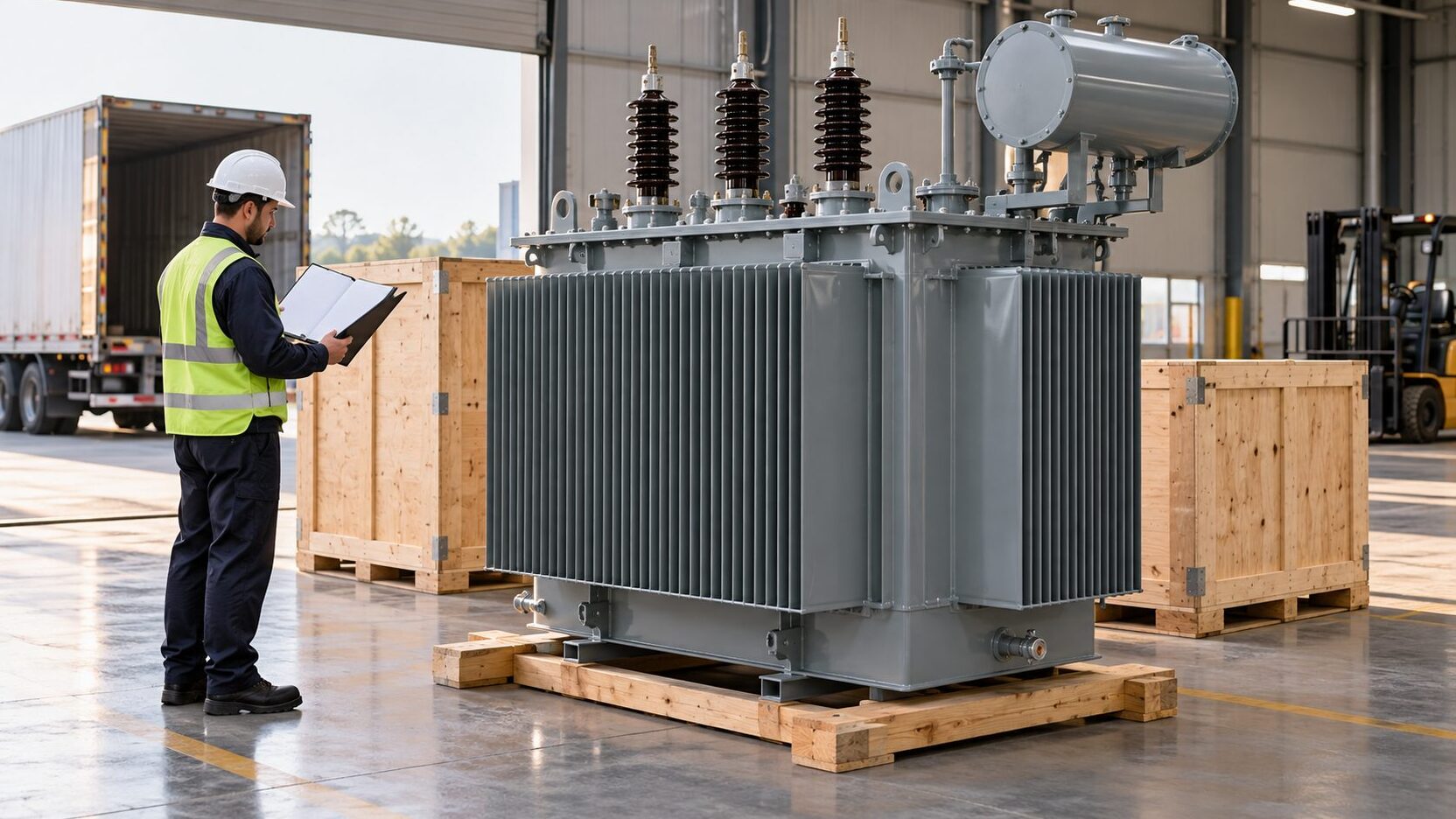
At receipt, log the unit identity and visible condition under the project’s approved inspection procedure. Do not confuse a receipt inspection with electrical acceptance. After installation, reconcile the equipment tag, terminal identification and operating data with the approved single-line diagram and asset register. Keep a controlled record of corrections. A replacement plate or amended test record needs a traceable reason and an authorized approval, not an undocumented swap.
For Latin American sites, site altitude, ambient conditions, coastal exposure, transport constraints and load behavior may affect the selected design and records, but their values must come from the actual project. Ask whether a revised site condition changes cooling, insulation, coating, handling or spare parts. The plate may need to reflect the final rating basis; the wider operating restrictions belong in the manual and approved data sheet. Our Andean delivery route survey covers the distinct transport-envelope decisions that can feed the shipment record.
Use a worked approval scenario, not a borrowed project claim
Consider a hypothetical industrial expansion importing two transformers through an EPC contractor. The initial offer uses the correct project tag, but its data sheet and proposed plate show different frequency entries. The contractor also finds that one drawing uses the original equipment tag after a design revision. No real project or supplied unit is implied.
The electrical lead obtains the approved supply data for the actual site and confirms the intended transformer operating conditions. The manufacturer then revises or confirms the design data in writing. The document controller checks every affected drawing and the inspection plan against the same equipment revision. The buyer releases plate artwork only after the conflict is closed. At FAT, the inspector verifies the physical plate, serial identity and test documents. On site, the installation team maps each delivered serial number to its final asset tag and handover pack.
If the site data remain unavailable, the team cannot responsibly turn a guessed frequency into a final design guarantee. The correct outcome is a documented hold or a conditional scope with a defined decision owner. That may feel slower than approving artwork, but it prevents a small document conflict from becoming a field problem after shipment.
Send a complete transformer nameplate approval package
Zisheng Electric can review an oil-immersed transformer enquiry and proposed document package against a project-specific equipment basis. For a smaller feeder, the 315kVA oil-immersed transformer is another product starting point; final selection depends on the project’s approved duty and interfaces. We can discuss what data the manufacturer must place on the proposed plate and what supporting drawings the EPC team needs to approve.
To start transformer nameplate approval, send the drawings, completed data sheets, load list, technical specification and single-line diagram. Add the destination grid parameters and environmental conditions supplied by the project authority, plus the equipment tag schedule, required document language and any accepted deviations. Those inputs allow the proposed configuration, plate artwork and handover records to be checked against one controlled procurement baseline.
Acerca de ZISHENG ELECTRICAL
Zisheng somos un fabricante profesional con más de 19 años de experiencia en la producción de Transformadores Sumergidos en Aceite, Subestación Compacta, Transformadores Montados en Base, Transformadores Montados en Poste y Transformadores de Tipo Seco. Poseemos los certificados de ISO/CE/IEC 60076 y TUV Rheinland.
Los transformadores pasan por rigurosas pruebas FAT y de tipo, y apoyan la personalización de voltaje/capacidad. Bienvenido a consultar por Catálogo y Producto. puede contactarnos por correo electrónico [email protected].