Selección de la distancia de fuga de los bujes de los transformadores para proyectos en la costa del Golfo: contaminación, perfiles y mantenimiento
Zisheng Electric recommends treating transformer bushing creepage selection as a site-specific insulation decision for coastal and industrial projects in the Gulf region. Rated voltage alone does not determine whether an outdoor bushing is suitable. Pollution severity, wetting mechanism, housing profile, electric-field distribution, maintenance access and the utility’s approved practice all influence the final selection.
This procurement guide helps EPC contractors, project owners and distributors structure the enquiry and compare offers. It does not assign one creepage distance to an entire country or claim that a longer distance automatically guarantees better service. Obtain the project’s environmental data, insulation-coordination study and applicable utility requirements before approving the offered bushing.
1. Begin transformer bushing creepage selection with the actual site
Describe where the transformer will operate rather than using the label “coastal” as the complete specification. Record distance and exposure to salt sources, prevailing winds, industrial emissions, dust, fog, dew, rainfall pattern and seasonal humidity. A site sheltered behind buildings can accumulate contamination differently from equipment directly exposed to sea spray or regular rainfall.
Ask the owner or responsible consultant to classify the environment using the project’s adopted method. IEC TS 60815-1:2025 provides general principles for external insulation in polluted conditions, including insulation forming part of equipment. The IEC 60815 series addresses selection and dimensioning of high-voltage insulators for polluted conditions, but its use still requires site information and engineering judgement. State the edition and part applied in the contract instead of inserting a bare millimetres-per-kilovolt figure without its basis.
Separate contamination from wetting
Deposited pollution becomes electrically important when the surface condition allows leakage current to develop. Salt fog, condensation, drizzle and other wetting mechanisms can produce different service conditions. The enquiry should therefore describe both the contaminants and the way the bushing surface becomes wet.
For projects near process plants, identify conductive or cementitious dust and any chemical deposits. For desert locations, assess whether infrequent rain cleans the surface or turns accumulated material into a temporary conductive layer. Use site surveys and owner experience where available; do not assume that high ambient temperature is the dominant insulation risk.
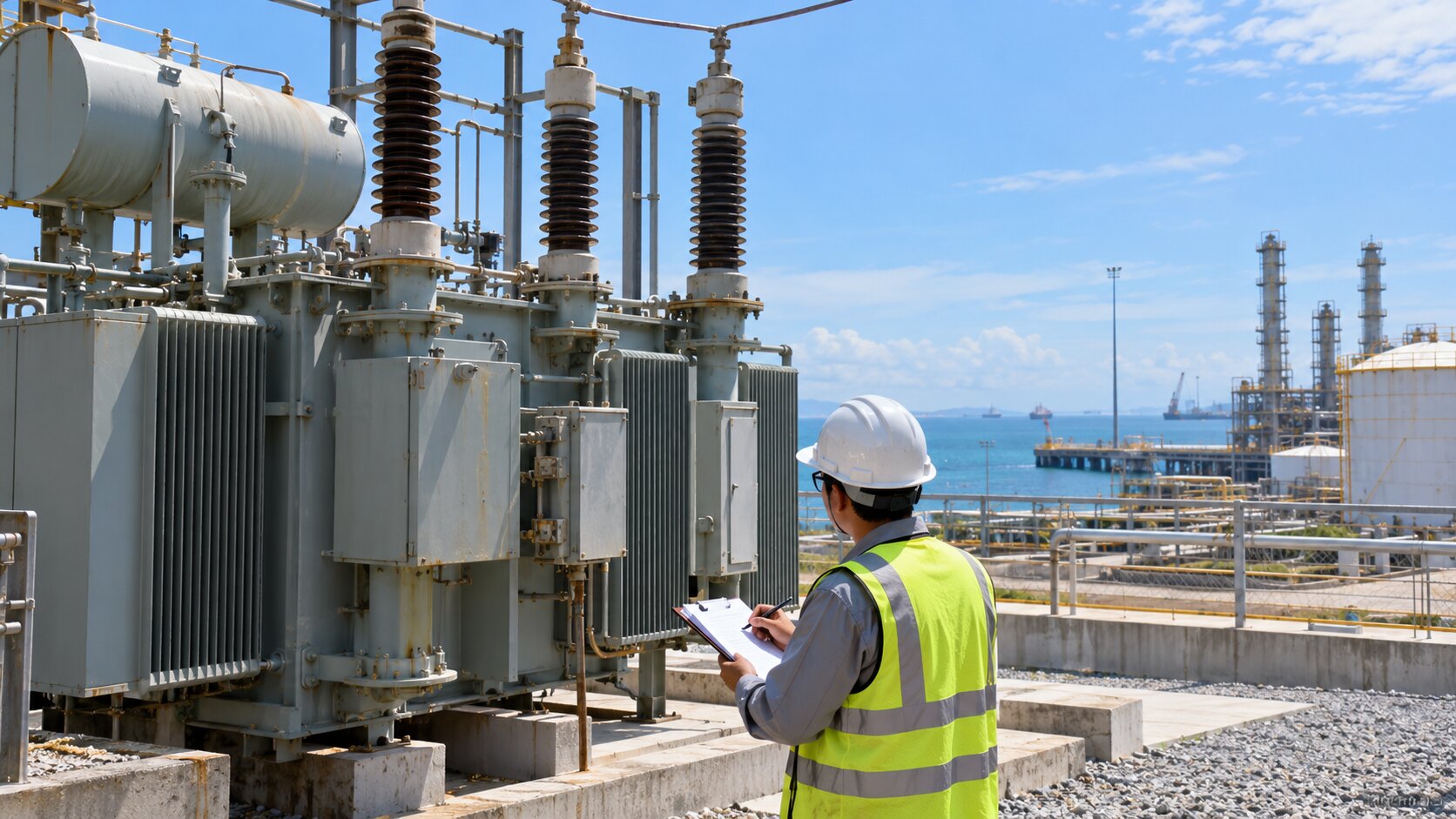
Document salt, dust and wetting conditions before approving the bushing profile.
2. Define the electrical and mechanical bushing duty
Provide the winding rated voltage, highest system voltage, insulation levels, terminal arrangement and applicable insulation-coordination requirements. Identify neutral and line-end duties separately. Confirm whether surge arresters are connected at the transformer and include the approved layout, because lead length and physical arrangement affect the coordinated interface.
The bushing schedule should also state rated current, expected overload, conductor connection, cantilever load, short-circuit forces and terminal hardware. A pollution-oriented housing selection does not replace mechanical verification. Heavy line leads, bus duct connections or cable-box conductors can impose loads that require their own assessment.
Check altitude and clearances together
Where the installation altitude requires correction under the project’s applicable standard, the design team should review external insulation and air clearances consistently. Do not adjust one bushing parameter while leaving phase-to-phase and phase-to-earth geometry unchanged. Ask the supplier to show the complete terminal-zone arrangement on the general arrangement drawing.
3. Use a comparison table instead of a single creepage number
For transformer bushing creepage selection, a bid table should connect the offered bushing to its environmental and construction evidence. The following structure helps expose missing assumptions before award.
| Artículo de reseña | Bid information required | Por qué es importante | Hold point |
|---|---|---|---|
| Site pollution basis | Survey, owner classification and adopted method | Prevents a generic regional assumption | Classification not approved |
| Creepage definition | Value, reference voltage and calculation convention | Allows like-for-like comparison | Number stated without basis |
| Housing profile | Material, shed geometry and manufacturer application statement | Profile affects contamination and wetting behaviour | Catalogue family only |
| Electrical duty | Voltage, insulation level, current and terminal arrangement | Pollution selection must fit the complete bushing duty | Schedule conflicts with transformer data |
| Maintenance strategy | Inspection, cleaning access and condition criteria | Service plan must be practical at the installed location | No safe access or owner procedure |
| Document traceability | Type designation, drawings, routine records and nameplate data | Confirms the delivered item matches the approved offer | Unidentified substitution |
4. Review housing material and shed profile
During transformer bushing creepage selection, ask the bushing manufacturer to state the housing material and the basis for the selected profile in the declared environment. Porcelain and composite housings have different construction, handling and maintenance considerations; neither should be accepted through a generic claim of superiority. The project needs evidence for the offered type and service conditions.
Examine shed spacing, overhang, protected creepage and the potential for uneven contamination. Closely spaced sheds may be difficult to clean, while a profile unsuitable for the wetting mechanism may not deliver the expected service behaviour. Require the manufacturer’s dimensioned drawing and application guidance, then connect it to the owner’s pollution assessment.

Compare the housing profile, terminal hardware and electrical clearances with the approved design.
Do not solve every concern by increasing length
Additional creepage can increase bushing height and influence terminal elevation, conductor forces, phase clearances, transport envelope and access. A taller bushing may require changes to the tank cover, supporting structure or line connection. Evaluate these consequences before approving the general arrangement, rather than discovering them after civil and conductor designs are frozen.
5. Coordinate the bushing with surge arresters and conductors
Translate transformer bushing creepage selection into a general arrangement showing bushing terminals, surge arresters, connectors and nearby grounded metalwork. Confirm electrical clearances through the expected range of conductor movement. If flexible conductors are used, include installation tolerances and environmental loads defined by the project.
For cable-box or bus-duct connections, external pollution may not be the controlling issue, but condensation, sealing and internal clearances still require review. Keep indoor and outdoor bushing requirements distinct within the schedule. A single line item for “HV bushings” can hide different service environments on the same transformer.
Assign ownership at the terminal boundary
State who supplies connectors, flexible links, corona hardware where applicable, terminal shields and installation bolts. Identify the approved tightening method and inspection record. The transformer supplier cannot verify a terminal load or clearance that is absent from the conductor designer’s interface data.
6. Build inspection and maintenance into the layout
Include maintenance access in transformer bushing creepage selection. Provide safe visual access to the bushing surface, lower flange, test tap where fitted and terminal connection. The owner should be able to inspect for contamination, damage, leakage and loose hardware without an improvised access method. Washing or cleaning plans must follow the owner’s safety rules and the bushing manufacturer’s instructions.
Where online monitoring or bushing test taps are specified, define the device interface, grounding arrangement, connector protection and maintenance responsibility. A test tap left with an incorrect cap or earth connection can create a new risk. Require clear labelling and include the normal service configuration in the handover record.
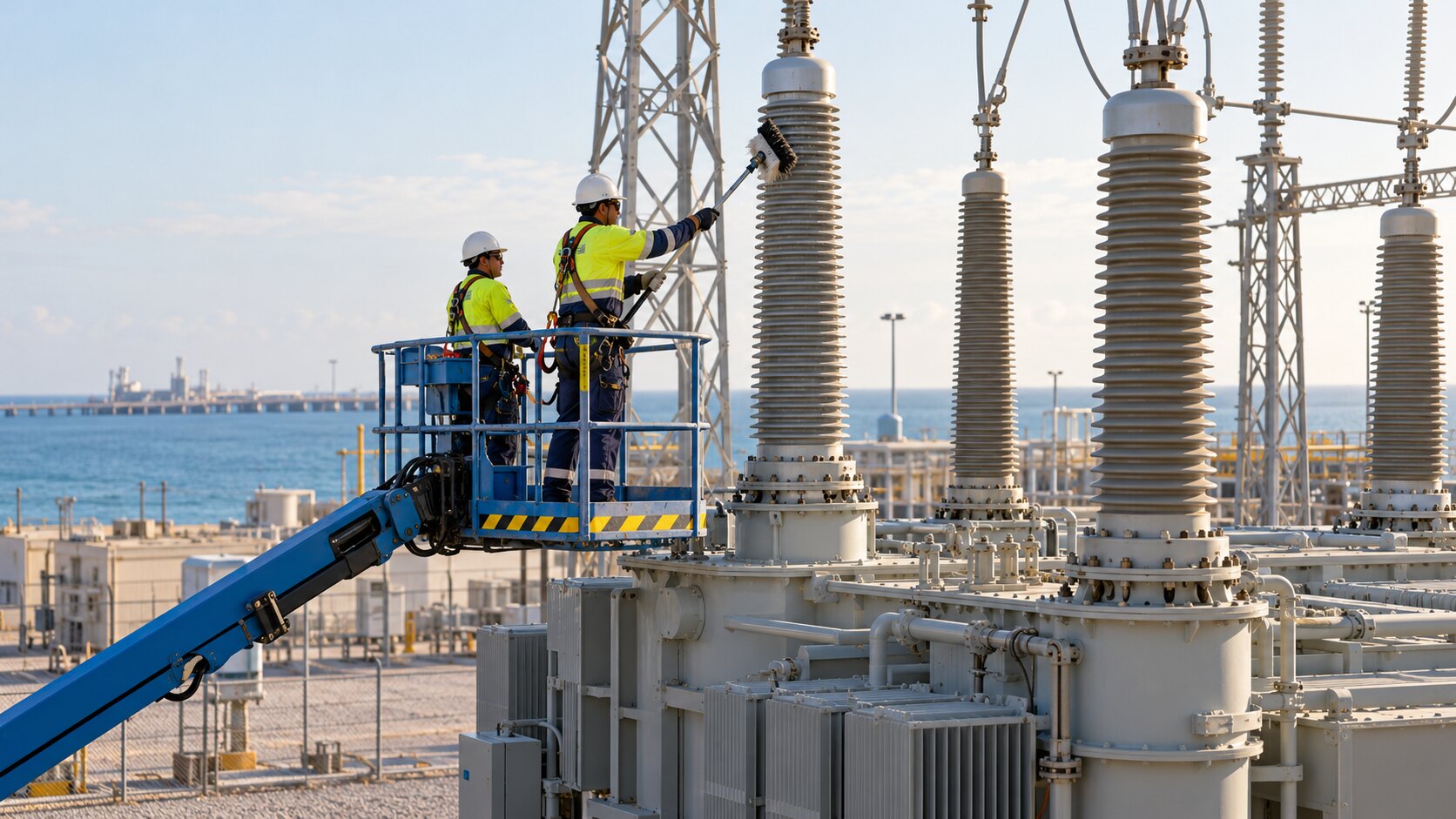
Plan safe inspection and cleaning access around outdoor transformer bushings.
7. Control substitutions during procurement and manufacture
Reopen the transformer bushing creepage selection review for any proposed substitution. Identify the exact type, dimensions, electrical ratings, housing profile, creepage basis, terminal details and interface changes. Similar rated voltage and current do not establish equivalence. Review the impact on the transformer design, spare strategy, drawings and maintenance tools before approval.
Record the disposition in the project deviation process. The approach in the transformer technical deviation register guide can help keep technical exceptions visible. For broader coastal risks, the coastal Ghana procurement guide shows how environment and site interfaces belong in the same purchasing decision.
8. Verify the delivered bushing at factory and site
At FAT, reconcile the installed bushing type and serial identification with the approved schedule and drawings. Review routine documentation required by the contract, terminal dimensions, oil level or pressure-related interfaces where applicable, test-tap condition and visible workmanship. Photographs should show identification and installed context.
After transport, inspect the packing condition, impact indicators if specified, housing surface, flange and terminal. Confirm that any items removed for shipment are reinstalled using the approved procedure. Site acceptance should close shipping damage, cleaning, connection, earthing and as-built documentation before energization.
Keep a site-specific service baseline
Record the surface condition at handover and define inspection triggers based on the owner’s maintenance programme. If the site environment proves more severe than the design basis, the owner and manufacturer should reassess the maintenance plan and equipment condition. Avoid treating a fixed calendar interval as a substitute for actual contamination evidence.
9. Plan transport, storage and installation controls
Long bushings and composite housings need handling arrangements that match the manufacturer’s instructions. Agree whether bushings ship installed or in separate crates, the lifting points, allowable orientation, storage environment and inspection after transport. The delivery plan should identify who supplies any installation tools and who performs or supervises site assembly.
For separate shipment, require crate identification linked to the transformer and phase position. Protect the housing, flange, terminal and test tap from moisture and impact. A visually intact crate is not sufficient evidence if shock indicators, seals or internal supports required by the shipping plan have not been checked. Record receipt condition before the equipment is moved into long-term storage.
Control cleanliness during site work
Site procedures should define cleaning materials, cover protection and weather restrictions for installation. Abrasive or incompatible cleaning agents can damage a housing surface. The bushing manufacturer’s current instruction takes precedence over an informal site habit. Close the installation record with photographs, torque or connection evidence required by the design, and confirmation that temporary protective items were removed.
10. Align spare-bushing strategy with the approved type
Apply the approved transformer bushing creepage selection basis to spare units as well as the installed equipment. A spare bushing should be selected by more than rated voltage and current. Compare mounting dimensions, oil-side geometry, terminal details, insulation level, housing profile, test-tap arrangement and accessories. If one spare is intended for several transformers, document the exact compatible positions and any adapters or restrictions.
Store the spare according to the manufacturer’s requirements and preserve its identification and inspection history. Packaging condition, humidity control and periodic checks should form part of the owner’s spare-management plan. An unidentified spare that appears to fit mechanically may not preserve the accepted creepage or electrical interface.
11. Use bid clarifications to close assumptions early
During technical evaluation, ask each bidder to mark deviations from the pollution and bushing schedule. A response such as “suitable for coastal service” does not reveal the environmental basis, calculation convention or housing profile. Require the offered value, drawing, type designation and manufacturer statement in a comparable format.
Resolve conflicts between the bushing schedule, transformer data sheet and general arrangement before award. If the selected profile changes overall dimensions, return the revised drawing to the conductor, foundation and layout teams. This disciplined interface control is more valuable than negotiating extra creepage after the transformer has entered manufacture.
Transformer Bushing Creepage Selection: Buyer FAQ
Can a Gulf country name determine the required creepage?
A country or coastal label is not a complete design input. Ask the owner to provide the site pollution assessment, wetting conditions and approved selection method. In transformer bushing creepage selection, the useful purchasing record is the link between these inputs and the offered housing, rather than a regional number without a stated basis.
Which IEC document should the enquiry identify?
Identify the contractually adopted edition and relevant material-specific part. IEC TS 60815-1:2025 provides the general framework, while IEC TS 60815-3:2025 addresses polymeric insulators for AC systems. These pollution-selection documents do not replace the complete bushing specification or the project insulation-coordination review. Record any difference between the contract edition and the bidder’s proposed basis.
How can buyers compare two different housing profiles?
Request the dimensioned drawings, stated creepage definition, reference voltage and manufacturer application evidence in the same bid matrix. Ask the responsible engineer to resolve differences in shed geometry, terminal height and cleaning access before commercial evaluation closes. A larger headline dimension alone does not establish that two offers have equivalent service suitability.
What belongs in the final approval package?
Keep the accepted bushing schedule, pollution basis, drawings, deviations and maintenance instructions under one revision record. List the responsible reviewer for each open point and identify which items block drawing approval or shipment release. This gives the receiving team a usable acceptance reference and helps future spare purchases preserve the approved interfaces.
Send a complete bushing enquiry to Zisheng Electric
Ask the quotation to separate standard supply from project-specific additions, including special terminals, monitoring accessories, extended factory records, separate shipping frames and site supervision. This makes bid comparison clearer and prevents an environmental requirement from remaining as an unpriced note. Confirm the final bushing schedule again when the transformer drawing is released for manufacture.
Zisheng Electric can coordinate bushing schedules for transformadores sumergidos en aceite and project-specific transformadores de potencia. A sound transformer bushing creepage selection should connect the site pollution assessment to housing design, terminal geometry, inspection access and lifecycle records.
Provide drawings, data sheets, load lists, technical specifications, single-line diagrams, grid parameters, environmental conditions and installation-site conditions. Include the pollution assessment, altitude, insulation-coordination requirements, conductor loads, utility interface and maintenance strategy. Our engineering team will review the requirements and respond to project inquiries within 24 hours.
Acerca de ZISHENG ELECTRICAL
Zisheng somos un fabricante profesional con más de 19 años de experiencia en la producción de Transformadores Sumergidos en Aceite, Subestación Compacta, Transformadores Montados en Base, Transformadores Montados en Poste y Transformadores de Tipo Seco. Poseemos los certificados de ISO/CE/IEC 60076 y TUV Rheinland.
Los transformadores pasan por rigurosas pruebas FAT y de tipo, y apoyan la personalización de voltaje/capacidad. Bienvenido a consultar por Catálogo y Producto. puede contactarnos por correo electrónico [email protected].