
Transformer Replacement Survey for Gulf Petrochemical Turnarounds: As-Built Interfaces and Bid Package
Zisheng Electric approaches a transformer replacement survey in a Gulf industrial plant as a test of whether a proposed replacement can actually be installed during the permitted shutdown. A purchase order may specify the correct MVA and voltage ratio while leaving the old bus duct flange, cable route, foundation, lifting envelope and plant controls unresolved. Those omissions become expensive when the existing transformer has already been isolated and the turnaround clock is running.
This guide is for petrochemical and other continuous-process owners, EPC contractors and transformer buyers. The Gulf label does not establish a common grid voltage, frequency, ambient temperature, corrosion class or utility approval. Use the actual site design basis, the owner’s operating rules and the written requirements of the receiving utility. The survey should produce a bid package that allows competing suppliers to price the same technical boundary.
Define the transformer replacement survey boundary
Begin with a marked single-line diagram and a physical walkdown. Identify the transformer being removed, upstream isolation point, downstream busbar or cable connection, neutral and earthing paths, auxiliary supply, protection and control interfaces, oil containment, fire protection and operating access. Record what remains in service during the outage. A line on a drawing is not enough when the plant has undergone years of modifications.
The replacement survey is different from the schedule exercise in our industrial transformer outage planning guide. This work establishes the as-built dimensions and technical interfaces that make the schedule credible. Record uncertainties explicitly. If a cable termination is behind an energized barrier and cannot be opened before the shutdown, the tender should include a controlled verification hold point and a contingency, not a fabricated dimension.
Build an evidence hierarchy for an ageing installation
Collect the existing nameplate, as-built general arrangement, foundation drawing, bus duct and cable termination drawings, protection settings, test history, maintenance records and operating load trend. Then verify each item against the plant. Documents can be wrong; photographs can omit hidden geometry. Use a measured survey with drawing references, locations, units and date. A three-dimensional scan may help in a congested plant, but it still requires an engineer to identify load-bearing and energized boundaries.
Mark each value as measured, document-derived or to be confirmed. Assign the plant owner and EPC engineer responsibility for authorizing access to restricted areas. Record the serial number and tap position of the existing unit, but do not assume the new transformer must copy every old value. The load and short-circuit studies may have changed. The survey should preserve what must physically interface while allowing a technically justified redesign.
Separate the fixed plant from replaceable items
Some interfaces can be rebuilt before the outage; others require the transformer supplier to match the existing installation. List the civil plinth, rail gauge, lifting beams, cable tray, trench, bus duct, switchgear, fire wall and bund as fixed or modifiable. For every modification, identify the design owner, approval route and earliest safe work window. A cheaper transformer that requires unexpected structural and cable work may be the more expensive project option.
Survey the electrical duty before copying the old nameplate
Request recent load curves, maximum demand, seasonal operating modes, process start sequence, major motors, harmonic sources and future expansion plans. Confirm the required continuous and emergency duty with the owner. If the plant has changed from direct-on-line motors to variable-speed drives, or added a new process train, the old transformer rating and loss guarantees may no longer be the right basis.
Check the approved system voltage, frequency, winding connection, vector group, earthing arrangement, tapping range and neutral current duty. The replacement must fit the system, not simply carry a similar label. Parallel operation, if intended, requires a separate study of ratio, phase displacement, impedance and tap coordination. Do not treat matching MVA as evidence of interchangeability. The study must also check fault current and downstream switchgear duty at the proposed impedance.
IEC 60076-1:2011 provides general power-transformer requirements, while the contract must identify the adopted edition, test schedule and any purchaser amendments. The survey itself is a project engineering activity, not a certification under that standard. Ask for guaranteed data and FAT evidence that can be compared with the final design and the plant’s acceptance criteria.
Transformer replacement survey decision table
Use this matrix to turn field observations into tender information and release gates. Values in the second column must be measured or obtained from approved project documents; they should not be filled with regional defaults.
| Interface | Survey evidence | Procurement decision | Hold point if unresolved |
|---|---|---|---|
| Electrical duty | Load trends, motor list, harmonics, fault study, system voltage and earthing | Rating, impedance, losses, taps, insulation and cooling | Electrical design approval before manufacturing release |
| Bus duct and cable termination | Flange, phase spacing, orientation, cable quantity and bending space | Terminal arrangement and adapter scope | Interface drawing and physical trial fit plan |
| Foundation and handling | Anchor pattern, reactions, rail gauge, access route and lift points | Base frame, shipment size and lift method | Civil and lifting review before dispatch |
| Controls and protection | CTs, alarms, trips, cooler controls, supply and terminal schedule | Marshalling, instruments and panel changes | Approved I/O and cause-and-effect matrix |
| Containment and environment | Bund, drainage, fire barriers, actual ambient and exposure | Oil volume, coating, enclosure and maintenance access | Owner approval of civil and environmental interface |
| Turnaround logistics | Gate route, transport restrictions, laydown, crane reach and work permits | Split or assembled shipment, tools and spares | Site-readiness review before outage commitment |
The matrix should include a responsible party, evidence reference, revision, due date and closure status. This is what makes a site survey usable in a competitive enquiry. A bidder can then price a stated adapter or site service instead of assuming someone else will provide it.

Measure terminations and physical fit together
For bus duct, capture the connection face, bolt pattern, phase spacing, enclosure clearance, flexible link allowance, support location and thermal movement arrangement. The transformer, bus duct and switchgear suppliers need one coordinated drawing. Our Middle East bus duct interface guide gives a detailed checklist for that boundary. The replacement survey adds the as-built condition and the possibility that an old installation no longer matches its drawing.
For cables, record number, size, insulation system, termination kit, gland plate, screen earthing and minimum working space. Check whether existing cable lengths permit a new terminal position. A transformer can fit on the plinth while its cable box makes every termination inaccessible. Establish the phase identification and test access before deciding that an adapter is a simple fabrication item.
Measure the floor-to-terminal height, plinth elevation, wheel or skid arrangement, transport opening and radiator envelope. Check clearances with the final assembled configuration, including conservator, coolers, bushings and fire barriers. A shipping outline may be smaller than the installed unit. The field record should distinguish transport and operating dimensions.
Test the route from factory to the final position
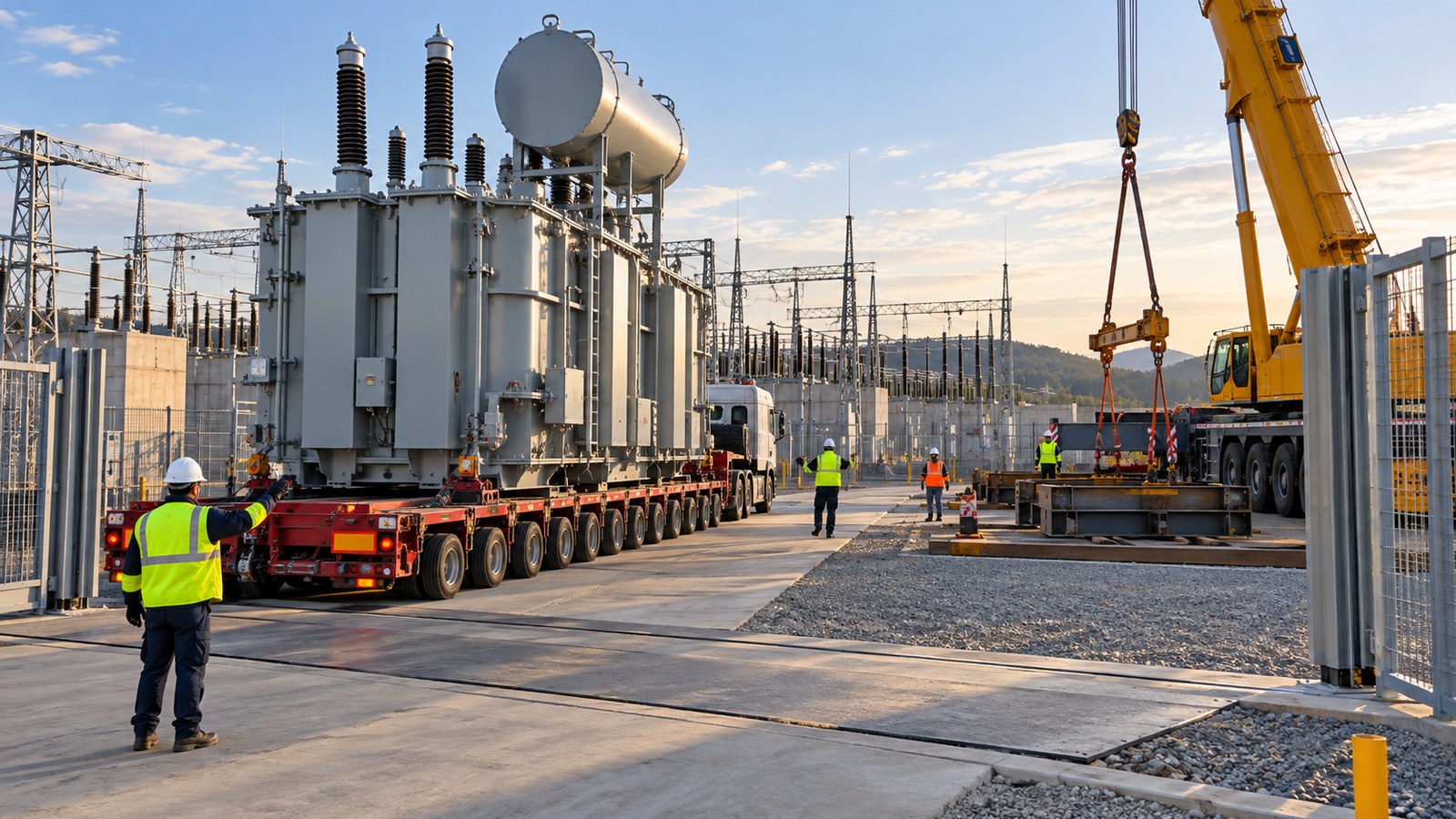
Determine whether the replacement can arrive assembled. Route width, bridge and gate capacity, turning radius, overhead clearance, crane position and available laydown area can drive a split shipment. A split package introduces site assembly, oil handling, drying or vacuum work, specialist supervision and additional tests. The transformer shipping configuration guide illustrates how to compare assembled and split delivery; apply its decision logic to the actual plant route rather than copying its regional example.
Separate the plant’s transport permit and lifting approval from the transformer supply. The manufacturer can provide mass, center-of-gravity and lift-point data for the proposed configuration; the site lifting engineer must check the real crane position and ground bearing. If the old unit must be removed through the same narrow path, include its removal plan in the survey. The new equipment cannot occupy a laydown area needed for the old unit.

Plan the process-plant shutdown interfaces
A petrochemical turnaround often has many simultaneous contractors and restricted access windows. The survey should identify who owns isolation, lockout, gas testing where applicable, lifting permits, hot work, fire watch and area release under the plant’s procedures. It should not prescribe a switching sequence. The authorized operations team develops and approves that sequence from the current single-line and operating conditions.
Map each activity to a predecessor and a fallback. A missing flexible connection, failed cable test or unexpected plinth defect can consume the shutdown margin. Decide which materials can be prefabricated and inspected beforehand, and what measurements remain inaccessible until isolation. Keep a contingency pack of project-specific connectors, gaskets and consumables defined by the interface drawings; a generic tool list is not enough.
If temporary supply is proposed, confirm its source, isolation, capacity, fault protection and load list through a separate study. Do not assume every process load can be transferred. For each essential service, record the owner-approved interruption tolerance and the test that proves the temporary arrangement before the main outage. The procurement package should distinguish equipment supply from temporary works and plant operations.
Connect FAT evidence to site acceptance
The factory test plan should cover the ordered transformer and its agreed accessories, with the correct serial number, ratings, tap range and configuration. Compare final drawings with the as-built interface schedule before dispatch. Witnessing electrical tests is valuable, but it will not reveal a mismatched flange or insufficient crane access unless those items are separately inspected.
At site, receive and inspect the shipment before committing the plant to isolation. Check shock or pressure records if specified, preservation seals, accessory packing, damage and documentation. Agree which post-assembly checks are necessary for the chosen shipping configuration. The owner and EPC engineer should have a commissioning plan for cable tests, grounding continuity, protection injection, controls, cooling, phase checks and first energization. The exact scope depends on the plant design and contract.
The handover dossier should record redlines, test results, settings, operating instructions, spares and warranty start conditions. A successful energization is not the end of the interface review. The maintenance team needs the as-left drawings and the differences between the new and old equipment.
Write a tender that makes comparison possible
Issue a common survey pack to every bidder: marked single-line, electrical duty schedule, as-built dimensions, photographs, interface drawings, outage assumptions, environmental design basis, test and document requirements, and a list of items awaiting verification. Require a compliance matrix and a separately priced deviation for each proposed plant modification. This prevents an attractive equipment price from hiding essential site work.
Ask each bidder to state what is included: transformer, bus duct transition, cable box, cooler package, site supervision, oil processing, commissioning support, transport, lifting data, spares and document revisions. Record whether the bid assumes access before shutdown. A bidder’s qualification should be assessed against the owner-approved plan, not silently accepted as a change in scope.
For a high-voltage replacement, Zisheng Electric can review a project-specific 66 kV oil-immersed power transformer or 132 kV–138 kV power transformer configuration against these interfaces. Send the as-built drawings, new data sheet, load list, technical specification, single-line diagram, grid parameters, environmental conditions and installation-site constraints. Add measured flange and foundation data, the turnaround window and the unresolved access list. A disciplined transformer replacement survey gives the factory and EPC team a shared basis for design and site release. Our engineering team will review the requirements and respond to project inquiries within 24 hours.
عن شركة ZISHENG ELECTRICAL
زيشينغ هي شركة متخصصة ذات خبرة تمتد لأكثر من 19 عاماً في التصنيع والإنتاج المحوّلات المغمورة بالزيت, المحطات الفرعية المدمجة, المحوّلات المركبة على القواعد, المحوّلات المثبتة على الأعمدة و المحوّلات الجافة. نحن نمتلك شهادات ISO/CE/IEC 60076 وTUV Rheinland.
تخضع المحولات لاختبارات FAT واختبار المواصفات النوعية بشكل صارم، وتدعم تخصيص الجهد/السعة. نرحب باستشارتكم بشأن كتالوج و المنتج. يمكنك الاتصال بنا عبر البريد الإلكتروني [email protected].