
Transformer Procurement for Colombia Pulp and Paper Mills: Large Motors, Humidity and Expansion Planning
Transformer procurement for a pulp and paper mill should begin with the operating sequence of the plant, not with a single total-kilowatt figure. Wood preparation, chipping, refining, pumping, drying, compressed air, wastewater treatment and finishing lines create different combinations of continuous load, large-motor starting duty and short process peaks. For a Colombian project, the purchaser must also confirm the utility interface, site environment, installation arrangement and future production plan before fixing the transformer rating.
Zisheng Electric treats Colombia pulp mill transformer procurement as an engineering coordination task. The transformer must support production reliability, acceptable voltage performance and practical maintenance while remaining compatible with the incoming network, protection system and plant expansion strategy. This guide explains the information an EPC contractor or industrial buyer should put into the enquiry package.
Start with operating cases, not connected load
A connected-load list is useful, but it does not describe how the mill actually runs. Some drives operate continuously, some cycle with batch processes, and others are standby units. Refiners, chipper motors, vacuum pumps, boiler auxiliaries and large process-water pumps may dominate the electrical response even when their combined nameplate power is only part of the total installed load.
The load schedule should therefore identify normal production, reduced production, start-up, planned shutdown, restart after an outage and emergency operation. Record the active power, power factor, starting method and expected coincidence for each major group. If variable-frequency drives are used, separate their fundamental-frequency demand from harmonic current. If generators can energize the transformer or supply a plant bus, include that operating case as well.
A useful first review is to compare the preliminary demand with the available ratings in the oil-immersed transformer range. The selected rating should then be verified by load flow, motor-starting and thermal-duty studies rather than chosen from a simple utilization factor.
Define the utility and plant interfaces
The enquiry should state the utility nominal voltage, maximum and minimum operating voltage, frequency, available short-circuit level, grounding method and insulation coordination basis. Do not assume that two projects in the same country use identical primary voltages or protection practices. The project utility or distribution company should confirm the point-of-connection data.
On the secondary side, define the plant bus voltage, neutral treatment, cable arrangement, busduct interface and whether transformers will operate separately or in parallel. Vector group, phase displacement, tap range and impedance require coordinated decisions. A transformer that is electrically suitable in isolation may be unsuitable for parallel operation or may produce an unacceptable fault-duty level at the switchboard.
The procurement team can use the checks in the industrial transformer tender review as a practical model for comparing impedance, vector group and interface data across bids.
Colombia pulp mill transformer procurement load matrix
| Operating case | Loads to include | Main transformer check | Required project evidence |
|---|---|---|---|
| Normal production | Process drives, pumps, fans, dryers and auxiliaries | Continuous loading, losses and temperature rise | Measured or estimated demand profile and ambient basis |
| Line start-up | Largest motor plus running essential loads | Voltage dip, acceleration time and tap position | Motor data, starting method, torque curve and network impedance |
| Process upset | Simultaneous pump, fan or conveyor recovery | Short-duration loading and protection coordination | Restart sequence and maximum coincidence |
| Generator supply | Essential production and safety loads | Inrush, voltage recovery and generator capability | Generator reactance, AVR data and switching sequence |
| Future expansion | Approved new line or capacity increase | Thermal margin, switchgear rating and spare ways | Expansion load list and implementation date |
Check large-motor starting before fixing impedance
Transformer impedance influences both voltage drop and short-circuit current. A higher impedance can reduce fault duty, but it can also increase the voltage depression during motor starting. A lower impedance may improve voltage stiffness while raising the prospective current seen by the low-voltage switchboard. The value should be coordinated with the upstream system, secondary cable impedance, switchgear interrupting rating and the starting method of the largest motor.
For each critical motor, provide rated power, efficiency, power factor, locked-rotor current, starting torque, load torque and acceleration time. State whether the motor starts direct-on-line, through a soft starter, through an autotransformer starter or from a VFD. The study should test the worst credible start while the required process loads remain online. The transformer voltage regulation guide explains how tap range, impedance and motor starting interact in an industrial bus.
Separate harmonic heating from fundamental loading
Modern mills can contain many VFDs, rectifiers, UPS systems and switched-mode power supplies. Their harmonic current can increase winding eddy losses, stray losses and neutral current without producing useful mechanical output. A transformer selected only from the fundamental kW demand may therefore have insufficient thermal margin.
The buyer should submit the drive topology, pulse number, harmonic spectrum or study model, expected loading range and any line reactors or filters. The transformer manufacturer can then assess conductor arrangement, winding hot spots, neutral sizing, shielding and temperature-rise margin. The specification should not request a generic derating percentage without identifying the harmonic assumptions behind it.
Where tap regulation is being considered, review the operating philosophy in the tap changer selection guide. Frequent process variation does not automatically justify an on-load tap changer; the actual utility voltage range, control objective and maintenance capability must be evaluated.

Select the installation arrangement for the site
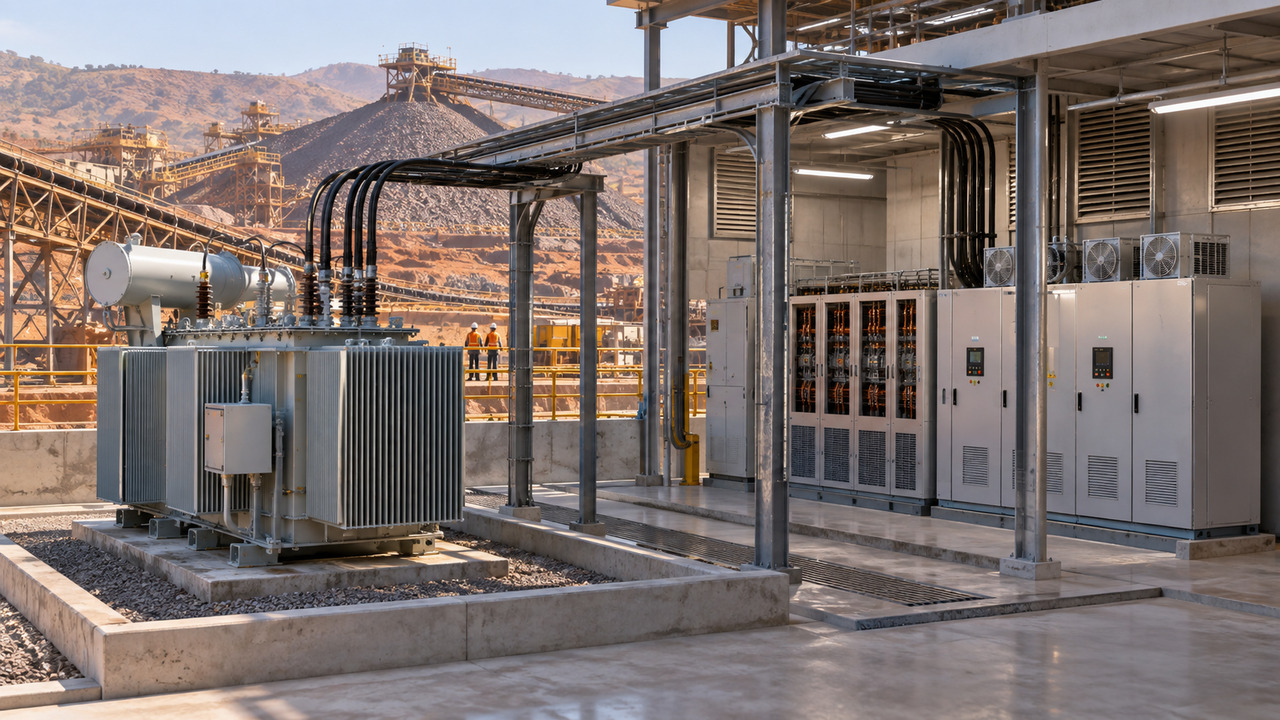
Outdoor oil-immersed transformers are often practical for industrial distribution because they provide robust insulation and effective heat transfer. Indoor installations may require dry-type equipment or a dedicated transformer room, depending on the project fire strategy, ventilation, access and local requirements. The final choice should follow the project risk assessment rather than a general preference.
For an outdoor unit, define maximum and minimum ambient temperature, solar exposure, humidity, rainfall, airborne contamination, corrosion category, flood level and drainage. Pulp and paper facilities can also expose equipment to moisture, process chemicals and fibers. The purchaser should describe the real installation zone so that coating system, enclosure material, sealing, terminal boxes and accessories are specified correctly.
For ratings near common distribution sizes, a product such as the 400 kVA oil-immersed transformer can be used as a configuration reference. The actual project may require a different capacity, voltage ratio, impedance, winding material or accessory package.

Coordinate protection, monitoring and maintainability
The transformer schedule should identify protection CT ratios and classes, temperature devices, pressure-relief equipment, oil-level indication, alarm contacts and required communication protocols. Protection settings must coordinate with upstream utility protection, transformer inrush, motor-starting current and downstream feeder protection. Do not leave CT selection until after the transformer drawings are approved.
Maintenance access is equally important. Confirm radiator clearance, oil sampling access, lifting points, valve locations, bushing removal space and the route for replacement equipment. If production continuity is critical, define whether the plant requires two transformers, a bus coupler, spare capacity or a mobile-transformer connection. Redundancy should be evaluated using credible outage scenarios rather than an undefined N+1 label.
Specify FAT records that support site decisions
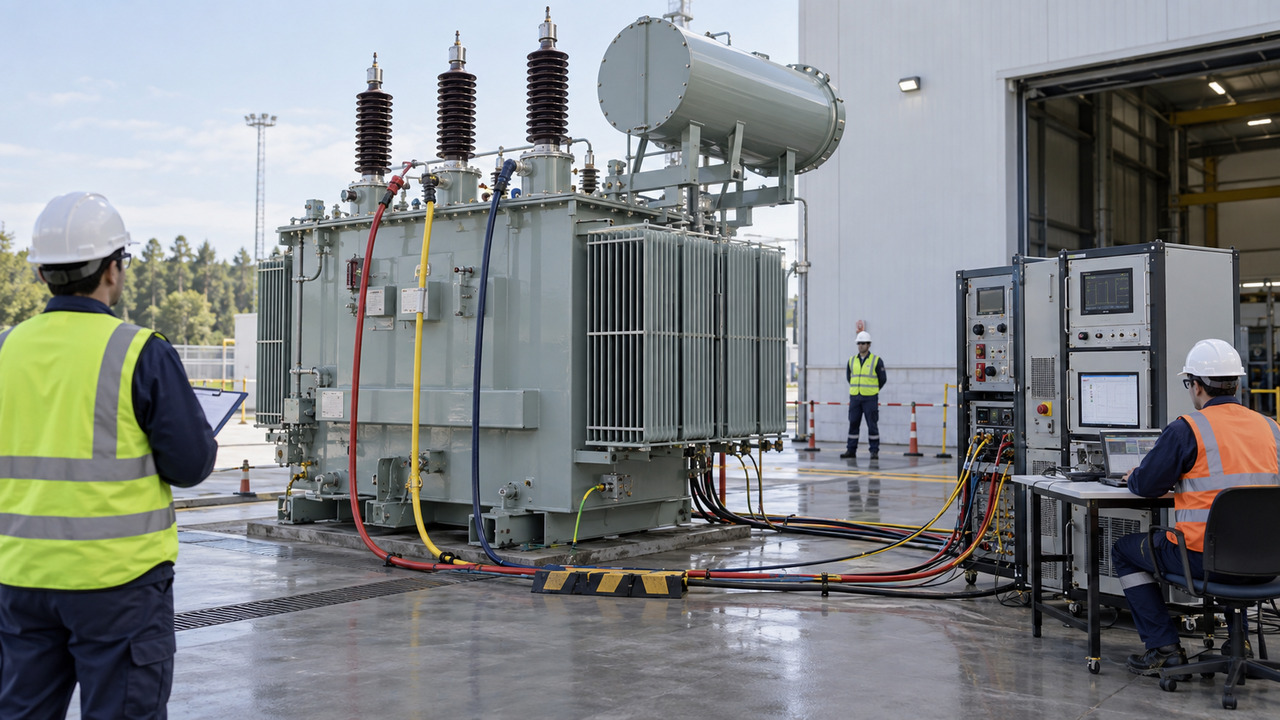
Factory acceptance testing should be connected to the approved data sheet and drawings. The inspection and test plan should identify witness, hold and review points. Routine tests normally cover winding resistance, ratio and phase displacement, short-circuit impedance and load loss, no-load loss and current, and dielectric tests as applicable to the agreed standard and design.
The buyer should also review nameplate data, accessory operation, alarm contacts, terminal markings, dimensional checks, coating inspection and document completeness. Where special tests are required, state them in the enquiry rather than after manufacturing begins. IEC 60076-1 provides the general framework for power transformers, while the project specification should identify the applicable edition and any utility additions.
FAT release should require closure of technical deviations and confirmation that the shipping configuration matches the approved transport plan. Test results are most useful when they can be traced to the serial number, approved drawings and guaranteed values.
Plan transport, storage and installation before dispatch
Industrial sites may have restricted bridges, sharp turns, limited crane positions or narrow equipment doors. Provide route limits, unloading method, allowable transport orientation and foundation drawings during design review. Confirm whether radiators, conservator, bushings or other accessories will be removed for shipment and what site work is required to reinstall them.
Storage instructions should cover moisture control, oil or gas condition, accessory protection and periodic inspection. Before energization, verify assembly, oil level, insulation condition, grounding, protection circuits, tap position, phase sequence and secondary connections. A documented energization checklist helps prevent interface errors that factory tests cannot reveal.
Build a procurement package that can be compared
A good request for quotation allows suppliers to price the same technical scope. Include a completed transformer data sheet, single-line diagram, load list, motor data, harmonic information, short-circuit data, site conditions, installation arrangement, protection requirements, accessory schedule, document list, FAT plan and delivery constraints. Separate mandatory requirements from preferences and request a deviation schedule with each offer.
Commercial comparison should consider guaranteed losses, testing scope, included accessories, drawings, packing, supervision, spare parts and warranty—not only the transformer price. Clarify which party is responsible for utility approval, protection studies, civil interfaces, cable terminations and commissioning.
Information Zisheng Electric needs for review
For a Colombia pulp or paper project, send the single-line diagram, primary and secondary voltages, required capacity, system frequency, short-circuit level, vector group, impedance target, tap range, largest motor data, harmonic study, installation conditions, accessory list and applicable standards. Also identify normal, start-up, generator and expansion operating cases.
Zisheng Electric can review the duty against suitable oil-immersed, dry-type or project-specific transformer configurations and return a technical deviation list for discussion. Our engineering team will review the requirements and respond to project inquiries within 24 hours.
Frequently asked questions
Should spare capacity be added as a fixed percentage?
No single percentage is correct for every mill. Reserve should reflect approved expansion, load uncertainty, ambient conditions, harmonic heating and the plant contingency philosophy.
Can transformer impedance be selected only from the fault-current study?
No. Fault duty, voltage regulation, motor starting and parallel-operation requirements must be reviewed together.
Is an on-load tap changer always necessary for variable process loads?
No. Tap selection should follow the utility voltage range, bus-voltage limits, control philosophy and maintenance plan. Process load variation alone is not sufficient justification.
What should be confirmed before quotation?
At minimum, confirm voltage ratio, frequency, capacity, vector group, impedance basis, tap range, installation environment, largest motor, harmonic duty, protection interfaces, FAT scope and delivery constraints.
About ZISHENG ELECTRICAL
Zisheng are a professional 19+ years manufacturer in producing Oil-Immersed Transformers, Compact Substation, Pad Mounted Transformers, Pole Mounted Transformers and Dry Type Transformers. We own the certificates of ISO/CE/IEC 60076 and TUV Rheinland.
Transformers undergo rigorous FAT and type testing, support voltage/capacity customization. Welcome to consult for Catalog and Product. you can contact us at email [email protected].