Power Transformer Guide: Types, Working Principle & Industrial Applications
Power Transformer Guide: Working Principle, Types, and Applications
Power transformers are essential components in modern electrical power systems. They ensure efficient voltage conversion, stable power distribution, and safe operation across industrial, commercial, and utility-scale applications.
This guide explains the working principle of transformers, main transformer types, key technical specifications, and their industrial applications to help engineers and buyers make informed decisions.
What is a Power Transformer? (Transformer Definition)
A power transformer is an electrical device that transfers electrical energy between circuits using electromagnetic induction.
Primary functions include:
- Voltage step-up for long-distance transmission
- Voltage step-down for industrial or residential use
- Electrical isolation between systems
Because transformers operate without moving parts, they are highly reliable and widely used in global power distribution systems.
Transformer Working Principle (Electromagnetic Induction)
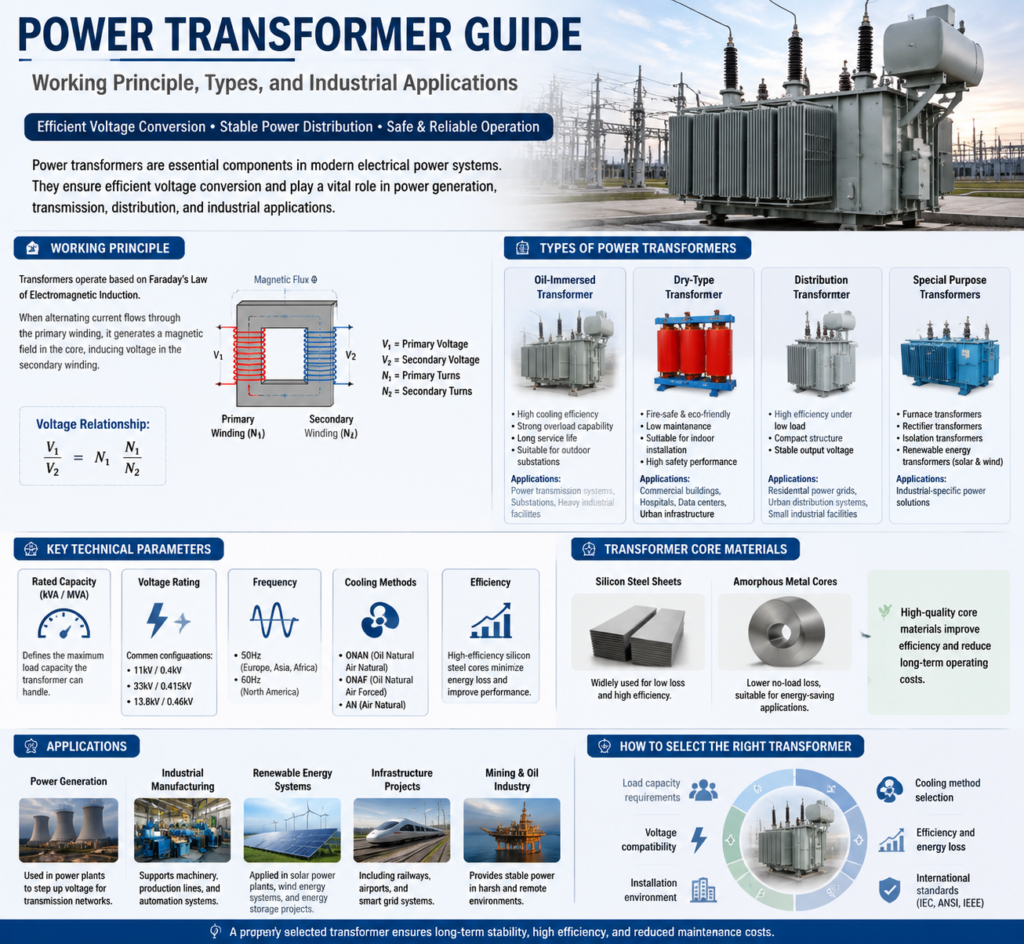
Transformers operate based on Faraday’s Law of Electromagnetic Induction.
When alternating current flows through the primary winding, it generates a magnetic field in the core. This induces voltage in the secondary winding.
Voltage relationship:
V₁ / V₂ = N₁ / N₂
Where:
- V₁ = Primary voltage
- V₂ = Secondary voltage
- N₁ = Primary winding turns
- N₂ = Secondary winding turns
This principle enables efficient voltage conversion without frequency change, making transformers highly efficient in electrical systems.
Types of Power Transformers
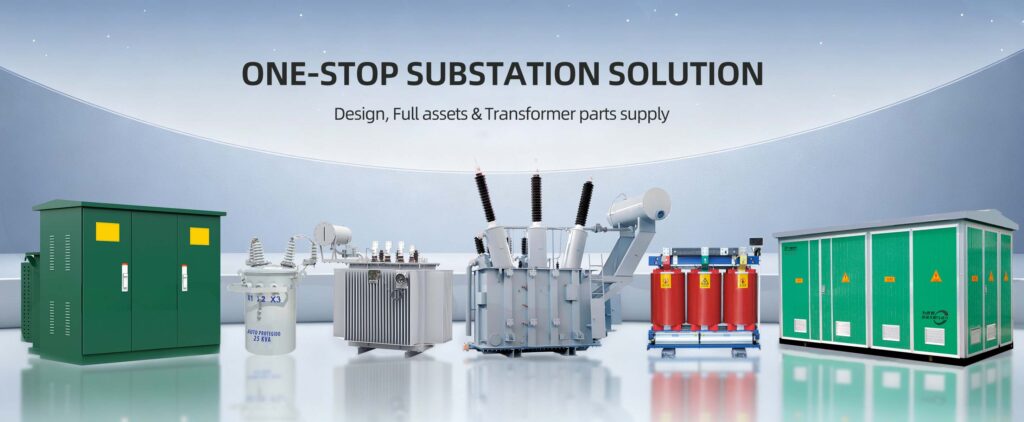
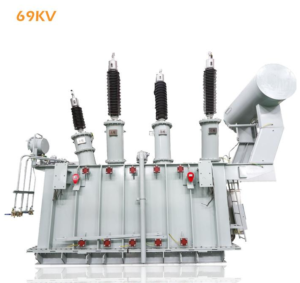
Oil-Immersed Transformer
Oil-immersed transformers use insulating oil for cooling and insulation.
Features:
- High cooling efficiency
- Strong overload capability
- Long service life
- Suitable for outdoor substations
Applications:
- Power transmission systems
- Substations
- Heavy industrial facilities
Dry-Type Transformer
Dry-type transformers use air or resin insulation instead of oil.
Features:
- Fire-safe and environmentally friendly
- Low maintenance
- Suitable for indoor installation
- High safety performance
Applications:
- Commercial buildings
- Hospitals
- Data centers
- Urban infrastructure
Distribution Transformer
A distribution transformer reduces voltage for end-user consumption.
Features:
- High efficiency under low load
- Compact structure
- Stable output voltage
Applications:
- Residential power grids
- Urban distribution systems
- Small industrial facilities
Special Purpose Transformers
Includes:
- Furnace transformers
- Rectifier transformers
- Isolation transformers
- Renewable energy transformers (solar & wind)
These transformers are designed for industrial-specific power requirements.
Key Technical Parameters of Power Transformers
When selecting a transformer, the following specifications are critical:
1. Rated Capacity (kVA / MVA)
Defines maximum load capacity and system compatibility.
2. Voltage Rating
Common configurations:
- 11kV / 0.4kV
- 33kV / 0.415kV
- 13.8kV / 0.46kV
3. Frequency
- 50Hz (Europe, Asia, Africa)
- 60Hz (North America)
4. Cooling Methods
- ONAN (Oil Natural Air Natural)
- ONAF (Oil Natural Air Forced)
- AN (Air Natural)
5. Efficiency
Modern energy-efficient transformers use advanced silicon steel cores to reduce losses and improve performance.
Transformer Core Materials and Efficiency
The transformer core plays a key role in energy performance.
Common materials:
- Silicon steel laminations (standard high-efficiency material)
- Amorphous alloy cores (low no-load loss, energy-saving design)
High-quality core materials significantly improve transformer efficiency and reduce long-term operating costs.
Applications of Power Transformers
Power transformers are widely used in global industries:
Power Generation
Used in power plants to step up voltage for transmission networks.
Industrial Manufacturing
Supports machinery, production lines, and automation systems.
Renewable Energy Systems
Applied in:
- Solar power plants
- Wind energy systems
- Energy storage projects
Infrastructure Projects
Including:
- Railways
- Airports
- Smart grid systems
H3: Mining and Oil Industry
Provides stable power in harsh and remote environments.
How to Select the Right Power Transformer
When choosing a transformer, consider:
- Load capacity requirements (kVA/MVA)
- Voltage compatibility
- Installation environment (indoor/outdoor)
- Cooling method selection
- Efficiency and energy loss
- International standards (IEC, ANSI, IEEE)
A properly selected transformer improves system reliability and reduces operational costs.
Conclusion
Power transformers are critical for modern electrical power distribution systems, enabling stable voltage conversion and efficient energy transmission.
Understanding transformer types, working principles, and technical specifications helps industries choose the right solution for long-term performance and safety.
As global demand for energy efficiency grows, advanced transformer technologies continue to play a key role in industrial and renewable energy development.
About ZISHENG ELECTRICAL
Zisheng are a professional 19+ years manufacturer in producing Oil-Immersed Transformers, Compact Substation, Pad Mounted Transformers, Pole Mounted Transformers and Dry Type Transformers. We own the certificates of ISO/CE/IEC 60076 and TUV Rheinland.
Transformers undergo rigorous FAT and type testing, support voltage/capacity customization. Welcome to consult for Catalog and Product. you can contact us at email [email protected].